Showing posts with label All Souls Day. Show all posts

Thursday, November 01, 2012

HEAVEN: PROBABLY NOT YOUR NEXT STOP


Anyone (Catholic) near my age can probably remember our mothers admonishing us to “offer it up for the poor souls in purgatory” whenever we complained about some pain or discomfort. It’s not something we hear much anymore. In fact, not only has the idea of “offer it up” generally disappeared from the list of routine Catholic expressions, it seems  “the poor souls” has to.


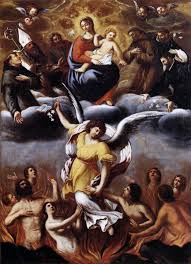
Today, we are more inclined to think of our dearly departed as whooping it up at some heavenly fiesta or flitting about with angels, than think of them as poor souls suffering helplessly in Purgatory and in grave need of our prayers and offerings.

In Guam, this produces a strange contrariety. We remember our dead on All Souls Day (Nov. 2) with a seriousness that is found in few other places in the Catholic world. And of course there is never a shortage of “animas” at almost every Mass. But we all but canonize - or even “angelicize” - our dead, in our talk, funeral announcements, eulogies and even sermons (sometimes).

Praying for the dead is very serious business. Unless one dies sinless or a martyr, chances are (it’s always up to God) he or she is not going straight to Heaven, but to Purgatory, and could be there awhile. Here’s why.

Revelations 21:27 tells us “nothing unclean” will enter Heaven. All of us who have the capacity to sin will more than likely die “unclean”, even if we have confessed our sin. A quick example:

A man cheats on his wife. He seeks absolution in the Sacrament of Confession and is absolved. He may even apologize to, and be forgiven by, his wife. Though the sin is forgiven, the damage remains. The strain between the husband and wife, the distrust which now must be endured, the damage done to the children -  these are the temporal effects, the vestiges of sin, which no absolution or forgiveness can make go away. In short, the sin may be forgiven, but the stain remains.

Non-Catholic Christians, most of whom do not accept the idea of a post-death state of purgation (Purgatory), do not deny that most will die “unclean”, but believe that Jesus covers that uncleanness: “piles of dung covered with snow”, as Luther put it. But snow or not, piles of dung, as per Revelation 21:27, will not get past St. Peter: “Nothing unclean will enter.” So now what?

The Catholic Church teaches that we are judged at the moment of death. Those who die in a state of unrepentant mortal sin will be cast into Hell. And those who are completely pure (only God can know) will be welcomed into Heaven (CCC 1022). But what of us who are neither guilty of unrepentant mortal sin or completely pure?

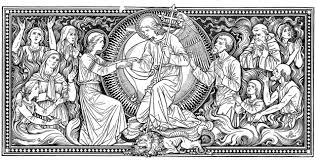
Thanks be to God for His mercy. For while there is no post-death second chance to be sorry, there is the chance to burn away the dung and dross of our human condition, to be made clean, so that at some point we may “enter it” and live with God forever. The Church calls this merciful opportunity “Purgatory”:

“All who die in God's grace and friendship, but still imperfectly purified, are indeed assured of their eternal salvation; but after death they undergo purification, so as to achieve the holiness necessary to enter the joy of heaven. The Church gives the name Purgatory to this final purification of the elect, which is entirely different from the punishment of the damned.” (CCC 1030-31)

But! - and this is the question which rocked Christendom and led to the many sad divisions which still exist in the Body of Christ: From whence comes this doctrine? Where do we find Purgatory in Scripture?

The Catechism references five scriptures as footnotes for Purgatory: Mt. 12:31 (“...whoever utters blasphemy against the Holy Spirit will be pardoned neither in this age nor in the age to come”), 1 Cor 3:15 and 1 Pet 1:7 (passages which speak of a “cleansing fire”), and 2 Maccabees 12:46 and Job 1:5 (where prayers for the dead are mentioned).
Protestant apologists dismiss these references. The pardon in the “age to come” is seen simply as a figure of speech emphasizing the unforgivable nature of blasphemy against the Holy Spirit. The “cleansing fire” verses are seen as metaphors and not definitive teaching. And the Old Testament passages found in Maccabees and Job are disqualified because Old Testament souls had no opportunity to go to Heaven prior to the coming of Jesus. (Also, Protestants do not accept the books of Maccabees as canonical.)

Catholic theologians argue the deeper meaning of these same verses, but - as evinced by more than 500 years of division - have achieved nothing more than a stalemate.

I wasn’t invited to the Council of Trent, but if I was, I would have offered Revelation 20:13-14, as a more helpful reference. The passage reads: “The sea gave up its dead; then Death and Hades gave up their dead. All the dead were judged according to their deeds. Then Death and Hades were thrown into the pool of fire.”

It’s quite clear. The passage occurs within the context of a description of events which will occur at the end of time. One of the main events is that Hades will “give up its dead”. We know Hades isn’t Hell (understood as the place of eternal damnation) because Hell is noted separately as “the pool of fire”. And we for sure know that Hades isn’t Heaven. So what is it?

Classically, Hades is understood as a holding place for the dead. Such a place was seen as necessary before Christ opened the gates of Heaven, but deemed by Luther and others as unnecessary after. Yet, here we are at the end of time, and not only is Hades still around, its got souls “holed up” there.

What are they doing there? There can be only one explanation. They are not deserving of Hell (or else they’d be there), and not yet worthy of Heaven (or else they’d be there). They are in fact, “spirits in prison”, which comports with Mt. 5:26: “you will not get out of there until you have paid the last penny.”

I’ll see what I can do to send in my entry for the next Council, but for now, study this verse and share it with those who do not accept the doctrine of Purgatory; for many of our loved ones probably yet languish there, and are in need of our prayers and our “offer it up” - as our mothers once admonished us.

P.S. Elmer Rohr, my grandfather, was known as a hard man - a tough old, cider-hardened, World War I vet who literally carved a living for his eleven children out of the rough Ohio ground behind a team of mules in the midst of the Great Depression. As age took its toll and death loomed, he sternly commanded his children to never stop praying for him. He knew that Heaven wasn’t going to be his next stop. We should not presume it will be ours.

Friday, November 02, 2007

Never stop praying for me


“Never stop praying for me."
- Elmer P. Rohr (to his 11 children)


Here on Guam, All Souls Day is probably celebrated with more activity and official recognition than any other place in the world except maybe the Philippines. The customs are quite beautiful: cemeteries are cleaned up, tombs are repainted, special Masses are said, flowers and bouquets are arranged about the plots, and candles light up the cemeteries for the next several nights.

The local government (and some private firms) even grants a holiday so that appropriate honor can be paid to each family’s dead. However, we should continue to remind ourselves that the purpose of All Souls Day is not to just honor the dead but to of course to pray for them.

And, why do we need to pray for them?

It has been said by more than one saint who was gifted with the vision of Purgatory that one moment of pain in its purifying flames is so great that it is unimaginably more painful than all the sufferings combined of a whole lifetime on this earth.

While the Church does not solemnly define the nature of the suffering a soul experiences in purgatory, the Church does declare 1) that souls do suffer in purgatory (The Church Suffering is the official title), and 2) they can do nothing to help themselves.

Because these souls are suffering and because they can do nothing of themselves to lessen their pains or shorten their time of purgation we are bound by charity to pray and even suffer for those souls.

In the past, the general Catholic consciousness of the helpless state of these souls was much more pronounced. My mother and teachers (Catholic school) never missed an opportunity to remind us to “offer it up for the poor souls in purgatory” whenever we kids experienced some sort of pain or discomfort.

It was also quite common to see or hear a death announcement accompanied by the words “please pray for the repose of the soul of…”. Funeral masses and masses for the dead (Requiems) complete with black vestments had a very sober and solemn tone to them, by which we were reminded that our loved one(s) may not yet be in heaven and that we should never cease praying for them.

Today, one not only rarely hears the admonition to offer up the pain from the splinter in your finger for the poor souls, but we quite often hear, even from practicing Catholics, some doubt or question as to the existence of purgatory (“Didn’t Vatican II do away with Purgatory?”).

It is my opinion that most Catholics can be forgiven for thinking such things. While there is usually a long list of “animas” (mass intentions for the souls of the dead) before each Mass, the level of catechetical understanding of the connection between those intentions and the suffering state of Purgatory is questionable.

Death announcements no longer read “please pray for the repose of the soul…” but happily proclaim: “in celebration of his new life”. Eulogies and homilies tend to “beatify” the person. Funeral and memorial masses are celebrated in white vestments and with a positive air.

While white vestments are legitimate and we should certainly celebrate our hope in the eternal happiness of heaven, the odds are that the person who just died, unless he or she was martyred, is probably not there yet, and may in fact be delayed in arriving there by our “he’s in a better place now” attitude..

Minus the sobering reminders of the probable state of the soul of our dearly departed and further confused by the “popular canonizations” (“In celebration of his new life…”) we may in fact neglect to pray for the person’s soul and thus leave him or her to the pains of purgatory longer than may have been the case if we were to have beseeched God with prayers and sufferings as indeed we are commanded to do.

My paternal grandfather, who celebrated the body and blood of Jesus at church in the morning with the same intensity as he celebrated homemade sausage and cider in the cellar at night, admonished his 11 children, long before death was upon him, to “never stop praying” for him after he died.

I continue to be amazed at the “awareness” of former generations as to the reality and sufferings of purgatory as contrasted with what seems to be a complete loss of this sense today.

Of course the Church has not changed its teachings. What it did do was change its practices. And therein lies another testament to the maxim that “what you do speaks so loudly that what you say I cannot hear”. Regardless of what the Catechism and the most orthodox of teachers continue to say, we simply do not “hear” because what we “see” speaks louder. How else to count for the seeming overwhelming belief that purgatory no longer exists and the preponderance of announcements celebrating “his new life” versus “please pray for the repose of the soul…” ?

As a graduate of a rather “liberal” institution in the early 80’s I got sidetracked from my childhood faith and fell in under the popular teaching that if there was a purgatory, it was just a place to stop and get “cleaned up”, and even if there was a Hell there was probably nobody in it.

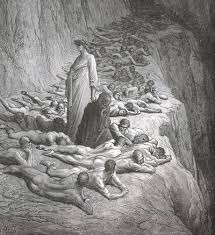
But that’s not what the Church teaches. There is in fact a hell, a “lake of fire” and there is in fact a Purgatory. As to what actually happens there (in Purgatory) we know nothing other than it is a place of final cleansing.

I suppose we are welcome to believe that it is some sort of cosmic Motel 6 where we can stop and get a shower along the way. But I would much rather trust the accounts of the saints who saw it for themselves even if the Church gives no official credence to those accounts.

For those who don't accept the existence of Purgatory or don't understand it see my other post on Purgatory here. If nothing else it has a good joke about it.

For more information on these accounts see:

Purgatory Explained By: Fr. F. X. Schouppe S.J. You would never dream so much is known about Purgatory. Not only is the basic teaching of the Church given here, but also countless true stories of apparitions and revelations on Purgatory from the lives of St. Margaret Mary, St. Gertrude, St. Bridget of Sweden, the Cure of Ars, St. Lidwina of Schiedam, etc.


Stories about Purgatory & What They Reveal By: An Ursiline of Sligo. This book was written to impress upon its readers many truths about Purgatory -- first, that it exists; second, that the souls detained there suffer long and excruciating pains, and that they desperately need our prayers and sacrifices; and that we ourselves should strive mightily to avoid Purgatory. Confirms in the reader's heart a healthy and holy respect for the sufferings endured by the Holy Souls, such that he will always remember them in his prayers. Impr. 169 pgs, PB


Purgatory By: Fr. Frederick Faber. Is Purgatory almost like Hell? Or is it a place of peace and even joy? The famous Fr. Faber explains both of these classic Catholic views of Purgatory, basing his discussion on Catholic teaching and the revelations of saintly souls, especially St. Catherine of Genoa, in her Treatise on Purgatory. Impr. 85 pgs, PB

Saints Who Raised the DeadTrue Stories of 400 Resurrection Miracles By: Rev. Albert J. Hebert. Stories from the lives of St. Francis Xavier, St. Patrick, St. John Bosco, St. Catherine of Siena, St. Teresa of Avila, St. Elizabeth of Hungary, St. Rose of Lima, Bl. Margaret of Castello, etc. Includes the raising of persons who had died, descriptions of Heaven, Hell and Purgatory by temporarily dead persons and an analysis of contemporary "after death" experiences. Many pictures of the saints and their miracles. Fascinating. Formerly published by TAN under the title "Raised from the Dead".


The Life of St. Gemma Galgani By: Venerable Fr. Germanus C.P. St. Gemma Galgani (1878-1903) was a mystic, stigmatist, visionary, ecstatic, victim soul, discerner of spirits, seer of hidden things, prophetess, spouse of Christ, zealot for souls and devotee of the Poor Souls in Purgatory. She died at only 25. Her mother was also saintly, and it is beautiful to see how she helped cultivate this lily of purity. See how Gemma made great sacrifices painful to human nature from her tenderest years. Inspiring and edifying! Impr. 349 pgs

Also see the Diary of St. Faustina. Here's a link to her entries on Purgatory.

Tim Rohr
Feast of All Souls, 2009


Related Posts Plugin for WordPress, Blogger...