Showing posts with label Translation Issues. Show all posts

Thursday, December 08, 2022

PIUS IX: "AND THUS CRUSHED HIS HEAD WITH HER IMMACULATE FOOT"


Today is December 8, the Feast of the Immaculate Conception, and time for my sometimes annual mini-rant about translations, and in this case, a particularly terrible translation in that it kicks Mary out of the plan of salvation. 

For years, probably since about 1970, the Gospel reading for Mass on this day (Lk 1: 26-38) did not use the words "full of grace" - which is the very basis of the Dogma of the Immaculate Conception - but used  "favored one," or "highly favored," or something like that. 

The New American Bible, the translation in standard use in the United States, and the translation that every Catholic school kid is stuck with, still uses that language

And coming to her, he said, "Hail, favored one! The Lord is with you."

Sometime in the mid-1990's, Pope John Paul II issued an instruction to fix that language, at least in the Lectionary, and so now we hear "Hail, full of grace" on the Holy Day set aside to specifically recognize and honor She who was and is "full of grace" from the moment of her conception. 

However, the language of the First Mass Reading on this day was never fixed and Genesis 3:15 still reads: 

I will put enmity between you and the woman, and between your offspring and hers; he will strike at your head, while you strike at his heel.”

Again, this was a circa 1970 invention and prior to this "updating" - made possible by the elimination of Latin and the vagaries of new vernacular translations - the faithful at Mass, on the Feast of the Immaculate Conception, heard:

inimicitias ponam inter te et mulierem et semen tuum et semen illius ipsa conteret caput tuum et tu insidiaberis calcaneo eius

I will put enmities between thee and the woman, and thy seed and her seed: she shall crush thy head, and thou shalt lie in wait for her heel.

There are two significant differences between the translation we heard today and the ancient one: First, there is "she" not "he." And second, the modern translation has Jesus and Satan striking at each other in what appears to be a battle of equals whereas the ancient text, in Latin (the Vulgate) has Mary CRUSHING a powerless Satan, i.e. Satan can only "lie in wait for her heel.

The Mary of the Vulgate, and the translation we heard for nearly 2000 years, is a much more powerful Mary, and said power underlies the reason for so many of her titles, including "Co-Redemptrix." Perhaps this is why - in the then-spirit of post-Vatican II ecumenism and wanting to get along with non-Catholics -  our own Catholic leadership got rid of the "she" in Genesis 3:15. 

Scholars debate whether the "ipsa" in the Vulgate can be translated as "he" or "she," however, there is no debating the language Pope Pius IX chose to employ and define in Ineffabilis Deus

Hence, just as Christ, the Mediator between God and man, assumed human nature, blotted the handwriting of the decree that stood against us, and fastened it triumphantly to the cross, so the most holy Virgin, united with him by a most intimate and indissoluble bond, was, with him and through him, eternally at enmity with the evil serpent, and most completely triumphed over him, and thus crushed his head with her immaculate foot.

It's curious, but since about 1970 when our Church leadership functionally dumped Mary as "Satan's head crusher," Satan has found his happy way back into the highest halls of power in our Church. 

However, as if to "fight back" against the MODERNISM which has eviscerated Mary in our modern translations - and even on the very day we honor her in a special way - Mary, a few days later in the liturgical calendar (Dec. 12) appears in Mexico and gives us her real name: 

"Te Coatlaxopeuh” ("she who crushes the stone serpent").
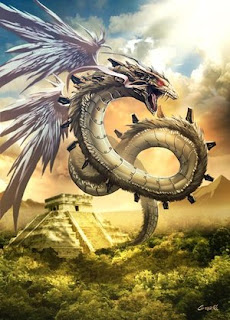

Read more at THE RETURN OF THE DEVOURER 

Wednesday, November 23, 2011

The New Missal and the Battle for the Language of the Liturgy


Published in the U Matuna, the newspaper for the Archdiocese of Hagatna, Guam, The First Sunday of Advent, November 27. 2011.
Today, the First Sunday of Advent, marks the beginning of the use of the New Roman Missal. I have been watching the evolution of this translation with some interest since John Paul II first officially called for it in Liturgicam Authenticam in 2001. Just as interesting as its genesis and evolution will be its implementation and the manner of its reception.

There has been no shortage of resources designed to facilitate the transition to the new translation. And while it is quite good that there has been a great effort to educate the laity, most of us will probably only notice (and stumble over) “and with your spirit” versus “and also with you”, as well as a few new words in the Creed. 
There is much more of course. The new translation was almost ten years in the making. Thousands of hours went into these words. To be sure, there is great depth there for those who would like to plumb it, and it is hoped that many will. But just as interesting and worth studying is the reason why it took ten years. I’m wondering if someone hasn’t already started writing the book. It is sure to be be high drama. 
Some of the drama has already played out with certain bishops showing no qualm about making their opposition to the new translation quite public. We won’t use any names, but the strong opinions appearing in print over the last few years is an indication that there had to have been some rather pitched battles throughout the process. 
But battles over what? Were the episcopal confrontations just over how to translate Latin verbs into English or was there a larger war to be waged?
Last week I wrote a column entitled “As the Church goes, so goes the world.” There’s actually a prequel to that. It’s called “As the Liturgy goes, so goes the Church.” It makes sense of course. If the Mass is the “source and summit” of our Faith, then all else flows from that. Cardinal Llovera, Prefect of the Congregation for Divine Worship and Sacraments, framed it thus: “The future of humanity is in the Liturgy...”, and thus the reason for the battle for the language of the Liturgy.
Language is power. Words matter. Both despot and democrat have historically understood that whoever controls language controls everything. Language shapes perception and perception shapes reality. And the reality is, that over the last 40 years, the American Church has seen a statistical collapse.
A 2007 Pew Research poll reported that only 25% of people raised Catholic still call themselves Catholic, and a 2010 CARA poll revealed that only 23% of those that still call themselves Catholic regularly attend Sunday Mass! In addition, a 2010 Pew Research poll reported that more than 40% of Catholics did not know that the bread and wine became the Body and Blood of Jesus during the consecration, and a 2009 study showed than an amazing 49% of Catholics believe that abortion should remain legal!
The 2007 poll also noted that, compared to other mainline denominations, the U.S. Catholic Church “has experienced the greatest net losses as a result of changes in affiliation”, and that, but for the “offsetting impact” of hispanic immigration, the decline would be even larger.
What happened? Certainly there are many possible factors. We could blame “the 60’s”, the sexual revolution, materialism, “the World”, etc. We might even look inward and see the weakness of of our catechetical programs, moral timidity, or the “mis-interpretation” of Vatican II. Progressives are likely to blame the Church’s position on women’s ordination, contraception, and homosexuality - positions, by the way that haven’t changed and can never change.
But at least one factor contributing to the decay of Catholic life in America was the Liturgy, or more specifically, the language of the Liturgy, which is why John Paul II demanded that it be fixed, and sent us the instruction manual (Liturgicam Authenticam) in 2001.
Anyone who has any question as to why a new translation of the Mass was much needed should consult this document. While he said it nicely, the Pope essentially laid the blame for the documentable decline of faith and morals at the feet of our “overly servile” translation of the Mass. 
In a 1993 address to a group of U.S. Bishops, in an obvious critique of the current translation and in anticipation of a new one, the Pope spoke about the power of the liturgical texts “for instilling in the lives of the Christian faithful the elements of faith and Christian morality...”, and emphasized that translations of liturgical texts “must always be in accord with sound doctrine.” We trust that the Missal we now possess is exactly that.

Sunday, May 20, 2007

God's Entrails (or how to reach young men)

Every morning, if you pray the Liturgy of the Hours, we say the "Benedictus", Zachary's exclaim and prophecy at the birth of his son John (the Baptist).It's a very beautiful and powerful canticle and its one of the few biblical texts of any length that I have committed completely to memory.

The topic of interest concerns the last few verses which read thus:

And you my child shall be called prophet of the Most High, for you will go before the Lord to prepare his way to give His people peace and knowledge of salvation by the forgiveness of their sins. In the tender compassion of our God the dawn from on high shall break upon us and shine on those who dwell in darkness and the shadow of death and to guide our feet into the way of peace. (Luke 1: 76-79)

(Just in case you're wondering which translation of the Bible this comes from, it doesn't. It's a product of the International Committee on the Use of English Texts)

Out of curiosity I often will look up biblical passages that I am reading in other versions of the Bible. As good students of our Faith we should have a variety of translations and good Catholic commentaries that aid us in deepening our study of Sacred Scripture.

One particular translation I like to refer to is the Douay Rheims. Few folks have heard of it but it has been around since the 16th century and for many years was the only Catholic translation in English. I like it because it is a close literal translation of our Church's official version of Scripture which is the Latin Vulgate of St. Jerome.Thus, when I read the DR translation, though some of its passages may seem a little archaic, I know I'm getting a pretty close translation of what the Church holds to be true and authentic.

This does not negate the authenticity of other Church approved translations, but until the Church changes its official translation to something else, I'll stick with Jerome when I want to look deeper into Sacred Texts.Well, pardon all that background, but it's important to have that information for the sake of our "word for the day".

And that word is "tender", as in the "tender compassion of our God". The NAB, which we use in the Liturgy, translates it "tender mercy", but "tender" is still there.

The Latin Vulgate uses this phrase: "per viscera misericordiae Dei nostri". Let's do a word for word translation minus "viscera" (which is the word of interest")

  • per = through
  • misericordiae = mercy, or really mercy from the heart, or pity, or compassion
  • Dei = God
  • nostri = our

So we have "through the compassion (mercy) or our God"But what of "viscera"? As we have seen, our modern versions translate it as "tender".

Viscera is also a word in English. Whenever we come across a word in our own language that is the same word in an antecedent language, it means that the word is so strong and specific in its meaning that it defies translation, and should attract our interest and inspection, especially when we find such words in Scripture.

A case in point is the word "Hallelujah". Ever wonder what that really means or what language that is? It comes from two Hebrew words: "hallel" "to praise" and "yah", which is the shortened form of Yahweh, the name of God.

Now we certainly can say, "Praise God" and we do, but when we really want to praise God, we say "Alleluia" or "Hallelujah" when we want the extra "umph"! Anyway, point is that some words just lose something in translation so we end up keeping the original word though we might anglicize it a bit.

Now, back to "viscera". The English definition is: "The soft internal organs of the body, especially those contained within the abdominal and thoracic cavities." In other words, your "guts", your "entrails".

So God's mercy and compassion is from His "guts", from His "viscera", from his "entrails", or "intestines" even! Wow! That's powerful!

Guys, ever get kicked in the ________(tender parts)? Well that's just the beginning of how much God "hurts" for us. The Douay Rhiems actually translates "viscera" as "bowels". Here's what it says: "Through the bowels of the mercy of our God". Wow!!

I probably won't change the way I say the "Benedictus" since I have it memorized, and at my age (over 50), if you change a word in something you've memorized you'll forget the whole thing! But I will say that after this short discovery and investigation, I will have a renewed and deepened appreciation for how much God loves me.

But perhaps this is once again instructive on how important translations are to our Faith formation. We complain how people today, especially kids, don't pay attention to God the way they should. And we wonder what has happened to our present generation, why we don't practice the Faith the way our parents and ancestors did.

We blame television and all the other products of technology that keep us busy, but perhaps it has something to do with how the Faith is presented. We hear no end of "God loves you", but, if we're honest, those words are increasingly irrelevant to our self-obsessed society.

We are not allowed to write off the wayward and go back to our little self-absorbed devotional enclave. "Go and teach!" said He as His last instruction. But what to do? Well, perhaps it's time we start looking at the official version of Catholic scripture and see what it has been saying for over 1600 years.

As a man (and once a boy) I am highly moved by the image of a God who loves me with his guts, from his bowels! Yes, my innermost parts are certainly "tender", but I believe the use of the word has the effect of making God soft, at least in the eyes (and hearing) of young men whose hormones are just beginning to scream for manly expression.

Perhaps that's why we see young men turning to fights, to sexual impurity, to foul language, to whatever they think makes them more of a man. Why turn to a God who is typified as "tender" (though He is that too of course) when everything about you (a young man) is rough and tough, and guess what, centered (at least in adolescence) around the bowels.

Perhaps it's time to re-present the God of the Bible who loves us from his bowels - since that is what it ACTUALLY says.

By the way, I have no formal education in this field. I just have an excellent book called the PRACTICAL COMMENTARY OF HOLY SCRIPTURE which was used as a tool for catechesis in Germany and in England for many years. Its original intended audience was grade school but when you read it you'll have an appreciation for how much more well-informed and literate people were 100 years ago.

I am going to write a separate article on this but the thing I love about it is that the formula for instruction follows the pattern of Jesus who, when instructing the masses, would often first tell a story (parable), then elicit the lesson, and then instruct those who heard Him to apply that which they had just learned.

This book does exactly that and uses the stories from Scripture as the beginning point of catechesis. If it was good enough for Jesus then it's good enough for me.

God Bless You (from His bowels)
Related Posts Plugin for WordPress, Blogger...