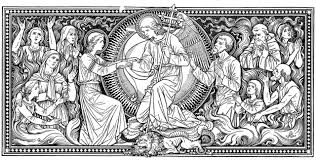
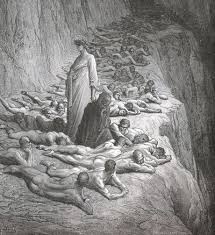
Today is November 2, and the Feast of All Souls or All Souls Day: the day when we as Catholics particularly remember and pray for the faithful departed.
The Divine Office for the day begins with this Scripture:
“But we would not have you ignorant, brethren, concerning those who are asleep, that you may not grieve as others do who have no hope. For since we believe that Jesus died and rose again, even so, through Jesus, God will bring with him those who have fallen asleep,” (1 Thess 4:13-14).
It caught my eye as another place in Scripture where Purgatory is alluded to. As we know, the concept of an intermediate place or state of purification, Purgatory, is not only not accepted by most, if not all, non-Catholic Christians ("NCC"), and even many Catholics these days, but was the central point of division which led to Luther's protestant revolution.
The typical NCC attack is based on the point that the word "Purgatory" isn't found in the Bible. The usual Catholic response is that the words "Trinity" and "Incarnation" are not found either but the concepts are clearly inferred.
The challenge with Purgatory is that the usual Catholic scriptures to support the reality of Purgatory are found in New Testament parables or a couple places in the Old Testament, one of which is the 2 Maccabees, a book non-Catholics don't have in their Bibles.
I wrote about that extensively here and proffered what I think is a more clear reference to Purgatory as found in Revelation, however, the above Scripture gives another reference to Purgatory that I haven't seen used, at least not in the Catechism or Apologetic circles. So let's take a look.
“But we would not have you ignorant, brethren, concerning those who are asleep, that you may not grieve as others do who have no hope. For since we believe that Jesus died and rose again, even so, through Jesus, God will bring with him those who have fallen asleep.” (1 Thess 4:13-14).
The words "those who are asleep" means those who have died. For NCC's who do not accept Purgatory, those who have died either go to Heaven or Hell, and for NCC's, the fate of the dead is clear: if they accepted Jesus as their personal Lord and Savior the dead go to Heaven, and if they didn't, they go to Hell. And for most NCC's, the fate of the dead is usually assured because the confession of faith must be a public thing.
However, if this is the case, then there is no reason for Paul to speak of "hope." There is no reason for us to hope the faithful departed is in Heaven if salvation was assured by a confession of faith while still alive. And there is no reason for hope if the person is in Hell, since Hell is an eternal sentence with no possibility of parole.
"Hope," as used here by Paul can only refer to those who have died and who may still gain Heaven as those would be the only souls we could "hope" for.
There is also more to be said about the term "fallen asleep." The above Scripture says: "through Jesus, God will bring with him those who have fallen asleep.”
We know that those who are with Jesus in Heaven enjoy the beatific vision and are very much alive in Christ. They are not "asleep."
NCC's will argue that "sleep" only refers to the body and not the soul, but this is out of whack with "through Jesus, God will bring with him those who have fallen asleep." Of course we believe in the Resurrection of the body, but clearly Paul isn't speaking of that here. He is speaking of those who have died, here and now, not the end of time.
Thus, "those who have fallen asleep" can only refer to souls who are waiting for Jesus to "bring with him." The only possibility for "waiting" after death is the Catholic doctrine of Purgatory.
"We believe that Bishop Dave has received his recompense for his life and his ministry...We know that he is in heaven. Let us ask for his intercession..."
- Archbishop Jose H. Gomez, at a novena for the recently murdered Bishop David O'Connell, quoted in Angelus, the official publication for the Archdiocese of Los Angeles, Mar. 10, 2023, Vol. 8 No. 5 (and also here on CNA).
I didn't know that an individual bishop could canonize another one, all by himself.
He can't of course.
It appears that Archbishop Gomez has fallen victim to the mostly post-Vatican II penchant to place loved ones in heaven...and immediately.
While that may make us feel better - which is what Archbishop Gomez may have been trying to do - it is probably the most uncharitable thing one (a Catholic) can do.
As Catholics we believe the following:
Those who die in God's grace and friendship and are perfectly purified live for ever with Christ. They are like God for ever, for they "see him as he is," face to face. - Catechism of the Catholic Church, Par. 1023
The key words are "perfectly purified," and only God can know that.
In fact the command to "judge not" (Mt. 7:1) goes both ways.
While we "use" the command to "judge not" mostly (and often wrongly) [1] to admonish others not to judge the sinfulness of others, we are also not to use it to judge the rightfulness of others - such as placing the dearly departed in heaven because he or she was a really good person, or we because we really liked him or her, or because we just really want to feel better.
Other than canonized saints - which is an act of authority to "bind and loose" possessed only and ultimately by the Successor of Peter - no one can say what Archbishop Gomez said...about anybody.
In fact, given what we Catholics believe about the Four Last Things (Death, Judgment, Heaven, and Hell), by believing or "placing" a departed soul in heaven, we may be uncharitably condemning that soul to a much longer term in Purgatory. [2]
Curiously, the Angelus article titled "Mourning a peacemaker," featured a picture of a crowd gathered in the parking lot of a local church on the second night of a novena organized by members of the Knights of Columbus "to pray for the repose of O'Connell's soul..."
The picture includes Archbishop Gomez, rosary in hand.
There is no point in praying for the repose of O'Connell's soul if, as Archbishop Gomez declares, O'Connell is already in heaven and we are to pray to him for his intercession.
Just more confusion in the name of "charity."
What a shame.
Notes:
[1] While we can, and must, judge acts as to their sinfulness or rightfulness, we are not to judge "hearts" as "the Lord looks on the heart” (1 Samuel 16:7 )
[2] See: "Greater than Any Pain of this Life: The Hard Truth About Purgatory" at Aletia.org
The author of the post followed the usual sola scriptura logic of if it's not in the Bible it doesn't exist, but goes further, calling the doctrine of Purgatory (a specifically Catholic doctrine) "the ANTI-Christ."
I read a few of the replies, all of which appeared to agree with the author and some of which even went further in their condemnation of the Catholic doctrine and belief in Purgatory.
I decided to leave the following reply:
The presupposition is that everything that Jesus taught can be found in Scripture. Aside from the fact that Jesus left us nothing in writing, there is also the matter as to who gets to decide what constitutes "Scripture." Just for starters, the followers of Martin Luther say there are 66 books in the Bible, the Catholics say there are 73, and the Greek Orthodox, Syrian Orthodox, and Ethiopian Orthodox all add to that. So whose "Bible" shall we refer to?
Additionally, John 21 tells us: “There are also many other things that Jesus did, but if these were to be described individually, I do not think the whole world would contain the books that would be written.”
More than likely, the “many other things that Jesus did/taught” may well have occurred in the 40 day period between the Resurrection and his Ascension into heaven. If there ever was a time for Jesus to teach and the Apostles to listen, it certainly would have been during this period.
In Acts 1, Luke tells us: “In the first book, Theophilus, I dealt with all that Jesus did and taught until the day he was taken up, after giving instructions through the holy Spirit to the apostles whom he had chosen. He presented himself alive to them by many proofs after he had suffered, appearing to them during forty days* and speaking about the kingdom of God.”
Obviously there was much instruction during this period but nothing specific seems to be recorded in “scripture.” In fact, Luke references his “first book” (probably his Gospel), where he dealt with “all that Jesus did and taught UNITL the day he was taken up.” However, other than the Road to Emmaus account, nothing much else is said about what Jesus did or taught during this period. So it may be that this portion of Luke’s Gospel was lost.
Specific to your inquiry, though, regarding a scriptural reference to Purgatory. A “third place” which is not Heaven or Hell can be found in Revelation 20:13-14: “The sea gave up its dead; then Death and Hades gave up their dead. All the dead were judged according to their deeds. Then Death and Hades were thrown into the pool of fire.”
At this point I will copy a portion of what I have already written on the matter elsewhere with a link to the source:
The passage (Revelation 20:13-14) occurs within the context of a description of events which will occur at the end of time. One of the main events is that Hades will “give up its dead”. We know Hades isn’t Hell (understood as the place of eternal damnation) because Hell is noted separately as “the pool of fire”. And we for sure know that Hades isn’t Heaven. So what is it?
Classically, Hades is understood as a holding place for the dead. Such a place was seen as necessary before Christ opened the gates of Heaven, but deemed by Luther and others as unnecessary after. Yet, here we are at the end of time, and not only is Hades still around, its got souls “holed up” there.
What are they doing there? There can be only one explanation. They are not deserving of Hell (or else they’d be there), and not yet worthy of Heaven (or else they’d be there). They are in fact, “spirits in prison”, which comports with Mt. 5:26: “you will not get out of there until you have paid the last penny.” http://www.themassneverends.com/2012/11/heaven-probably-not-your-next-stop.html
"There is not one baptism only. One is that which the Church administers here by water and the Holy Ghost. Another is the baptism of suffering, whereby each is cleansed by his own blood. There is also a baptism at the entrance of Paradise. This last baptism did not exist in the beginning; but after the sinner was driven out of Paradise, God set there a fiery sword… But though there be a purgation here, there must be a second purification there, that each of us, burnt but not burnt up by that fiery sword, may enter into the delight of Paradise. But this fire whereby involuntary and casual sins are burnt away… is different from that which the Lord assigned to the devil and his angels, of which he says, enter ‘into everlasting fire.’”- St. Ambrose of Milan, Doctor of the Church, Explanation of Psalm 118, c. A.D. 380
“That there should be some fire even after this life is not incredible, and it can be inquired into and either be discovered or left hidden whether some of the faithful may be saved, some more slowly and some more quickly in the greater or lesser degree in which they loved the good things that perish, through a certain purgatorial fire."- St. Augustine, Doctor of the Church, Enchiridion on Faith, Hope, and Charity 18:69, A.D. 421
“Each one will be presented to the Judge exactly as he was when he departed this life. Yet, there must be a cleansing fire before judgment, because of some minor faults that may remain to be purged away. Does not Christ, the Truth, say that if anyone blasphemes against the Holy Spirit he shall not be forgiven 'either in this world or in the world to come' (Mt 12:32)? From this statement we learn that some sins can be forgiven in this world and some in the world to come. For, if forgiveness is refused for a particular sin, we conclude logically that it is granted for others. This must apply, as I said, to slight transgressions.”- Pope St. Gregory the Great, Doctor of the Church, Dialogues, 4:39, A.D. 594
Anyone (Catholic) near my age can probably remember our mothers admonishing us to “offer it up for the poor souls in purgatory” whenever we complained about some pain or discomfort. It’s not something we hear much anymore. In fact, not only has the idea of “offer it up” generally disappeared from the list of routine Catholic expressions, it seems “the poor souls” has to.
Today, we are more inclined to think of our dearly departed as whooping it up at some heavenly fiesta or flitting about with angels, than think of them as poor souls suffering helplessly in Purgatory and in grave need of our prayers and offerings.
In Guam, this produces a strange contrariety. We remember our dead on All Souls Day (Nov. 2) with a seriousness that is found in few other places in the Catholic world. And of course there is never a shortage of “animas” at almost every Mass. But we all but canonize - or even “angelicize” - our dead, in our talk, funeral announcements, eulogies and even sermons (sometimes).
Praying for the dead is very serious business. Unless one dies sinless or a martyr, chances are (it’s always up to God) he or she is not going straight to Heaven, but to Purgatory, and could be there awhile. Here’s why.
Revelations 21:27 tells us “nothing unclean” will enter Heaven. All of us who have the capacity to sin will more than likely die “unclean”, even if we have confessed our sin. A quick example:
A man cheats on his wife. He seeks absolution in the Sacrament of Confession and is absolved. He may even apologize to, and be forgiven by, his wife. Though the sin is forgiven, the damage remains. The strain between the husband and wife, the distrust which now must be endured, the damage done to the children - these are the temporal effects, the vestiges of sin, which no absolution or forgiveness can make go away. In short, the sin may be forgiven, but the stain remains.
Non-Catholic Christians, most of whom do not accept the idea of a post-death state of purgation (Purgatory), do not deny that most will die “unclean”, but believe that Jesus covers that uncleanness: “piles of dung covered with snow”, as Luther put it. But snow or not, piles of dung, as per Revelation 21:27, will not get past St. Peter: “Nothing unclean will enter.” So now what?
The Catholic Church teaches that we are judged at the moment of death. Those who die in a state of unrepentant mortal sin will be cast into Hell. And those who are completely pure (only God can know) will be welcomed into Heaven (CCC 1022). But what of us who are neither guilty of unrepentant mortal sin or completely pure?
Thanks be to God for His mercy. For while there is no post-death second chance to be sorry, there is the chance to burn away the dung and dross of our human condition, to be made clean, so that at some point we may “enter it” and live with God forever. The Church calls this merciful opportunity “Purgatory”:
“All who die in God's grace and friendship, but still imperfectly purified, are indeed assured of their eternal salvation; but after death they undergo purification, so as to achieve the holiness necessary to enter the joy of heaven. The Church gives the name Purgatory to this final purification of the elect, which is entirely different from the punishment of the damned.” (CCC 1030-31)
But! - and this is the question which rocked Christendom and led to the many sad divisions which still exist in the Body of Christ: From whence comes this doctrine? Where do we find Purgatory in Scripture?
The Catechism references five scriptures as footnotes for Purgatory: Mt. 12:31 (“...whoever utters blasphemy against the Holy Spirit will be pardoned neither in this age nor in the age to come”), 1 Cor 3:15 and 1 Pet 1:7 (passages which speak of a “cleansing fire”), and 2 Maccabees 12:46 and Job 1:5 (where prayers for the dead are mentioned).
Protestant apologists dismiss these references. The pardon in the “age to come” is seen simply as a figure of speech emphasizing the unforgivable nature of blasphemy against the Holy Spirit. The “cleansing fire” verses are seen as metaphors and not definitive teaching. And the Old Testament passages found in Maccabees and Job are disqualified because Old Testament souls had no opportunity to go to Heaven prior to the coming of Jesus. (Also, Protestants do not accept the books of Maccabees as canonical.)
Catholic theologians argue the deeper meaning of these same verses, but - as evinced by more than 500 years of division - have achieved nothing more than a stalemate.
I wasn’t invited to the Council of Trent, but if I was, I would have offered Revelation 20:13-14, as a more helpful reference. The passage reads: “The sea gave up its dead; then Death and Hades gave up their dead. All the dead were judged according to their deeds. Then Death and Hades were thrown into the pool of fire.”
It’s quite clear. The passage occurs within the context of a description of events which will occur at the end of time. One of the main events is that Hades will “give up its dead”. We know Hades isn’t Hell (understood as the place of eternal damnation) because Hell is noted separately as “the pool of fire”. And we for sure know that Hades isn’t Heaven. So what is it?
Classically, Hades is understood as a holding place for the dead. Such a place was seen as necessary before Christ opened the gates of Heaven, but deemed by Luther and others as unnecessary after. Yet, here we are at the end of time, and not only is Hades still around, its got souls “holed up” there.
What are they doing there? There can be only one explanation. They are not deserving of Hell (or else they’d be there), and not yet worthy of Heaven (or else they’d be there). They are in fact, “spirits in prison”, which comports with Mt. 5:26: “you will not get out of there until you have paid the last penny.”
I’ll see what I can do to send in my entry for the next Council, but for now, study this verse and share it with those who do not accept the doctrine of Purgatory; for many of our loved ones probably yet languish there, and are in need of our prayers and our “offer it up” - as our mothers once admonished us.
P.S. Elmer Rohr, my grandfather, was known as a hard man - a tough old, cider-hardened, World War I vet who literally carved a living for his eleven children out of the rough Ohio ground behind a team of mules in the midst of the Great Depression. As age took its toll and death loomed, he sternly commanded his children to never stop praying for him. He knew that Heaven wasn’t going to be his next stop. We should not presume it will be ours.
Printed in the U Matuna, newspaper for the Archdiocese of Hagatna, Guam, on November 13, 2011.
As mentioned in a previous column, the entire month of November is dedicated to the memory of the Poor Souls in Purgatory, so we will take this occasion to speak of Purgatory a bit more.
Disagreement about Purgatory is at the root of the Protestant Reformation, and remains a critical issue of division between Catholics and non-Catholic Christians.
Martin Luther essentially claimed that Purgatory did not exist because it could not be proved from the Bible, and the challenge to prove Purgatory from Scripture is still a challenge that confronts Catholics today.
While Catholicism is not a “Bible-Only” religion - and we do not require that everything we believe be explicitly stated in Scripture - most of what Catholics believe is in fact very explicit in Scripture, including Purgatory.
First, let’s look at a few scriptures where the concept of Purgatory is implicit, and why Luther and Protestantism reject those scriptures as evidence of Purgatory.
In its short entry on Purgatory, the Catechism employs the support of Matthew 12:31 and 2 Maccabees 12:46.
In the Matthew passage, Christ warns that sins against the Holy Spirit will not be forgiven “in this age or the age to come.” The implication is a time or state (age) after death when sin might still be forgiven.
However, non-Catholics - and even some Catholic scholars - dismiss the reference to this “age to come” - as evidence of Purgatory since even if Purgatory does exist, sin must be repented for in this life. In other words, there is no "second chance."
However, scholars believe that Christ was rather emphasizing the gravity of a sin against the Holy Spirit.
2 Maccabees recounts the prayer of Judas Maccabeus to pray for the souls of his fallen men “that their sin (idolatry) might be blotted out”.
Because prayer is not needed for souls in Heaven and is of no use to those in Hell, it appears that at least some Jews believed in an intermediate state.
However, 2 Maccabees was one of the seven books of "the bible" that Luther discarded from the Old Testament.
So the passage is useless in an apologetic endeavor with a non-Catholic.
The Catechism of the Catholic Church also references 1 Cor 3:15; 1 Pet 1:7, and Job 1:5.
Let us take a look at these.
Both Corinthians and Peter refer to a purifying fire.
However, both scriptures are metaphoric and do not explicitly support the post-death state of purgation which Luther and Protestant challengers require.
The passage from Job shows Job offering sacrifice for his children, but since his children are living, it rather supports the idea of intercession on behalf of the living but not necessarily the dead.
There are several other scriptures where a post-death state of purification is implied: Mt. 5:26, Lk 12:47, and Lk 16:19, to name a few; but these are parables and normally not accepted as proofs.
And the “prison” mentioned in 1 Peter 3:19, where the souls of the righteous dead went to await the Savior, is a “third place” that Protestants already accept but believe there was no need for such a state after Christ died, rose, and ascended into Heaven.
So where do we find absolute proof of Purgatory in Scripture?
We find it In Revelations 20:13-14:
"The sea gave up its dead; then Death and Hades gave up their dead. All the dead were judged according to their deeds.Then Death and Hades were thrown into the pool of fire.”
Here, at the end of time, we see “Death and Hades” as a place that is not Heaven and not Hell.
We know it’s not Hell because after giving up “their dead”, Death and Hades is “thrown into the pool of fire”, which IS Hell.
Hell can’t be thrown into Hell so Death and Hades is a third place, and what’s more, Scripture tells us there are souls detained there.
We know that these souls are not damned because the damned go immediately to Hell upon death and judgement. There is no holding place for them. But they are obviously not in Heaven either.
So where are they?
They are in a third place. And the only reason they could be there is that they are not deserving of Hell but not yet pure enough to enter Heaven. (“Nothing unclean shall enter it” - Revelations 21:27).
The Church just gives a name to this “place”, a name relative to the nature of its purpose: to purge.
For some reason, Revelations 20:13-14 never seems to pop up in apologetic writings about Purgatory. However, it is the only place in Scripture, despite the highly symbolic nature of Revelation, where a post-Resurrection, “third place”, is explicitly referenced, and wherein souls of the dead are detained. I hear that Catholics and Protestants are both there.
Printed in the U Matuna, the newspaper for the Archdiocese of Hagatna Guam, October 30, 2011
In the “7 Habits of Highly Effective People” by Steven Covey, the first habit is “Begin with the end in mind.” Whether we are going to construct a house, build a business, or run an errand, we begin with the end in mind. To not do so would result in a structurally unsound house, a failed business, or an aimless drive.
As Christians, we are admonished by our Church and its Saints to do the same: to begin with the end in mind, and to KEEP it in mind. Liturgically we do this especially in the month of November, which is dedicated to the Poor Souls, and during which the Mass readings speak increasingly of the Last Things as the liturgical year comes to a close.
Elmer Rohr's 11 Children
So perhaps this is an appropriate moment to address a curious development in Catholic sensibilities about Purgatory. A quick internet search or even a casual survey will reveal that many Catholics think little of Purgatory and even believe that Vatican II did away with it. Of course Vatican II did no such thing, but the pervasiveness of the belief that it did should be cause for concern and correction.
On Guam, with our custom of rosaries for the dead, private memorials to deceased relatives, and homage rendered to All Souls Day (no other place makes it a government holiday), it would seem that we are in no danger of forgetting the plight of the Suffering Souls. Yet, funeral announcements today rarely call for prayers for the repose of the soul of the deceased as they once did. More often such announcements include warm phrases such as: “In Celebration of His New Life”, or “In her new life she now joins (a list of relatives)”, and the like.
It is understandable that we wish the best for our loved ones, but given the teaching of our Church on the necessity of purification before one enters Heaven, it is very likely that the dearly departed do not enter immediately into Heaven at the moment of their passing (even if they do die in a state of grace), and are more in need of our intercession than they were on earth since in Purgatory they can do nothing for themselves. Thus they are called the “Poor Souls”.
In other words, that beloved relative whose funeral announcement or eulogy placed him or her immediately in heavenly glory may be left to endure the pains of Purgatory much “longer” than need be because, believing the deceased is already in Heaven, there are few prayers for his or her poor soul. (“Longer” is in quotes because in the afterlife there is no time: “a thousand years is as a day...” 2 Pet 3:8)
The Church does not expound on the nature of this post-death purification other than to quote certain references in Scripture to a “cleansing fire”. But because the Church officially calls the souls in Purgatory the “Church Suffering”, there is no doubt about the condition of the souls who are there.
We also have the accounts of Purgatory from approved apparitions and canonized Saints, which, though not official Church teaching, should nevertheless be taken with great seriousness. St. Margaret Mary, upon being shown Purgatory is said to have said: “If only you knew with what great longing these holy souls yearn for relief from their suffering.”
Earlier this year, on the Feast of St. Catherine of Genoa (1447-1510), Pope Benedict XVI, recounted the Saint’s mystical understanding of the nature of the suffering in Purgatory as an interior fire fueled by the soul’s hatred for one’s own sins.
“Thus for Catherine,” said the Pope, "the soul is aware of God's immense love and perfect justice; as a consequence, it suffers for not having responded to that love perfectly, and it is precisely the love of God Himself which purifies the soul from the ravages of sin...(and)...only after having been purified of sin can the soul approach God.”
It would seem that at least part of the suffering of the Poor Souls is due to the knowledge that in Purgatory they can do nothing for themselves, which makes the necessity of our intercessions entirely urgent.
To understand how we can assist them in their agonies, it is necessary to understand the Communion of Saints and the “exchange of all good things” between the Church Triumphant (in Heaven), the Church Militant (here on Earth), and the Church Suffering (in Purgatory). See Catechism, paragraph 1475.
Many years ago, as my grandfather grew more aware of his approaching death and the probability of an “extended stay” in Purgatory, an aunt later told me that he had implored his eleven children to never stop praying for him. I intend to tell my children the same.
Prayer of St. Gertrude
"Eternal Father, I offer Thee the Most Precious Blood of Thy Divine Son, Jesus, in union with the Masses said throughout the world today, for all the holy souls in Purgatory, for sinners everywhere, for sinners in the universal church, those in my own home and within my family. Amen."
Catholics have great jokes. And we should. Heck we’ve been around 2000 years, so we’ve had lots of time to come up with them. Jokes about confession are probably the most numerous, but purgatory ranks right up there.
Here’s one for you:
A recently departed soul reaches Heaven’s gate and is advised that he’ll be needing to spend a little time in Purgatory before he can get into the Big House. An Archangel escorts the man to Purgatory where they enter a long hall with three doors. The angel explains that there are three ways to spend one’s time in Purgatory and each soul gets to choose his own form of discomfort.
The angel opens the first door and the man sees many poor souls up to their necks in mud. Not particularly excited about spending his time in such a manner he asks the angel to show him what’s behind the 2nd door. The angel opens door #2 and the man sees the poor souls clanking about in chains and carrying rocks.
The man then requests to see behind door #3. The man sees all sorts of folks walking about with cocktails, chatting, and carrying on. The only down side was that they were knee deep in sewage. “Well”, thought the man. “This can’t be all that bad.” So he informs the angel that he’ll take door #3.
“No problem” says the angel and he leads him into the room, introduces him to the rest of the folks, hands him a martini, and the man joins the party. About 10 minutes later the angel claps his hands and says “Okay, folks. break's over - everybody back on your heads.”
Purgatory, like confession, and other uniquely Catholic practices and beliefs, provide fodder for many such stories, probably because such things are mysterious and often little understood.
So let’s take a quick stab at Purgatory, especially since its existence is rejected by most non-Catholic Christians and little understood even by most Catholics. As a matter of fact, many Catholics are under the impression that Vatican II “did away” with Purgatory. I’m afraid that’s not the case.
If you want to read exactly what the Catechism says about Purgatory you can go here and begin reading at paragraph 1030. But essentially the Church teaches 3 things about Purgatory:
1. That there is such a "place" or state. 2. That most of us will need to spend some time there. 3. That there is suffering in Purgatory though we do not the nature of it.
Most non-Catholic Christians will be too scandalized by now to read further, so we'll just continue with the Catholics...or at least some of them. Let's work backward on our 3 points.
Not much more to say about #3. The word Purgatory implies "purgation", cleaning, purging, etc. So you know something's going on there that probably isn't too pleasant. We do find some references to a purgatorial type of suffering in Scripture:
1 Cor 3:15 speaks of being saved "but only as through fire": "But if someone's work is burned up, that person will suffer loss, the person will be saved, but only as through fire."
Luke 12:58 tells us a prison that we may have to endure until we "pay the last penny": "If you are to go with your opponent before a magistrate, make an effort to settle the matter on the way; otherwise your opponent will turn you over to the judge, and the judge hand you over to the constable, and the constable throw you into prison. I say to you, you will not be released until you have paid the last penny."
Luke 16:19-31 gives us the story of the poor man, Lazarus, and Dives, the rich man, who calls out from a place of torment after his death and asks Lazarus to warn his brothers. We know that Dives cannot be in Hell, because in Hell one is no longer capable of doing or desiring good, which Dives tries to do (warn his brothers). This is an interesting story because it comes from the lips of Jesus himself. The story also refutes the so-called "soul sleep" that some believe. Dives is very much alive in this parable.
As for #2 and why we'll need to spend some time there, Church teaching is based on 5 words in Revelation 21:27: "nothing unclean will enter it". The "it" is Heaven and the "unclean" is most of us, since most of us will not die in a state of complete perfection except for genuine martyrs which the Church defines as those who have shed their blood for the Faith. However, only God can judge the heart so we know not who else God may have allowed to reach a state of perfection while still in this life.
Many of our non-Catholic Christian brethren believe that regardless of the woeful state of our soul at death, Christ's blood will cover us, and so long as we believe in Jesus, we'll skip right into Heaven. While they are welcome to believe that, believing it doesn't necessarily make it so. Discussing that here would take us into a separate discussion into what constitutes "salvation". So for now we'll need to suffice it to say that while Catholics also believe that we are covered with the Blood of Christ, we believe that we are also called to take up our cross and may indeed to have to shed a little blood of our own.
Now to the first point: there is such a place or state. Yes, we know the word Purgatory is not in the Bible and we're not going to get into a discussion here about "solo scriptura", but let's take a look at Revelations 20:13-14:
"The sea gave up its dead; then Death and Hades gave up their dead. All the dead were judged according to their deeds. Then Death and Hades were thrown into the pool of fire."
What is "Hades"? Most will say it is "Hell", or more precisely, Gehenna, the place of eternal torment. But it's not, for we see that Hades itself is "thrown into the pool of fire" (lake of fire in some translations). Can't throw Hell into Hell, so Hades has to be something other than Hell. It's obviously a THIRD place.
What's more is that there are people in it since it says that "Death and Hades gave up their dead". We are well aware of the existence of a third place called "the bosom of Abraham" where the righteous went to await the coming of the Lord. But there was no need for the "bosom of Abraham" after Christ opened the gates of Heaven.
So here we have a "third place" with people (souls) in it at the end of time (at the time of the Final Judgment). So what could it be and why are there souls in it? They're obviously not in Heaven, and as we explained, Hades isn't Gehenna.
So, maybe the Bible doesn't call it Purgatory, but there is certainly a "Third Place" in Scripture, and we can only imagine that since these souls are not yet with the Lord after their death that there must certainly also be suffering...if only the suffering of waiting.
Conclusion:
1. Scripture shows us a place that is not Heaven and is not Hell. 2. Souls are in this place. 3. The souls are not damned or they'd be in Gehenna and the "Hades" that they are in is not Gehenna. 4. This New Testament "Hades" is not the "bosom of Abraham" of the Old Testament. 5. The existence of this place of waiting is consistent with the Scripture references to "paying the last penny", "being saved as through fire", "this place of torment", etc., but especially with Revelation 21:27 which reminds us that "nothing unclean shall enter it."
Because most of us will die in a state of imperfection but still desirous of union with God, God's Mercy demands that we be allowed a state of final purgation so that we CAN "enter it". This is not the second chance that some think Purgatory is, just a final state of purgation for those who have already sought God's Mercy.
But even if you dont' accept the need for a Purgatory, Scripture clearly shows that there is one. Guess we'll find out for sure some day. I already am sure.
“Never stop praying for me." - Elmer P. Rohr (to his 11 children)
Here on Guam, All Souls Day is probably celebrated with more activity and official recognition than any other place in the world except maybe the Philippines. The customs are quite beautiful: cemeteries are cleaned up, tombs are repainted, special Masses are said, flowers and bouquets are arranged about the plots, and candles light up the cemeteries for the next several nights.
The local government (and some private firms) even grants a holiday so that appropriate honor can be paid to each family’s dead. However, we should continue to remind ourselves that the purpose of All Souls Day is not to just honor the dead but to of course to pray for them.
And, why do we need to pray for them?
It has been said by more than one saint who was gifted with the vision of Purgatory that one moment of pain in its purifying flames is so great that it is unimaginably more painful than all the sufferings combined of a whole lifetime on this earth.
While the Church does not solemnly define the nature of the suffering a soul experiences in purgatory, the Church does declare 1) that souls do suffer in purgatory (The Church Suffering is the official title), and 2) they can do nothing to help themselves.
Because these souls are suffering and because they can do nothing of themselves to lessen their pains or shorten their time of purgation we are bound by charity to pray and even suffer for those souls.
In the past, the general Catholic consciousness of the helpless state of these souls was much more pronounced. My mother and teachers (Catholic school) never missed an opportunity to remind us to “offer it up for the poor souls in purgatory” whenever we kids experienced some sort of pain or discomfort.
It was also quite common to see or hear a death announcement accompanied by the words “please pray for the repose of the soul of…”. Funeral masses and masses for the dead (Requiems) complete with black vestments had a very sober and solemn tone to them, by which we were reminded that our loved one(s) may not yet be in heaven and that we should never cease praying for them.
Today, one not only rarely hears the admonition to offer up the pain from the splinter in your finger for the poor souls, but we quite often hear, even from practicing Catholics, some doubt or question as to the existence of purgatory (“Didn’t Vatican II do away with Purgatory?”).
It is my opinion that most Catholics can be forgiven for thinking such things. While there is usually a long list of “animas” (mass intentions for the souls of the dead) before each Mass, the level of catechetical understanding of the connection between those intentions and the suffering state of Purgatory is questionable.
Death announcements no longer read “please pray for the repose of the soul…” but happily proclaim: “in celebration of his new life”. Eulogies and homilies tend to “beatify” the person. Funeral and memorial masses are celebrated in white vestments and with a positive air. While white vestments are legitimate and we should certainly celebrate our hope in the eternal happiness of heaven, the odds are that the person who just died, unless he or she was martyred, is probably not there yet, and may in fact be delayed in arriving there by our “he’s in a better place now” attitude..
Minus the sobering reminders of the probable state of the soul of our dearly departed and further confused by the “popular canonizations” (“In celebration of his new life…”) we may in fact neglect to pray for the person’s soul and thus leave him or her to the pains of purgatory longer than may have been the case if we were to have beseeched God with prayers and sufferings as indeed we are commanded to do.
My paternal grandfather, who celebrated the body and blood of Jesus at church in the morning with the same intensity as he celebrated homemade sausage and cider in the cellar at night, admonished his 11 children, long before death was upon him, to “never stop praying” for him after he died.
I continue to be amazed at the “awareness” of former generations as to the reality and sufferings of purgatory as contrasted with what seems to be a complete loss of this sense today.
Of course the Church has not changed its teachings. What it did do was change its practices. And therein lies another testament to the maxim that “what you do speaks so loudly that what you say I cannot hear”. Regardless of what the Catechism and the most orthodox of teachers continue to say, we simply do not “hear” because what we “see” speaks louder. How else to count for the seeming overwhelming belief that purgatory no longer exists and the preponderance of announcements celebrating “his new life” versus “please pray for the repose of the soul…” ?
As a graduate of a rather “liberal” institution in the early 80’s I got sidetracked from my childhood faith and fell in under the popular teaching that if there was a purgatory, it was just a place to stop and get “cleaned up”, and even if there was a Hell there was probably nobody in it.
But that’s not what the Church teaches. There is in fact a hell, a “lake of fire” and there is in fact a Purgatory. As to what actually happens there (in Purgatory) we know nothing other than it is a place of final cleansing.
I suppose we are welcome to believe that it is some sort of cosmic Motel 6 where we can stop and get a shower along the way. But I would much rather trust the accounts of the saints who saw it for themselves even if the Church gives no official credence to those accounts.
For those who don't accept the existence of Purgatory or don't understand it see my other post on Purgatory here. If nothing else it has a good joke about it.
For more information on these accounts see:
Purgatory Explained By: Fr. F. X. Schouppe S.J. You would never dream so much is known about Purgatory. Not only is the basic teaching of the Church given here, but also countless true stories of apparitions and revelations on Purgatory from the lives of St. Margaret Mary, St. Gertrude, St. Bridget of Sweden, the Cure of Ars, St. Lidwina of Schiedam, etc.
Stories about Purgatory & What They Reveal By: An Ursiline of Sligo. This book was written to impress upon its readers many truths about Purgatory -- first, that it exists; second, that the souls detained there suffer long and excruciating pains, and that they desperately need our prayers and sacrifices; and that we ourselves should strive mightily to avoid Purgatory. Confirms in the reader's heart a healthy and holy respect for the sufferings endured by the Holy Souls, such that he will always remember them in his prayers. Impr. 169 pgs, PB
Purgatory By: Fr. Frederick Faber. Is Purgatory almost like Hell? Or is it a place of peace and even joy? The famous Fr. Faber explains both of these classic Catholic views of Purgatory, basing his discussion on Catholic teaching and the revelations of saintly souls, especially St. Catherine of Genoa, in her Treatise on Purgatory. Impr. 85 pgs, PB
Saints Who Raised the DeadTrue Stories of 400 Resurrection Miracles By: Rev. Albert J. Hebert. Stories from the lives of St. Francis Xavier, St. Patrick, St. John Bosco, St. Catherine of Siena, St. Teresa of Avila, St. Elizabeth of Hungary, St. Rose of Lima, Bl. Margaret of Castello, etc. Includes the raising of persons who had died, descriptions of Heaven, Hell and Purgatory by temporarily dead persons and an analysis of contemporary "after death" experiences. Many pictures of the saints and their miracles. Fascinating. Formerly published by TAN under the title "Raised from the Dead".
The Life of St. Gemma Galgani By: Venerable Fr. Germanus C.P. St. Gemma Galgani (1878-1903) was a mystic, stigmatist, visionary, ecstatic, victim soul, discerner of spirits, seer of hidden things, prophetess, spouse of Christ, zealot for souls and devotee of the Poor Souls in Purgatory. She died at only 25. Her mother was also saintly, and it is beautiful to see how she helped cultivate this lily of purity. See how Gemma made great sacrifices painful to human nature from her tenderest years. Inspiring and edifying! Impr. 349 pgs
Also see the Diary of St. Faustina. Here's a link to her entries on Purgatory.