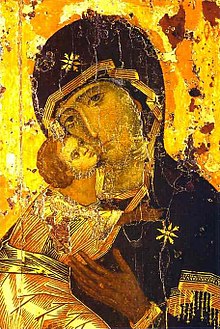
“...so the most holy Virgin, united with him by a most intimate and indissoluble bond, was, with him and through him, eternally at enmity with the evil serpent, and most completely triumphed over him, and thus crushed his head with her immaculate foot.” - Pope Pius IX, Ineffabilis Deus, December 8, 1854
Sunday, December 08, 2013
Tequantlaxopeuh and the Immaculate Conception
Monday, June 04, 2012
INCORRUTIBITER GENUIT
Thursday, May 31, 2012
ENGAGING THE CHALLENGE TO THE PERPETUAL VIRGINITY OF MARY
| The Aeiparthenos (Ever Virgin) |
Thursday, May 10, 2012
THE ATTACK ON MARY
The thinly veiled disgust with which these people speak of Mary is a source of pain for many Catholics who not only regard Mary as the Mother of God, but as their own Mother as well. It's like these guys are saying bad things about your own mom, and there is nothing that quite boils the blood as when some jerk is messing with your mom!
I can remember my own mother crying after a fruitless conversation with a neighbor who had left the Catholic Church for one of those born-again church-in-an-abandoned-gas station deals. The neighbor blasted Mary with all the regurgitated venom she could recall from the anti-Marian diatribe she probably had heard from her “gas station pastor” the night before. I was just a boy then, but even today, I can still feel the rage that welled up within me, seeing my mother wounded, but also smelling the evil I still smell today when someone attacks and degrades the Mother of God. Perhaps you know the “smell” as well.
But what to make of it? From whence comes this hostile disgust? This knee-jerk attack? What is it that drives these people nuts about the veneration of the Blessed Mother and impels them to degrade, impugn, muddy, and malign the Woman through whom the Son of God took flesh? Is it just a lack of understanding? Misinformation? Invincible ignorance? Perhaps all of the above. But perhaps something else too. And here's my thought.
In Genesis 3:15, God informs Satan of his doom: “I will put enmity between thee and the Woman and thy seed and her seed and she will crush thy head while you lie in wait for her heel.” In short, it’s curtains for Satan, and Mary is at the center of it.
Some believe this verse (as found in the Vulgate) to be translated in error, that it is not Mary who will crush the head of Satan but her seed: Jesus. Thus later translations change the “she” to a “he”. But translation debates aside, God undeniably chooses to crush Satan through Mary. (Thus the centuries of paintings and statues showing her doing so.)
Without getting too theological here, it is necessary to understand that salvation is ongoing: that Christ has saved us, is saving us, and will continue to save us (should that be our desire) until the end of time; and he does so, he comes to us, as he first did, through his Mother. Thus John Paul II says: [it is] “in Mary and through Mary (that) the situation of humanity (sin) has been reversed...” (The Protoevangelium of Salvation). And this is why Satan hates her.
However, Satan cannot harm Mary directly because she is sinless. God has put “enmity” - total opposition - between Satan and the Woman. Since Satan is pure evil, total enmity in this case means the total opposite of pure evil which is pure good, sinlessness, which is precisely why Mary is the “Refuge of Sinners” and why we “flee to thy (her) protection”.
As humans, it is impossible to imagine the cosmic proportions of Satan’s hatred of Mary. But I believe we get a glimpse of it when the Mother of God is attacked, either in the pornographic “art” of a Marian image splattered with elephant dung (as displayed in the Brooklyn Museum), or the diseased harangue we hear from the likes of the anti-Catholics already noted.
To Satan, it matters not how or through whom the Mother of God is discredited, demeaned, and disavowed. The fewer sinners that seek her refuge, the more for him to devour. Don’t be one of them.
Thursday, August 18, 2011
Dealing with some assumptions about the Assumption of Mary
- “Do you believe that God is all-powerful?” (Yes.)
- “Then, do you believe that God could have taken Mary into heaven, body and soul, if He wanted to?” (They will have to answer yes, but will still contend that “it is not in the Bible”.)
- Continuing: “It is true that the Assumption of Mary is not in the Bible, but then of course, John 21:25 tells us that Jesus did many things that are not in the Bible. Do you think taking His Mother, body and soul, into heaven could have been one of them?”
- There is a biblical precedent for the Assumption of Mary in the assumptions of Enoch and Elijah; and
- Not everything God does is recorded in Scripture (e.g. the assumption of Moses).
Saturday, February 28, 2009
“Why do you Catholics worship Mary?”
I realize that for many of our non-Catholic brethren, the public processions honoring Mary, the many Marian statues in our churches and homes, our ever present rosary beads, and the great reverence we Catholics give to her, can certainly give the appearance of worship or even idolatry.
A story is told about an elderly Italian woman who was praying in a dark church in front of her favorite Madonna. And as many elderly Italian women are wont to do she was praying rather audibly begging the Madonna for assistance on some family matter. The Lord, Himself, looked down on her and decided to grant her request. So He called to her from heaven, “Maria”, he said. Startled, the woman paused briefly, looked around and went back to her loud supplications to the Madonna. Again Jesus called to her: “Maria, Maria” The elderly lady again paused, looked about, sighed, and went back to imploring the Blessed Mother. Finally Jesus called out in a voice loud enough to shake the church, “Maria, it is I, Jesus. I will grant your request.” Maria, stops praying, looks up to heaven and says with a tone of exasperation, “Hush-a your mouth, I’m a talking to your mother.”
The story is funny because, like all funny stories, there is a streak of truth about it. To the outsider, the sight of someone kneeling before a statue and even talking to it could certainly appear to be idolatry or at least superstitious.
Let's use the story to answer 3 questions:
• Does kneeling denote worship?
• Is praying to the saints the same as worshiping them?
• Do we, Catholics, in fact worship Mary?
Kneeling
Kneeling or bowing does not always denote worship. Here on Guam it is common to bow down to an elder as a sign of respect. We are not worshiping our grandmother when we do so. A man may get down on his knees before a woman and propose marriage, but it is only a posture of supplication, not worship. So no, kneeling and bowing are not always peculiar to worship.
By way of comparison, a Catholic may see a non-Catholic brother or sister kneeling while reading the Bible, but we would not immediately assume that he or she is worshiping the book.
“Praying to”
Next, let us examine what it means to "pray". "Prayer" can certainly be equated with worship when the prayer is directed toward God. But "prayer" is one of those words that has several meanings depending on the context. You've heard the expression "he doesn't have a prayer". In this context, "prayer" means hope, and does not imply worship.
Essentially, "pray" means to ask or implore. In older forms of English conversation it was employed in such phrases as "Pray thee, come hither" (Please, come here). So to "pray" does not mean "to worship".
But even if the woman in our story is only imploring Mary and not worshiping her, why doesn't she just go straight to God? That's a topic called the Intercession of the Saints and we'll address that in another post.
Do Catholics Worship Mary?
For now let us answer the question we began with: Why do Catholics worship Mary? If you are going to be intellectually honest, the question one must first ask is "Does the Catholic Church teach the worship of Mary?"
Paragraph 971 of the Catechism of the Catholic Church states in part:
The Church rightly honors "the Blessed Virgin with special devotion. This very special devotion . . . differs essentially from the adoration which is given to the incarnate Word and equally to the Father and the Holy Spirit...
The Church here makes a distinction between adoration, which is due only to God, and veneration, or the act of showing honor. So, in short, the Church does not teach us to worship Mary. What it does teach us to do is venerate her in a most special way. And why is that?
Essentially, the special claim that Mary makes on our attention is rooted in the words of Luke, Chapter 1, verse 48:
“All generations will call me blessed”
This is not an ordinary claim to blessedness. My wife and I have 11 children. I am often told that I am blest. I thank them and agree. But what would you think of me if I said, "yes, and all generations will call me blessed"? You'd think I had a mental problem.
Yet there it is in scripture. Mary makes this claim for herself, and we, being a member of those generations to whom she refers, are obligated to address her as "blessed" lest we deny the authority of the Word of God and flaunt the clear directive.
Yes, you may say, I may have to refer to her as "blessed", but I don't have to show her special honor as you Catholics do.
Titles are not just adjectives. The title "Doctor" in front of someone's name is not just an honorific. A particular authority is implied. Thus we go to the doctor not because he is called doctor but because he is one. We respond to him (or her) differently than someone who is not a doctor.
Thus, inherent in the title "Blessed" is the instruction to in fact treat her as such. And so it is in obedience to Luke Chapter 1 verse 48 that the Catholic Church instructs the faithful to venerate Mary in both word and deed. And so we do.
Friday, July 21, 2006
Why Not Believing that Mary is the Mother of God Is Hazardous to Your Marriage
Virtually all Christian religions other than the Catholic Church allow for divorce and remarriage. Their reasons may differ and they may preach vehemently against it, but ultimately they allow it.
Most Catholic apologists will point to the protestant misinterpretation of Matthew 19:9 where Jesus seems to allow divorce for reasons of “fornication” or “adultery” depending on which version you are reading. Whereas Protestants take this passage as permission to divorce and remarry, the Catholic Church, while allowing for the physical separation of the spouses for a variety of good reasons, still does not allow for remarriage.
(Some scholars point out that the original Greek word used in this passage – and still used by some translations- is “pornea”, and that “pornea” does not refer to adultery but to illicit union such as a marriage between two close relatives.)
Dr. Robert Morgan, in his recent visit to Guam, pointed out that the further away one gets from Catholic truth, the further one gets from the true understanding of the person of Christ. As evidence of this he pointed out that most Protestants will not refer to Mary as the “Mother of God”. To not accept Mary as the Mother of God and address her as such is to deny the fundamental truth of the Trinity: that there are three persons in one God, that Jesus Christ is the second person of the Blessed Trinity, and that Mary is His Mother.
So what does this have to do with divorce? The Catholic Church teaches that though a full understanding of the Trinity is not possible in this life, there are some things we do know:
- That God is a community of persons: Father, Son, & Holy Spirit
- That it is the Father eternally loving the Son that begets the Spirit
- That we are made in the image of the Trinity (Gen 1:26-27)
There is only one other reference in Scripture to a community of persons comprising a single being and that would be Marriage: “…and the two shall become one flesh” (Gen 2:24). This union physically manifests itself in the birth of a third person and thus images the Trinity in an earthly way.
Because the Trinity is indissoluble, Marriage is indissoluble. The Godhead cannot be broken and reassembled. Neither can Marriage. Jesus reminds us that this in fact is God’s design when, commenting on the leniency of Moses to allow divorce, He says “from the beginning it was not so”. (Mat 19:8) Emphasis is on the word “beginning” which is the word “genesis”.
It follows then that if one does not accept the Trinity as an indissoluble community of persons, then one can easily allow for the dissolubility of that other community of persons. In fact, this is exactly what happens. The willingness to allow for divorce and remarriage evinces a fundamental denial of the nature of the Trinity.
Protestants will argue otherwise but the litmus test remains whether or not they can address Mary as “Mother of God”. “Mother of God” is more than just another affectionate title, it is our guarantee that Jesus is in fact: “God with us”, God Himself. To deny that Mary is the “Mother of God” is to deny that Jesus is God. To deny that Jesus is God is to deny the Trinity. To deny the Trinity is to deny all that God has revealed to us about Himself…including His Son.
Divorce then is both symptom and cause: symptom in the sense that divorce evinces a fundamental misunderstanding of the Trinity and God’s design for Marriage; and cause in the sense that divorce, because it negates the indissoluble community of persons signified by the words “one flesh” inevitably and logically leads to a negation of the ultimate community of persons upon which Marriage is modeled.
This fundamental error also inevitably leads to the ultimate manifestation of the denial of the Trinity by also admitting contraception which completes the denial of the Trinity by negating a “third person”. Is it any wonder that the same religions that allow divorce also allow artificial contraception? Having denied Mary her rightful title as “Mother of God” they have inevitably denied the Trinity, rendered the marriage vow void, and the nuptial act sterile.
This is why our Church CANNOT change its teaching on the indissolubility of marriage or the sacred openness to life in the nuptial act. She would first have to deny the Trinitarian God.