Showing posts with label Saints. Show all posts

Tuesday, July 11, 2017

ON THE FEAST OF ST. BENEDICT

A few days ago in Poland, President Trump characterized the current struggle with "terrorism" as a war between cultures, and questioned whether the West had the will to survive.

It's a good question. And one worth pondering especially today, the Feast of St. Benedict, whom history has come to see as not just the father of Western monasticism, but the father of Western civilization.


HOW ST. BENEDICT RESHAPED THE CULTURE

Thursday, March 12, 2015

TODAY'S SAINT: ST. LUIGI ORIONE, PRIEST

Too often today Catholics are led to believe that Pope Francis is the first pope to ever care about the poor or that the church was somehow aloof and deaf to the cries of the poor before Vatican II. That's absolutely ridiculous but it's nice to be able to show just how ridiculous that idea is in the concrete reality of today's saint. Among his many good works, St. Luigi Orione set up special homes for the care of the suffering and abandoned. His example is a real lesson to our post-Vatican II modern American church which seems to look more to legislation instead of love to deal with these realities.

12 March Saint Luigi Orione  Priest (1872-1940)         

Luigi Orione was born in Pontecurone, diocese of Tortona, on 23 June 1872. At thirteen years of age he entered the Franciscan Friary of Voghera (Pavia), but he left after one year owing to poor health. From 1886 to 1889 he was a pupil of Saint John Bosco at the Valdocco Oratory (Youth Centre) in Turin.         

On 16 October 1889, he joined the diocesan seminary of Tortona. As a young seminarian he devoted himself to the care of others by becoming a member of both the San Marziano Society for Mutual Help and the Society of Saint Vincent de Paul. On 3 July 1892 he opened the first Oratory in Tortona to provide for the Christian training of boys. The following year, on 15 October 1893, Luigi Orione, then a seminarian of twenty-one, started a boarding school for poor boys, in the Saint Bernardine estate.         

On 13 April 1895, Luigi Orione was ordained priest and, on that occasion, the Bishop gave the clerical habit to six pupils of the boarding school. Within a brief span of time, Don Orione opened new houses at Mornico Losana (Pavia), Noto - in Sicily, Sanremo and Rome.          

Around the young Founder there grew up seminarians and priests who made up the first core group of the Little Work of Divine Providence. In 1899, he founded the branch of the Hermits of Divine Providence. The Bishop of Tortona, Mgr Igino Bandi, by a Decree of 21 March 1903, issued the canonical approval of the Sons of Divine Providence (priests, lay brothers and hermits) - the male congregation of the Little Work of Divine Providence. It aims to "co-operate to bring the little ones, the poor and the people to the Church and to the Pope, by means of the works of charity", and professes a fourth vow of special "faithfulness to the Pope". In the first Constitutions of 1904, among the aims of the new Congregation, there appears that of working to "achieve the union of the separated Churches".         

Inspired by a profound love for the Church and for the salvation of Souls, he was actively interested in the new problems of his time, such as the freedom and unity of the Church, the Roman question, modernism, socialism and the Christian evangelisation of industrial workers.         

He rushed to assist the victims of the earthquakes of Reggio and Messina (1908) and the Marsica region (1915). By appointment of Saint Pius X, he was made Vicar General of the diocese of Messina for three years.         

On 29 June 1915, twenty years after the foundation of the Sons of Divine Providence, he added to the "single tree of many branches" the Congregation of the Little Missionary Sisters of Charity who are inspired by the same founding charism. Alongside them, he placed the Blind Sisters, Adorers of the Blessed Sacrament. Later, the Contemplative Sisters of Jesus Crucified were also founded.         

For lay people he set up the associations of the "Ladies of Divine Providence", the "Former Pupils", and the "Friends". More recently, the Don Orione Secular Institute and the Don Orione Lay People's Movement have come into being.         

Following the First World War (1914-1918), the number of schools, boarding houses, agricultural schools, charitable and welfare works increased. Among his most enterprising and original works, he set up the "Little Cottolengos", for the care of the suffering and abandoned, which were usually built in the outskirts of large cities to act as "new pulpits" from which to speak of Christ and of the Church - "true beacons of faith and of civilisation". 

Don Orione's missionary zeal, which had already manifested itself in 1913 when he sent his first religious to Brazil, expanded subsequently to Argentina and Uruguay (1921), Palestine (1921), Poland (1923), Rhodes (1925), the USA (1934), England (1935), Albania (1936). From 1921-1922 and from 1934-1937, he himself made two missionary journeys to Latin America: to Argentina, Brazil and Uruguay, going as far as Chile.         

He enjoyed the personal respect of the Popes and the Holy See's Authorities, who entrusted him with confidential tasks of sorting out problems and healing wounds both inside the Church as well as in the relations with society. He was a preacher, a confessor and a tireless organiser of pilgrimages, missions, processions, live cribs and other popular manifestations and celebrations of the faith. He loved Our Lady deeply and fostered devotion to her by every means possible and, through the manual labour of his seminarians, built the shrines of Our Lady of Safe Keeping in Tortona and Our Lady of Caravaggio at Fumo. 

In the winter of 1940, with the intention of easing the heart and lung complaints that were troubling him, he went to the Sanremo house, even though, as he said, "it is not among the palm trees that I would like to die, but among the poor who are Jesus Christ". Only three days later, on 12 March 1940, surrounded by the love of his confreres, Don Orione died, while sighing "Jesus, Jesus! I am going".         

His body was found to be intact at its first exhumation in 1965. It has been exposed to the veneration of the faithful in the shrine of Our Lady of Safe Keeping in Tortona ever since 26 October 1980 - the day in which Pope John Paul II inscribed Don Luigi Orione in the Book of the Blessed. He was canonized on 16 May 2004. 

- Copyright © Libreria Editrice Vaticana

Saturday, November 30, 2013

WEALTH AND POWER


There is many a storied Catholic saint who is lauded by Christian writers, teachers, priests, and prelates, for renouncing wealth and power and embracing poverty (Francis of Assisi, Anthony of Padua, Frances de Sales, et. al.). However, let them be reminded that they could not have renounced it had they had not had it to begin with. Let there be more wealth and power. For if good people do not claim it, bad people will.

Saturday, July 06, 2013

MORE Q&A ON FACEBOOK

Following is response to an earlier post which you can read here. The conversation on Facebook can be found here.

WAYNE SAYS: The last part I have issue with being a non Catholic. I believe that while Jesus did leave us a church the head was probably James and not Peter. not that Peter was not used by God. but the church of Jesus Christ is much more than a building.

WAYNE SAYS: about Sunday: I always have worshiped on Sundays and always will. That said I know the Bible doesn't mention Sunday but the first day of the week. which in Israel started at sunset not at sunrise. from what I read most scholars think Jesus rose at midnight on Saturday night which would have been the first day. the women who brought him spices did so just before dawn according to Jewish custom but Jesus already had risen.

WAYNE SAYS: Also, in Catholic teaching “pray to” does not mean to worship, but “to ask”. We ask the saints for their assistance because in John’s vision we see the saints praying for us: “the prayers of the saints”.=====I have an issue with too because I don't believe praying or interceding with the dead is very Biblical since through Christ we have direct access to God whom we can call Abba Father. its the same access the saints have.

TIM SAYS:
@ Wayne. We don't believe the dead are "dead", but in heaven, truly alive. And in Revelation, John sees the saints in heaven with bowls of incense which he calls the "prayers of the saints". And just as you can pray for me and I can pray for you, the saints in heaven can pray for us as well. In fact, their prayers, if we are to believe James 5:16, are exponentially more efficacious: "The effectual fervent prayer of a righteous man availeth much." (KJV). Being in heaven, the saints are fully "righteous". 

You are welcome to believe that James was the head of the Church, which in fact he was, in Jerusalem. But the "key" is understanding what Jesus meant when he gave to Peter the "keys". We see almost the same exact phrase in Isaiah 22:22, where the key to the house of David is given to the new prime minister. Christ is the son of David, and by divine right, it is now His house, and his key to give. He gives it to Peter, not to James. In addition, before he does this, Christ gives Peter his name - changing it from Simon to Peter. A name change in ancient Israel designated a role change. It is obvious here, that Peter is to be the "prime minister", otherwise we have to say that Jesus was just using some flowery language. In fact, he was quoting Isaiah 22:22.

As for Sunday, you are correct, the Jewish day did begin at sunset. However, perhaps to distinguish themselves from the Jews, the first Christians gathered together on the first day and in the morning. The most prominent extra-biblical record of this is found in a letter from the Roman governor, Pliny the Younger to the Emperor Trajan:

“They were in the habit of meeting on a certain fixed day before it was light, when they sang in alternate verses a hymn to Christ, as to a god, and bound themselves by a solemn oath, not to any wicked deeds, but never to commit any fraud, theft or adultery, never to falsify their word, nor deny a trust when they should be called upon to deliver it up; after which it was their custom to separate, and then reassemble to partake of food--but food of an ordinary and innocent kind.”

Notice too what they did at their assembly. We call it the Eucharist.


JEFFREY SAYS: I am not Catholic but my wife is,, I thought that MAN could not judge a Man for their sins or works, only God, so if he is a saint, by whose standards.. Please inform me of this my wife of 20yrs could not

TIM SAYS:
Hi Jeffrey. I thought I answered this before, but I don't see it, so I'll give it another go. Let's talk about "judging" for a minute. The minute we say "he's a good man", we've exercised judgement, or even "a nice guy". This is not the judgement we are forbidden by Christ to make when he says "judge not". What Christ is referring to is "the heart", which only God can know. But on to canonization. The power for the Pope to declare a man a saint is found in Matthew 16:18-19, where upon Christ's giving the keys of the kingdom to Peter he then gives him the power to bind and loose: "what you declare bound on earth will be bound in heaven and what you declare loosed on earth will be loosed in heaven." There is no doubt that Peter is given a unique power - even power over heaven. 

The "keys" imply dynastic succession. They represent an office, and are first mentioned in Isaiah 22:22 as the "key to the House of David". Christ is the son of David. It his now his "house" and his keys to give. He gives them to Peter. And just as the office of the "prime minister" as symbolized by the "keys" passed down from Hezechiah (Isaiah 22) and now to Peter, the keys, the office, continues to Pope Francis. 


So in answer to your question: "the pope's standards".

WHAT THE BIBLE SAYS ABOUT SAINTHOOD - A FACEBOOK RESPONSE

In a Facebook post about recent news on possible sainthood for Pope John Paul II, one commenter posts:

How does the Roman Catholic understanding of “saints” compare with the biblical teaching? Not very well. In Roman Catholic theology, the saints are in heaven. In the Bible, the saints are on earth. In Roman Catholic teaching, a person does not become a saint unless he/she is “beatified” or “canonized” by the Pope or prominent bishop. In the Bible, everyone who has received Jesus Christ by faith is a saint. In Roman Catholic practice, the saints are revered, prayed to, and in some instances, worshipped. In the Bible, saints are called to revere, worship, and pray to God alone.

+++MY RESPONSE +++

YOU SAY: In Roman Catholic theology, the saints are in heaven. In the Bible, the saints are on earth. 

Actually our church teaches that it's both - the saints are in heaven and on earth. We call this the "communion of saints": "'What is the Church if not the assembly of all the saints?' The communion of saints is the Church."(Catechism of the Catholic Church, par. 946)

In the Bible, we find the saints in heaven quite clearly in Hebrews 12:1: “Therefore, since we are surrounded by so great a cloud of witnesses...” And John, in recording his vision of heaven writes:  “And when he had taken the book, the four beasts and four and twenty elders fell down before the Lamb, having every one of them harps, and golden vials full of odours, which are the prayers of saints.” (KJV)


YOU SAY: In Roman Catholic teaching, a person does not become a saint unless he/she is “beatified” or “canonized” by the Pope or prominent bishop.

First off, for several centuries, only the Pope, not a prominent bishop, has the final say on canonization. Second, canonization does not make a saint, God does. Canonization only bestows an official recognition. There are (we hope) billions of souls who are in the presence of God whose names we do not know. 

YOU SAY: In the Bible, everyone who has received Jesus Christ by faith is a saint. In Roman Catholic practice, the saints are revered, prayed to, and in some instances, worshipped. In the Bible, saints are called to revere, worship, and pray to God alone.

Nowhere in Catholic teaching are the faithful instructed to “worship” any one but God. Saints are revered for their exemplary Christian examples, the same way we would revere living Christian examples. Also, in Catholic teaching “pray to” does not mean to worship, but “to ask”. We ask the saints for their assistance because in John’s vision we see the saints praying for us: “the prayers of the saints”.

Finally, Catholics do not limit their knowledge of faith to what is only in the Bible simply because Jesus didn’t leave us one. As you know, Jesus wrote nothing, nor did he instruct anyone to write anything (other than John in Revelation). If he wanted us to only follow a book he would have left us one.

You may well believe, as we do, that the authors of Scripture were inspired of the Holy Spirit, but that is a “belief”, and nowhere in Scripture do we find what is supposed to be in Scripture. In fact, we might well assume that Jesus did his most serious teaching after the Resurrection when he had his apostles' full attention. Why else would he hang around for an extra 40 days. Yet, the Bible records relatively little of what Jesus said and did during this period. 

A quick example. Most Christians worship on Sunday, yet nowhere in the Bible does Jesus say to worship on Sunday (instead of Saturday). However, we find the Christians gathering “on the first day of the week to break bread” in Acts 20:7. Where did they learn to do this? We can assume that Jesus himself started this on the Sunday’s after the resurrection. While Scripture is silent on this, most Christians accept Sunday worship unquestioningly. 


While Jesus did not leave us a book, he did leave us a Church, and a teaching authority for that Church. We believe that Church was founded on Peter, and that the “seat of Peter” is today occupied by a man who took the name of Francis. You are welcome not to believe that and to reject any of the above. But you are not welcome to your own facts about what our Church teaches. It’s our party, you are welcome to attend. But you don’t have to. 

Saturday, June 08, 2013

JUNE 1: FEAST OF ST. PAMPHILUS, MARTYR

From Butler's "Lives of the Saints"

ST. PAMPHILUS was of a rich and honorable family, and a native of Berytus (Beirut), in which city, at that time famous for its schools, he in his youth ran through the whole circle of the sciences, and was afterward honored with the first employments of the magistracy. 

After he began to know Christ, he could relish no other study but that of salvation, and renounced everything else that he might apply himself wholly to the exercise of virtue and the studies of the Holy Scriptures. 

This accomplished master in profane sciences, and this renowned magistrate, was not ashamed to become the humble scholar of Pierius, the successor of Origen, in the great catechetical school of Alexandria. He afterward made Caesarea, in Palestine, his residence, where, at his private expense, he collected a great library, which he bestowed on the church of that city. 

The Saint established there also a public school of sacred literature, and to his labors the Church was indebted for a most correct edition of the Holy Bible, which, with infinite care, he transcribed himself. 

But nothing was more remarkable in this Saint than his extraordinary humility. His paternal estate heat length distributed among the poor: towards his slaves and domestics his behavior was always that of a brother or a tender father. He led a most austere life, sequestered from the world and its company, and was indefatigable in labor. Such a  virtue was his apprenticeship to the race of martyrdom. 

In the year 307, Urbanus, the cruel governor of Palestine, caused him to be apprehended, and commanded him to be most inhumanely tormented. But the iron hooks which tore the martyr's sides served only to cover the judge with confusion. After this, the Saint remained almost two years in prison. 

Urbanus, the governor, was himself beheaded by an order of the Emperor Maximinus, but was succeeded by Firmilian, a man no less barbarous, bigoted and superstitious. 

After several butcheries, he caused St. Pamphilus to be brought before him, and passed sentence of death upon him. His flesh was torn off to the very bones, and his bowels exposed to view, and the torments were continued a long time without intermission, but he never once opened his mouth so much as to groan. He finished his martyrdom by a slow fire, and died invoking Jesus, the Son of God. 

Reflection. - A cloud of witnesses, a noble army of martyrs, teach us by their constancy to suffer wrong with patience, and strenuously to resist evil. The daily trials we meet with from others or from ourselves are always sent us by God. Who sometimes throws difficulties in our way on purpose to reward our conquest. And sometimes, like a wise physician, restores us to our health by bitter potions.

Wednesday, May 29, 2013

MAY 29 - FEAST OF ST. CYRIL MARTYR

From BUTLER’S LIVES OF THE SAINTS

ST. CYRIL suffered while still a boy at Caesarea in Cappadocia, during the persecutions of the third century.  He used to repeat the name of Christ at all times, and confessed that the mere utterance of this name moved him strangely.

He was beaten and reviled by his heathen father. But he bore all this with joy, increasing in the strength of Christ, Who dwelt within him, and drawing many of his own age to the imitation of his heavenly life.  When his father in his fury turned him out of doors, he said he had lost little, and wold receive a great recompense instead.

Soon after, he was brought before the magistrate on account of his faith. No threats could make him show a sign of fear, and the judge, pitying perhaps his tender years, offered him his freedom, assured him of his father’s forgiveness, and besought him to return to his home and inheritance. 

But the blessed youth replied, “I left my home gladly, for I have a greater and a better which is waiting for me.” He was filled with the same heavenly desires to the end. 

He was taken to the fires as if for execution, and was then brought back and re-examined, but he only protested against the cruel delay. Led out to die, he hurried on the executioners, gazed unmoved at the flames which were kindled for him, and expired, hastening, as he said, to his home.


REFLECTION. - Ask Our Lord to make all earthly joy insipid, and to fill you with the constant desire of heaven. This desire will make labor easy and suffering light. It will make you fervent and detached, and bring you even here a foretasted of that eternal joy and peace to which you are hastening.

Thursday, May 23, 2013

MAY 22 - ST. YVO, CONFESSOR

From Butler's "Lives of the Saints"

ST. YVO HELORI, descended from a noble and virtuous family near Treguier, in Brittany, was born in 1253. At fourteen years of age he went to Paris, and afterwards to Orleans, to pursue his studies. His mother was won frequently to say to him that he ought so to live as became a Saint, to which he is answer always was, that he hoped to be one.

This resolution took deep root in his soul, and was continual spur to virtue, and a check against the least shadow of any dangerous course. His time was chiefly divided between study and prayer; for his recreation he visited the hospitals, where he attended the sick with great charity, and comforted them under the severe trials of their suffering condition.

He made a private vow of perpetual chastity; but this not being known, many honorable matches were proposed to him which he modestly rejected as incompatible with his studious life. He long deliberated whether to embrace a religious or a clerical state; but the desire of serving his neighbor determined him at length in favor of the latter.

He wished, out of humility, to remain in the lesser orders; but his bishop compelled him to receive the priesthood, - a step which cost him many tears, though he had qualified himself for that sacred dignity by the most perfect purity of mind and body, and by a long and fervent preparation.

He was appointed ecclesiastical judge for the diocese of Rennes. St. Yvo protected the orphans and widows, defended the poor, and administered justice to all with an impartiality, application, and tenderness which gained him the good-will even of those who lost their causes. He was surnamed the advocate and lawyer of the poor.

He built a house near his own for a hospital of the poor and sick; he washed their feet, cleansed their ulcers, served them at table, and ate himself only the scraps which they had left. He distributed his corn, or the price for which he sold it, among the poor immediately after the harvest. When a certain person endeavored to persuade him to keep it some months, that he might sell it at a better price, he answered, "I know not whether I shall be then alive to give it."

Another time the same person said to him, "I have gained a fifth by keeping my corn." "But I," replied the Saint, "a hundredfold by giving it immediately away."

During the Lent of 1303 he felt his strength failing him; yet, far from abating anything in his austerities, he thought himself obliged to redouble his fervor in proportion as he advanced nearer to eternity.

On the eve of the Ascension he preached to his people, said Mass, being upheld by two persons, and gave advice to all who address themselves to him. After this he lay down on his bed, which was a hurdle of twigs plaited together, and received the last sacraments. From that moment he entertained himself with God alone, till his soul went ot possess Him in His glory. His death happened on the 19th of May, 1303, in the fiftieth year of his age.

REFLECTION -  St. Yvo was a Saint amidst the dangers of the world; but he preserved his virtue untainted only by arming himself carefully against them, by conversing assiduously with God in prayer and holy meditation, and by most watchfully shunning the snares of bad company. Without this precaution all the instructions of parents and all other means of virtue are ineffectual; and the soul is sure to split against this rock which does not steer wide of it.


Wednesday, April 24, 2013

APRIL 24 - FEAST OF ST. FIDELIS OF SGMARINGEN, PRIEST AND MARTYR

St Fidelis it the name of our local (Guam) Capuchin monastery. But probably few people here know much about him.

(From the breviary)
St. Fidelis was born in the town of Sigmaringen in Germany in 1578. He entered the Order of Friars Minor Capuchins and led an austere life of penance, vigils and prayer. Continuously engaged in preaching the word of God, he was commissioned by the Sacred Congregation for The Propagation of the Faith to preach in the canton of the Grisons. In 1633 he was attacked by a band of heretics, and suffered martyrdom at Seewis in Switzerland.

Prayer
Father, you filled Saint Fidelis with the fire of your love and gave him the privilege of dying that the faith might live. Let his prayers keep us firmly grounded in your love, and help us to come to know the power of Christ's resurrection. We ask this through our Lord jesus Christ, your Son, who lives and reigns with you and the Holy Spirit, one God, for ever and ever.

More at NewAdvent.org

Current St. Fidelis Friary, Guam


Old Friary of St. Fidelis, Guam. Destroyed in Typhoon 2002


Saturday, February 16, 2013

ST. DOROTHY, VIRGIN & MARTYR (FEB. 6, d. 311AD)

ST. DOROTHY was a young virgin, celebrated at Caesarea, where she lived, for her angelic virtue.

Her parents seem to have been martyred before her in the Diocletian persecution, and when the Governor Sapricius came to Caesarea he called her before him, and sent this child of martyrs to the home where they were waiting for her.

She was stretched upon the rack, and offered marriage if she would consent to sacrifice, or death if she refused. But she replied that "Christ was her only Spouse, and death her desire."

She was then placed in the charge of two women who had fallen away from the faith, in the hope that they might pervert her: but the fir of her own heart rekindled the flame in theirs, and led them back to Christ.

When she was set once more on the rack, Sapricius himself was amazed at the heavenly look she wore, and asked her the cause of her joy. "Because," she said, "I have brought back two souls to Christ, and because I shall soon be in heaven rejoicing with the angels."

Her joy grew as she was buffeted in the face and her sides burned with plates of red-hot iron. "Blessed be Thou," she cried, when she was sentenced to be beheaded, - "blessed be Thou, O Thou Lover of souls! Who dost call me to Paradise, and invitest me to Thy nuptial chamber."

St. Dorothy suffered in the dead of winter, and it said that on the road to her passion, a lawyer, called Theophilus, who had been used to calumniate and persecute the Christians, asked her, in mockery, to send him "apples or roses from the garden of her Spouse."

The Saint promised to grant his request, and, just before she died, a little child stood by her side bearing three apples and three roses. She bade him take them to Theolphilus and tell him this was the present which he sought from the garden of her Spouse.

St. Dorothy had gone to heaven, and Theophilus was still making merry over his challenge to the Saint when the child entered his room. He saw that the child was an angel in disguise, and the fruit and flowers of no earthly growth. He was converted to the faith, and then sared in the martyrdom of St. Dorothy.

REFLECTION - Do you wish to be safe in the pleasures and happy in the troubles of the world? Fray for heavenly desires, and say, with St. Phillip, "Paradise, Paradise!"

From Butler's Lives of the Saints. Read more.

Wednesday, December 28, 2011

December 28: The Feast of the Holy Innocents

A very beautiful poem taken from today's Lauds:


With terror doth the tyrant hear
The King of kings hath come to dwell
Where David’s court shall widely rear
A sceptered reign o’er Israel.

Then cries out, raging at the word:
“He comes to stand where we have stood:
Hence, soldier, and with ruthless sword
Deluge the cradles deep with blood!”

What profiteth a crime so dread?
What hope shall Herod’s bosom sway?
Alone amidst the thronging dead,
The Christ is safely born away!

All hail! ye infant Martyr flowers
Cut off in life’s first dawning hours:
As rosebuds snapt in tempest strife,
When Herod sought your Savior’s life.

You, tender flock of lambs, we sing,
First victims slain for Christ your King:
Beside the very altar, gay
With palms and crowns, ye seem to play.

All honor, laud, and glory be,
O Jesus, Virgin-born to Thee;
All glory, as is ever meet,
To Father and to Paraclete.

Saturday, February 13, 2010

Valentines Day and the Protestant Predicament


Valentines Day is named after one or more early Christian martyrs named Valentine and was established by Pope Gelasius I in 496 AD. To read a rather decent and succinct history of Saint Valentine on Wikipedia go here. For a more lengthy article in the Catholic Encyclopedia, go here.

To the point though of the title of this post. At issue is the fact that Valentine's Day is in fact Saint Valentine's Day, a feast day added to the Roman Calendar, as mentioned above, by a Pope.

As we know, most non-Catholic Christians (actually all non-Catholic Christians that I know of) do not recognize either the authority of Rome (the Pope) nor the Catholic practice of honoring saints, which some consider a form of idolatry.

Yet, just about everbody I know (except Jehovah's Witnesses) "celebrate" Valentines Day - Saint Valentines Day.

Of course, they don't think of Valentines as the feast day of a Catholic saint, and if pressed, would probably respond that they emphasize the expression of love, etc., and the tradition of the day, and are definitely not honoring this early Christian martyr. (One might wonder what could be wrong with honoring an early Christian who suffered and died for Christ - but so be it.)

Sadly, many Catholics have no clue either...and think nothing of the Saint. The Church itself took Valentine off the calendar in 1969, not because he was demoted from sainthood (can't do that), but because nothing much was known about him, and in the competition for space on the ever-crowding calendar of saints and feastdays, he was let go...or more precisely, left up to local ordinaries (bishops) who are to decide to honor him or not.

One nice thing about being a "Traditional Catholic" (i.e. "Latin-Masser") is that Valentine is still on the calendar and we honor his love for Christ written into history in martyr's blood.

In any event, Valentines is a feast day honoring a Catholic saint, instituted by a Catholic Pope, and kept alive for the better part of 2 millenia by the Catholic Church. Whether our non-Catholic friends, or Catholics for that matter, pay the real Valentine any attention, does not alter the truth about the day and about the man, and about the Church that enshrined him.

But having made a note of this, we should also note that the Catholic Church is responsible for also choosing the dates for both Christmas and Easter (and Easter changes every year). I don't mean to pick a bone here, but the celebration of Christmas and Easter on the dates chosen by the Catholic Church in general, and a Pope in particular, is an implicit admission of the authority of the Catholic Church and the Pope, at least in this matter.

However, if one is to reject this authority outright, as some non-Catholic demoninations do, then intellectual honesty would demand that such objectors make their own dates for Christmas and Easter. But since that probably won't happen, I'm sure Pope Benedict has no issue with ya'll using his calendar.

Happy Valentines Day

Friday, November 02, 2007

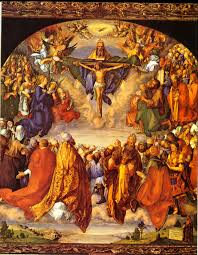
All Saints Day - a meditation

“The only tragedy is not to be Saint” – G.K. Chesterton

To have been a Christian during the Roman persecutions and to have witnessed the heroic deaths of fellow Christians had to have been a soul wrenching experience beyond compare. The Romans had been perfecting the art of human torture for centuries by the time the Christians provided more bodies to be tormented as entertainment.

It is all but impossible for the well-fed and reasonably safe American Christian to even begin to imagine the sufferings of those whose blood ran in rivers from the floor of the Roman Coliseum. It is not hard to imagine however how those who watched their fellow Christians suffer and die would have wanted to honor and remember them in some way.

For those who witnessed the Roman horrors perpetrated with the exacting scientific cruelty on the followers of Christ, the honoring of martyrs was more than just a service in their memory; it was an occasion to draw courage and grace from their heroic death, a death that they who were still alive were almost certain themselves to face.

Thus, from the earliest times, we can find many references honoring those who gave their life for Him who first gave His life for them. Initially, the martyr was honored annually on the day of his or her death. As the persecutions increased in fury, the number of calendar days that could be individually devoted to the memory of a particular martyr quickly ran out. This led to the eventual assigning by the Church of a common day to commemorate all the martyrs lest any be overlooked.

November 1 was first officially dedicated to the memory of All Martyrs (as it was originally called) by Pope Gregory III (731-741) and was officially extended to the whole Church by Pope Gregory IV (827-844) and our Church has kept this solemnity ever since.

Because, here in Guam, All Saints Day is not a Holy Day of obligation as it is in much of the rest of the Catholic world, one may lack the motivation to attend Mass and pay the Saints any special honor. Perhaps if we knew we were going to get hacked to death tomorrow or impaled on a spike and doused with pitch and set aflame to light up Nero’s garden we’d think a bit differently.

It’s hard for us to imagine such horrors sitting in our air-conditioned churches. But we may be yet called upon to suffer such things. May I suggest as preparation a reading of the following two books:

The Martyrs of The Coliseum - Historical Records of the Great Amphitheater of Ancient RomeBy: Rev. A. J. O'Reilly
Here is told both the fascinating history of the Roman Coliseum and the lives and deaths of many famous Roman martyrs, such as St. Ignatius of Antioch, St. Prisca, Pope St. Stephen, St. Vitus and companions, St. Marinus, St. Martina, etc. Tells the heroism of the martyrs, the cruelty of the Roman mob, and the incredible miracles God worked on behalf of His saints. Exciting and vivid even today. Impr. 441 pgs, PB


The Age Of Martyrs - Christianity from Diocletian (284) to Constantine (337) By: Abbott Giuseppe Ricciotti
In The Age of Martyrs, the famous Catholic historian Abbot Giuseppe Ricciotti records the epochal events of Roman history from the rise of Diocletian (284) to the death of Constantine the Great (337), a period which witnessed the last and greatest of the 10 persecutions of the Christians by the Roman government. Impr. 305 pgs, PB
Related Posts Plugin for WordPress, Blogger...