Friday, March 28, 2008

Teaching Calvary

This morning I was able to listen briefly to a program on the radio entitled “A Doctor at Calvary” which explored the sufferings of Christ in medical detail. I was only able to listen to a few calls from the listeners and the doctor’s response. (You can listen to the show here or see www.catholic.com > Radio > Calendar > March 21.)

A teacher called about how to get her 6th grade students to appreciate more deeply the sufferings of Christ. Another caller asked about whether or not a thorn had pierced the eyeball of Christ. Something struck me wrong about the whole deal and I turned it off.

At first I just attributed it to my personal squeamishness. But after I reached my office and sat down to do some spiritual reading before I started the day, the awareness of what really bothered me surfaced.

I happen to be reading Pope Benedict’s Journey to Easter – Spiritual Reflections for the Lenten Season (even though it’s after Easter – I didn’t finish it during Lent). I could go on in many paragraphs about how much I love what Benedict has to say and how he says it, but that’s not the point.

Benedict doesn’t take us through a medical tour of the crucifixion but a tour into the personal conversion that the sufferings of Christ were meant to effect. Not that I am opposed to such physical illustrations. I am a big fan and proponent of Gibson’s Passion of the Christ. But such graphic meditations have their place.

The question is whether or not exposure to, and how much exposure to, the blood, gore, and medical minutiae are really helpful in effecting the desired conversion. My personal opinion is that such exposure is not only NOT helpful but will produce the opposite effect if a person is not spiritually mature enough to assimilate it.

We don’t need to be child psychologists to see that exposure to violence does not repel but attracts. Thus the video games become ever more violent. Murderers need to murder again. Sadists need ever more sadistic experiences.

Violence is an addiction. Perhaps the best evidence of this is the so called Roman games. Perhaps in the history of humanity no more cruel human tortures have ever been devised than those that bloodied the floors of the Coliseum and other such venues throughout the Roman Empire. The records show the popularity of these games which is why the tortures were ever more sadistic. People loved it. They cheered for more and more.

To the untrained soul, exposure to the sufferings of Christ simply for the sake of effect or shock would simply harden the person, as it did the very soldiers who carried out the original brutalities.

We are not going to reach young people this way. We are going to reach young people the same way the saints before us have reached people of all ages, by carrying the cross ourselves and smiling while we do it.
For most of us carrying the cross isn't the issue. The smile is. See what you can do.

Friday, March 21, 2008

Wrists or Hands - an odd Good Friday meditation


Today, March 21, is Good Friday. The TV is tuned to EWTN and there is a cartoon version of the Sorrowful Mysteries on. The crucifixion scene shows Jesus with the nails through his wrists. Some children's books I have in my store also show Jesus with the nails through his wrists.

I don't have the time to research when this "nails through the wrist thing" got started, but I remember hearing about it in college. Seems to have started from some observation that a nail through the hand could not have supported a man's weight therefore it must have been through the wrist.

There are two problems with this:

1. There is a lack of evidence in sacred art. I don't claim to have done exhaustive research but as one who has traveled the world and visited many churches and prayed before many crucifixes and pictures of the crucifixion, I don't recall a single one (pre-1960's anyway) that shows the nails through the wrist. The same would be true of all the pictures in books (pre-1960).

2. Jesus doesn't say to Thomas (in John 20:27) "see my wrists". He says "see my hands".

The shroud seems to show that the nails were through the wrist, but the holes are actually through the bottom of the hand. I'll do more work on this later, as there are several scientific investigations of the shroud that positively identify the position of the nail holds and the effect on the position of the hand in death.

So, who cares? Wrist, hand, so what? He was crucified and that's all that matters. Right? Hmmm.

For anyone who has grown up with the traditional images of the crucifixion, the sight of a crucifix with the nails through the wrists can be quite jarring. I was personally "jarred", irritated actually, irritated to the point of being made curious as to the cause of my own irritation.

It occured to me that I've lived through a generation of "shocks" as regards the expression of the Catholic Faith, from the music, to the architecture, to the location of the tabernacle, to the vestments and vessels, the position of the altar, the ever evolving theatrics of what happens in what used to be the sanctuary, and now to sacred art and to the very image of the crucifixion, the central fact, the nucleic image, the ultimate icon of the Christian Faith, and the focus of all that is worship.

I don't pronounce these good or bad. For some this "fiddling" with the "stuff" of Faith may have provided some benefit to those who need a warmer, more welcoming, more factual, more scientific expression of the Faith, an expression that is supposedly more relatable to the modern mind.

Wonderful. "Shock" is only my personal and immediate, non-agenda driven gut reaction to such things. Luckily though these new "crucifixes" are so cartoonish (even the ones that are not in cartoons) that the crucifix itself evokes no meditation and thus the poor believer will not be forced long to wonder at the nails in the wrists.


Saturday, March 15, 2008

Pope Not Looking Just to Party at World Youth Day

Going to World Youth Day? Sounds like you better bring your knee pads. Pope B is stressing the importance of youth discovering the sense of "smallness before God" and coming "face to face with God's justice" in the Sacrament of Confession, and yes the word "Confession" is used (not Reconciliation). See: http://www.zenit.org/article-22037?l=english

I came into my young adult years (many years ago) at about the same time confessionals were being turned into storage closets and the word "sin" was being replaced with the likes of "failings" and "human weaknesses" which had the effect of lessening a sense of personal responsibility. As a consequence I went 23 years without going to confession. I was under the impression that I didn't need to.

Nothing in the language of my up to date religion courses (I went to Catholic school all the way through University) implied that confession was necessary. Along with "sin", the words "mercy", "pity", "reparation", "hell", "purgatory" and the like had also disappeared, not just from text books but from sermons, lectures, and general religious conversation. And while the mantra of "social justice" became the rallying chant of my age, the term "Divine Justice" all but disappeared.

I'm back to regular Confession thanks largely to it actually being made available on a regular basis (as opposed to making an appointment), but the sad part is what my life could have been had I not denied my soul for 23 years the forgiveness and grace Christ was waiting to give me in this Sacrament, not to mention the further damage that was done by my unworthy partaking in the Eucharist during this period. True, it may not have been completely my fault due to the lack of proper instruction, but the effect was the same: my soul was sick just the same.

But back to "World Youth Day". I'm thinking that this might be the last "World Youth Day". Not because the Pope is going to be too old for the next one, or that he is a party pooper, but because it is time to move on.

"World Youth Day" was a creation of John Paul II. In effect it was an "end run" around a generation (baby boomers mostly) who had become hardened, numbed, and obstinate by the licentiousness and rebellion that typified the life and times of that generation. JPII knew that the generation that had been wandering for 40 years in the post-Vatican II wilderness would not be the generation to cross into the promised land that Vatican II had envisioned.

It was an ingenious move and it worked. Today we are beginning to see great fruits from what has become the "John Paul II Generation": more vocations, increasing openness to life, closer adherence to the Magisterium, greater reverence for the mystery of the Eucharist, and more. In a sense, JPII, along with the voices of millions of young people, brought down the walls of what had become a geriatric Jericho and the Jordan has been crossed...or is being crossed. So why not continue on with something that is working?

Staying with our Exodus imagery, the whole point of God bringing the children of Israel (the youth) out of Egypt (the baby boom generation), was to establish His family. Thus I think it is time for "World Family Day". In fact, the members of the generation that JPII initially targeted are now raising families of their own. In other words, "mission accomplished". Now it's time to get onto the real business of the Church which is the nurturing of the Family itself and not just a segment of it.

The Church has always taught that it is the FAMILY that is the essential unit of society, the very image of the Trinity, God, Himself, present in the world. How great it would be to actually begin celebrating this eternal fact in universal concrete way. What a great sign that would be to the rest of the world.

Sunday, December 23, 2007

Happy Holidays or Merry Christmas?

This has become a battleground the last few years, with most Christians on one side and secularists on the other. So just for the fun of it I’m going to jump into the fray.

First, let’s look at “Happy Holidays”. Is there anything wrong with this greeting? Well, first we need to find out just what the “holidays” part of the greeting is referring to.

Assuming the common understanding of popular culture the “holidays” referred to is Christmas and New Years with the “eves” of both days thrown in. However, from a true Catholic perspective the “holidays” or “holy-days” would really be Christmas (which includes Christmas Eve) through perhaps the Feast of the Epiphany or the traditional “Twelve Days of Christmas”.

Either way, I see nothing wrong with wishing folks a “happy” anything be they the secular idea of Christmas and New Year’s, or the special days on the liturgical calendar.

But of course, what the “Merry Christmas” advocates have in mind is that “Happy Holidays” is being used by secularists to keep Christ out of the deal. This may or may not be true. Bing Crosby was singing “Happy Holidays” in the 40’s along with “White Christmas”. But let’s assume that the Christians are right about the secular conspiracy to keep Christ out of Christmas.

The question then becomes at what point on the calendar do we begin wishing folks a “Merry Christmas”? I have a protestant friend who claims that the Christmas Season begins on December 1. Others say “after Thanksgiving”. What should be the Catholic answer? When should we begin saying “Merry Christmas”?

Well, if you’ve read any of my other related entries on this topic, you know that I’m a stickler for “Advent” and for the keeping of Advent in a sort of “opposition to the world” sort of way.

As you know Advent begins 4 Sundays before Christmas and ends on Christmas Eve. So should we as Catholics be saying Merry Christmas when it is not only NOT Christmas, but also because we are in fact in the middle of a penitential season?

I don’t think there is any papal bull on the topic so I believe we are free to fumble around for the answer for ourselves. And here’s what I’ve come up with:

To Catholics I say (during Advent) “Have a Blessed Advent”. To non-Catholics I don’t say anything other than “hello” and “good bye”. Or if it gets close to Christmas I say “Have a Merry Christmas if I don’t see you” – thus projecting the greeting correctly into the future where it belongs.

Now if someone wishes me “Happy Holidays” I DO NOT say “Merry Christmas” back to them as if in protest or with a corrective tone.. Obviously that is just bad form and uncharitable to boot. So I say “thank you” or “the same to you”.

Lastly, I begin saying “Merry Christmas” on Christmas Eve and on through to the Epiphany. While the liturgical calendar shows that the real Christmas Season goes from Christmas Eve to the Baptism of our Lord, and thus we could technically (and liturgically) greet our fellow believers with a “Merry Christmas” right on into February, I think that we should at least do it until the Feast of the Epiphany or right on through the Twelve Days of Christmas.

So rather than put so much energy into battling with the “Happy Holidays” crowd before Christmas (Day), let’s just say “Merry Christmas” when we’re supposed to and thus give true witness to the Church that decided when Christmas would be in the first place.

Well, “Have a Blessed Advent” and “Merry Christmas if I don’t see you”.

Tim Rohr

Global Warming & Making Babies

Columnist Pat Sajak posted an article entitled Man-Made Global Warming: 10 Questions which you can read here: http://www.humanevents.com/article.php?id=24090&page=6&cp=1#hec75136

Basically he asks 10 perfectly common sense questions that should be answered before we start running around screaming “the sky is falling”.

I posted a comment that I’ll copy below. I’ve posted such comments before as regards this issue and have found no sympathizers with my position. I am also alarmed at how many Catholics are going “gah-gah” over Gore as our planet’s prophet.

We need to remember that Al Gore is VERY PRO-ABORTION. I don’t trust anyone who is “pro-abortion”. In my view they have sold their soul to the devil. But that’s just my view. Here’s my other one:

I'm on your side, but I think that even the skeptics will brush off my reason. I happen to believe that the global warming deal is just one more way to justify abortion. and by extension, birth control, which by more extension, is all about sex without consequences. The main thing is to convince people that there are too many people, that people and more people are the problem. We have to stop making people. Abortion can no longer be justified on its own. Too many people now know what a baby looks like in the womb, that its not just "matter". So now the pro-aborts need to come up with a good reason to kill babies. This is a good one. It works. Sadly even the "pro-life" folks are running around mouthing Gore-ian mantras. Sad. Fight back. Have more babies.

Saturday, December 15, 2007

SHOULD I GIVE TO THE SALVATION ARMY


Every year at this time we begin to see the very familiar sight of Salvation Army volunteers ringing their bells alongside the little red buckets. And every year, or at least for the last few, I have sent out the following reminder.

There is no doubt that the Salvation Army does great good in our society. However, the Salvation Army openly encourages the use of contraception and also supports abortion, although less openly.

Obviously, these are two activities of the Salvation Army that Catholics cannot support either directly, or indirectly, as would be the case with any donations either of time or money.

While one may argue in favor of the good the Salvation Army does as justification for your donation, the fact that there are comparable Catholic organizationsthat do not compromise Catholic Teaching, would negate any such justification and perhaps expose you to some form of moral culpability for what we know to be sinful.

For your reference I am copying the Salvation Army statements on Birth Control and Abortion directly from their website. I am also providing the link to the actual posting.

Pay close attention to how both the statements on Birth Control and Abortion begin with lofty sounding moral platitudes and scripture references but end up allowing for practices Catholics cannot accept.

This is especially dangerous because it’s harder to spot. A blatant pro-abortion organization is much easier to identify. The Salvation Army is a supposed Christian organization that uses Christian language to hide, intended or not, immoral practices.

One more thing: Such a position is not unique to the Salvation Army. Almost all non-Catholic Christian religions have similar positions. This is the logical result of Protestantism where the sole authority ultimately relies on one’s personal interpretation of Scripture and not on the Teaching Authority that Jesus himself has left us: His Church.


Birth Control

The Salvation Army believes that sex and its proper use is a gift, created, ordained and blessed by God and intended to find expression only within the context of a loving marriage relationship. The Salvation Army believes that sexual expression within marriage has a number of divinely intended purposes including: procreation (Genesis 1:28, 9:1,7); companionship (Genesis 2:18); unity (Genesis 2:24, Matthew 19:4-6) and pleasure (Song of Songs).

The Salvation Army supports the desire of many married couples to limit the number of children in their family and believes that there are morally acceptable, contraceptive solutions available to achieve this end. (emphases mine)

The Salvation Army encourages the use of birth control methods that are contraceptive (i.e. that prevent conception) versus the use of methods that are abortifacient (i.e. that prevent implantation after fertilization). The Salvation Army is opposed to abortion as a means of birth control. (emphases mine)

(Also, note how the SA tries to put a moral face on this by saying it supports those means which are “not abortifacient.” The bottom line is that we can’t always be sure, especially with chemical contraceptives, if in fact the baby is not actually killed.))

The Salvation Army does not oppose sterilization as a means of contraception. However, because it is generally irreversible in nature, such a procedure should be undertaken only after full consideration is given to spiritual, moral and practical ramifications. (emphases mine)

(The Catholic Church teaches that sterilization is “morally unacceptable” – CCC 2399)

Abortion

Note: The support of abortion is very well veiled but is apparent in the 4th paragraph in the words “Such decisions”. In other words, despite all the preceding rhetoric, the SA ultimately allows that abortion is licit when it is the result of an informed decision. In contrast the Catechism of the Catholic Church which affirms the “moral evil of every procured abortion” (CCC – 2271).

The Salvation Army believes in the sanctity of all human life and considers each person to be of infinite value and each life a gift from God to be cherished, nurtured and redeemed. Human life is sacred because it is made in the image of God and has an eternal destiny. (Genesis 1:27) Sacredness is not conferred, nor can it be taken away by human agreement.

The Salvation Army deplores society's ready acceptance of abortion, which reflects insufficient concern for vulnerable persons, including the unborn. (Psalms 82:3-4)

The Salvation Army holds to the Christian ideals of chastity before marriage and fidelity within the marriage relationship and, consistent with these ideals, supports measures to prevent crisis pregnancies. It is opposed to abortion as a means of birth control, family planning, sex selection or for any reason of mere convenience to avoid the responsibility for conception. Therefore, when an unwanted pregnancy occurs, The Salvation Army advises that the situation be accepted and that the pregnancy be carried to term, and offers supportive help and assistance with planning.

The Salvation Army recognizes tragic and perplexing circumstances that require difficult decisions regarding a pregnancy. Such decisions should be made only after prayerful and thoughtful consideration, with appropriate involvement of the woman's family and pastoral, medical and other counsel. A woman in these circumstances needs acceptance, love and compassion. (emphases mine)

When an abortion has taken place, The Salvation Army will continue to show love and compassion and to offer its services and fellowship to those involved.

Note: It is difficult to ignore the seeming moral superiority of this language of love and compassion. However, an innocent life has been taken. A murder has occurred. The SA allows for this and thus participates in grave moral evil. Make sure you’re not part of it.

Advent Thoughts

As you know, the true liturgical season of Christmas starts on Christmas, not ends with it. What most of society considers to be the Christmas Season, is in fact the Season of Advent.

So with all the “stuff” of Christmas surrounding us: the parties, the decorations, the music, the “happy holidays”, the shopping… what’s a Catholic to do? Do we ignore “the world” and ascetically hold out from the Christmas “busy-ness” that buzzes around us?

That’s not likely unless you live in a cloister. The world has co-opted the period between Thanksgiving and Christmas as its Christmas Season (the malls begin a little earlier), and let’s face it, most of us Catholics are shopping, partying, and decorating along with the rest of the world.

However, there’s nothing keeping us from keeping an “inner Advent”. The Advent Season is, liturgically, a time of preparation. The traditional means of preparation for the Church is prayer and fasting. And there’s nothing keeping us (most of us) from doing just that.

When I was kid (yes, in the “pre-Vatican II days”) I remember well that we were asked to give up something for Advent. One doesn’t hear much admonition to do that anymore. But whether we hear about it or not, it’s still a venerable and recommended practice.

In past years I tried to “fight back” against the world by refusing to put up a tree (or at least decorate it) until “the night before Christmas (that’s the traditional way). I tried to ignore the holiday buzz, avoided the malls, avoided saying “Merry Christmas”, and do whatever I could to at least keep some sort of an “exterior Advent”.

This year I gave up the fight. The tree was up in our house just after Thanksgiving. Christmas CD’s started playing. Lights were up all over the house. “Christmasy” movies were rented, etc.

However, this is probably my best personal Advent in a long time simply because I’ve decided to “return to my roots” and do exactly what the Church has said to do: fast and pray.

Now, I’m a wimp when it comes to real fasting, so I just decided to give up a few things (sweets – especially donuts, fried stuff, red meat, and beer). No real hunger, but just enough self-denial to remind me its Advent. And as you can see, it’s stuff I (and probably you, too) should do without anyway. (Well I’ll have to think about the beer.)

I’ve also put more emphasis on praying with the family (a nightly rosary or some other prayers and readings). Again, stuff we should be doing anyway.

The wisdom of the Church never ceases to amaze me. Even these terribly small acts of prayer and mortification (if I can even call it that!) have given me a certain something this Advent Season that I haven’t experienced in a long time, if ever.

I call it a “certain something” because I don’t have a name for it. It’s not joy or peace or any cliché sort of feeling. My real world troubles aren’t any lighter. The financial pressures of expecting an 11th child are more overwhelming than ever.

I also hurt my back a few weeks ago (just in time for Advent) and have been moving about in pain for awhile. The irony of the back injury is that it, of course, is coinciding with the busiest time of year for us at our store – where I am the primary employee as well as the owner.

I could go on, but I find my most frequent conversation with God is “Okay, Lord, what do you have in mind NOW?” I would call it a “broken record”, but I doubt there are very many folks out there in the Ipod generation who would even know what a “broken record” is.

So what is the “certain something”? Here I do the “prayer and fasting” thing and the troubles pile on. What’s up with that? I’ll just call it a certain peace that comes from knowing that you are doing what you are supposed to be doing regardless of the feelings that one may or may not have. (In my case it’s the “not have”.)

Also, I’ve noticed that there is an absence of despair or at least the temptation to it. I personally have many reasons to despair or at least descend into a chronic state of exacerbation. Perhaps it’s just a merciful numbness to the difficulties that swirl around me.

No matter. Thanks to the wisdom of the Church, my parents, and the Benedictine Sisters of yesteryear who imparted it to me, I know what is TRUE, and that is the greatest gift of all! Truth is the real source of peace and the original gift of Christmas.

I also have, for the first time in my life, an expanded understanding of Christmas. It’s the Church’s teaching, but I’m just getting it. (I’m 51, so it’s never too late for anyone to learn new stuff.) Here’s what I mean.

In the past I would read the readings and prayers and Advent admonitions that led up to Christmas with a certain attempt to be “thankful” for Christ’s coming. But to be honest I could never quite get “into it”. I kept trying to recreate the first Christmas in my mind and “get in the mood” as they say.

This year, I am beginning to understand Christmas the way the Church understands it: we celebrate the First Coming of Christ as a preparation and reminder of His Second. The real thing here is to “get ready”, to light the candles and turn the lights on not to just remember some stable scene that happened two millennia ago, but to get ready and be ready for Him who is coming again, and coming “like a thief in the night”.

We’re not just talking “end of the world” stuff or some sort of “Apocalypse Now”. We’re talking the end of “your world”, of “my world”. It’s called Death. Jesus is coming for us. It could be tonight, tomorrow, in the next 2 seconds for that matter. But He’s coming. Keep you lights on….and give up something while you’re waiting.

Mary Christmas

Tim Rohr
December 15, 2007

Tithing...and other stuff

A few days ago I was in conversation with a Protestant friend and the subject of tithing came up. He made the statement that “Catholics don’t tithe”.

Of course some Catholics do tithe (give 10% of their income to the Church). What he meant was, of course, that the Catholic Church doesn’t teach or at least emphasize a strict tithe as does his religious denomination.

I mentioned that the Catholic Church does not teach tithing because Jesus never did. There was a pause in the conversation. It’s difficult for folks who live by “sola scriptura”, who believe that the Bible is some sort of step by step manual for every move, to deal with glaring scriptural realities such as this one.

Jesus never negated giving and caring for the poor. Of course not, this was one of His primary messages. But He never used the word “tithe”.

Tithing wasn’t the main topic of conversation so I bounced over it and moved on.

A few days later, while researching a different topic altogether I came across some interesting stuff in the OT about tithing that one rarely hears about. The verses are so striking that I thought there must be some important commentary about this somewhere. However, neither the Jerome Biblical Commentary nor the Navarre Bible says much about it.

The scripture in question starts at Deuteronomy 14:22.

"Each year you shall tithe all the produce that grows in the field you have sown; then in the place which the LORD, your God, chooses as the dwelling place of his name you shall eat in his presence your tithe of the grain, wine and oil, as well as the firstlings of your herd and flock, that you may learn always to fear the LORD, your God.”

Now, if I was a protestant and took the whole teaching on tithing in the OT literally, I would see here that I am supposed to actually consume my tithe. But of course, people don’t bring grain and cattle to church these days, they bring money, so the consuming of the tithe wouldn’t literally apply, right? The following verses have something to say about that.

“If, however, the journey is too much for you and you are not able to bring your tithe, because the place which the LORD, your God, chooses for the abode of his name is too far for you, considering how the LORD has blessed you, you may exchange the tithe for money and, with the purse of money in hand, go to the place which the LORD, your God, chooses.”

Okay, so bringing cash instead of a cow is cool with the LORD. But now look what He says to do with the money!

“You may then exchange the money for whatever you desire, oxen or sheep, wine or strong drink, or anything else you would enjoy, and there before the LORD, your God, you shall partake of it and make merry with your family.”

Eh? What’s up with that? We’re supposed to party with it? Looks like either way, whether you bring the fixins’ or buy the fixin’s the main deal is to “eat, drink, and be merry” with your “first fruits”. The only stipulation is that the LORD is invited – that you “eat in His presence”.

Another shock to the fundamental literalist is the recommendation that we imbibe on “wine or strong drink”! As you know many of our non-Catholic brethren abstain from alcohol due to the admonitions in the scriptures against drunkenness. But looks to me like there’s a time to not only enjoy “strong drink” but to even get drunk! Consider the following form Proverbs 31:6-7:

"Give strong drink to him who is perishing, and wine to those in bitter distress; let them drink and forget their poverty, and remember their misery no more".

Now that’s interesting! According to the inspired word of God there are times when it is God’s will that you just get drunk and forget about it. Hmmmmmmmm.

Latin Lesson for 34th Sunday in Ordinary Time

May I recommend getting your own copy of the Daily Roman Missal (ed. James Socias). It’s a wonderful resource: readings for all Masses, weekday and Sunday, all 3 cycles, Proper of the Saints, Common Masses, Ritual Masses, a summary catechism, and loads of Devotions and Prayers. The beautiful leather binding and gold gilt pages make you want to respect what’s in it…something the disposable Missalette lacks.

But the feature that I most enjoy about the missal is its inclusion of Latin. The missal employs Latin alongside the English in the canon and also inserts it at the Responsorial and Alleluia verses.

While some do not see any reason to pay attention to the Latin, I personally find it absolutely fascinating. As you may know, Latin is our Catholic ancestral language (one of them – Greek is the other). Latin is also the official language of the Church. So if you want to know what the Church really says about something, you need to “go to the Latin”.

This is the same reason Biblical scholars “go to the Greek” – since it’s the language in which most of the Bible was written, or at least has come down to us. No serious student of the Bible doubts the importance of “going to the Greek” in any genuine study of the Bible. Thus, we shouldn’t doubt the importance of “going to the Latin” when we are searching for the truth in matters as regards our Liturgy and official Church teaching.

I am not a Latin scholar, but Latin resources are easy enough to come by these days. One particular resource is Latin Grammar – Grammar Vocabularies, and Exercises in Preparation for the Reading of the Missal and Breviary. Since we are at present more concerned with the study of Latin as it regards our Faith and not the reading of Virgil or Cicero, this book (and its companion “Second Latin”) would be an excellent and focused resource. Other excellent resources are only a click or two away online. But back to the topic at hand.

The side by side translations of the Responsorial and Alleluia verses sometimes amaze, amuse, or at least interest me. Here is an example.

This past Sunday, (34th Sunday in Ordinary Time, Cycle C), the Responsorial Verse reads:
“The Lord comes to rule the earth with justice.”
The accompanying Latin text reads:
“Venit Dominus iudicare populos in aequitate”.

Let’s do a word by word translation:

Venit - Venit is a third person singular perfect indicative active verb, and is the main verb of the sentence. Thus, we get: “came” or perhaps “has come”.

Dominus – Lord

Iudicare – to judge

Populos – people

In – in
Aequitate – equity or justice

The words are quite easy and almost a transliteration, thus you almost don’t need a dictionary.

The actual translation is:
“The Lord has come to judge the people in equity (justice)”.
And again, the English translation in the missal is:
“The Lord has come to rule the earth with justice”.
Since the English translation of the Lectionary is authorized by the USCCB we cannot question its legitimacy so we won’t. We can and should however dig more deeply into texts to better understand and grow from them just as a student of the Bible would want to get at the words behind the words to get a better sense of the biblical message.

In this case, I see the Latin giving us a full sense of God as Judge, something we don’t hear much about anymore, along with such related topics as sin, hell, purgatory, judgment, etc. I don’t know about you, but I need constant reminding about my “End”. Sometimes it’s the only thing that keeps me good. I’d like to say that I choose “Good” because I want to please God. But I don’t. Perhaps I’m not spiritually mature enough, so the “fear of the Lord”, helps me in times of great temptation.

But let’s continue the Latin Lesson just a bit more. Again, I in no way want to slight or slander the English translation as we must accept it as valid and licit. But the word study here is valuable.

There are those who may say “well, it may not be an exact translation but it still gives the same sense or the same meaning”. Maybe it does, but the bottom line is what the Latin actually says and what it doesn’t say.

The English uses the word “rule” instead of “judge”. In Latin, “to rule” is “regere”. There is no relation here to “judge”. It’s a completely different word with a completely different sense. Obviously the Latin wanted to stress that God will judge us … and that there is something to judge!

The English translation uses the word “earth” instead of “people” (populos). “Terra” is the Latin word for “earth”. While it could be argued that “earth” implies its human inhabitants why not just use “people” since that is what it actually says? Also, only “people” can be judged since only people have free will and thus something to judge. God won’t be judging the rocks and dirt.

The above discussion reveals an obvious attempt to “soften” the message of the scripture, something that happens quite frequently in the current Lectionary and in more contemporary versions of Scripture. While we cannot contend with the translator’s right to make such modifications, I believe we should ask ourselves if a “kinder, gentler” message is what our culture needs just now. I personally think not. Yes, God is infinitely loving and merciful. But He is also infinitely JUST. I wonder if we understand the implications of that.

The "Brothers of Jesus" and the Perpetual Virginity of Mary

The Perpetual Virginity of Mary is a DOGMA of the Catholic Church. A DOGMA is a teaching of the Church that is “binding” on the faithful. That means if you don’t accept it you’re outside the Church. Pretty serious stuff!

Non-Catholic Christians (NCC’s) generally do not accept this Teaching. They commonly reference Mt. 13:55: “And are not his brethren James and Joseph and Simon and Judas?” as evidence that Jesus had “brothers” and therefore Mary must not have been a perpetual virgin. Lesser known are the “sisters of Jesus” found in the very next verse: “And are not all his sisters with us?” (NRSV-CE) Wow! If you take the word “all” as in “all his sisters”, it sounds like not only was Mary not a perpetual virgin but that she must have been perpetually pregnant!

However, there is a problem with this assumption regardless of the number of the supposed siblings of Jesus: It’s NOT in the Bible! It is our NCC friends who make the claim that in order to believe something it has to “be in the Bible”. However, NOWHERE in the Bible does it ever say that Mary had other children. NOWHERE! Thus, by the NCC logic of “the Bible Alone”, there is simply NO scriptural evidence that Mary was not a perpetual virgin.

The common Catholic “apologetic” or response on this issue is to point out that in the language which Jesus spoke (Aramaic) there is no word for “cousin” and thus the word “brother” or “sister” was used to indicate a cousin relationship. While the “cousin” apologetic is correct, it seems to be rather ineffective as evidenced by the fact that it rarely convinces an NCC to the Catholic side. Thus it is probably much better to use their own doctrine “the Bible Alone” to show that irregardless of their belief about Mary’s Perpetual Virginity, there is no evidence in the Bible to the contrary. NCC’s will have to agree with you on that point.

But what of the brothers and sisters of Jesus? Yes, they could have been cousins, but they could also have been blood brothers. Many early sources, most notably the Protoevangelium of James, make reference to the fact that Joseph may have in fact been a widower and thus could have had children by a previous wife. Thus the “brothers” (and “sisters”) of Jesus certainly could have been his half-brothers (and sisters).

There is also another problem with the NCC thinking on this. Most NCC’s accept that Joseph died while Jesus was an adolescent. (The last time we hear of Joseph is in Luke 2 when he and Mary find the 12 year old Jesus teaching in the Temple.) It is interesting to note that no mention of siblings is made at this time. So if we stay with the “Bible Alone” approach of our NCC friends, then we have to assume that no siblings had yet been born.

However, by the time we get to the initial accounts of Jesus’ public ministry when He is approximately 30 years old, we, if we take the NCC interpretation of Mt. 13:55, have to accept that Jesus had at least 7 siblings: the four brothers, as named in the passage, plus at least 3 sisters (“all his sisters” implies that there had to be at least 3 – “all” implies more than one, and if there were only 2, the word “both” would have been used).

Doing the math, Joseph and Mary would have had to have had 7 more children in 18 years. Not impossible, however, Mt. 13 implies that at least the males are adults. Also, in order for the “sisters” to have been “here with us”, the girls probably were not infants, and must have at least been in their teens. So subtract at least 10 years from the 18 and we get 8, meaning Mary had to have had at least 7 children in 8 years. Also not impossible, but then we’d have to believe that either Mary found another husband after Joseph died or Joseph must have lived a lot longer (and have been a lot healthier!) than what 2000 years of tradition (both Catholic and NCC) has left us.

It is hoped by now that you deem all this adding, subtracting, assuming, and implying to be a bit ridiculous. It is. And that’s why our Church has not cared to address it. It also demonstrates what happens to those outside our Church who do not have any authority other than their own private interpretation of Scripture.

The Catholic Church has the authority of Christ who did not leave us a Bible, but a Church, and a teaching authority for that Church, which He meant to continue and protect until the end of time (Mt. 16:13). And that same Church has proclaimed Mary as “Ever-Virgin”. There is simply no evidence, Biblical or otherwise, to the contrary.

A personal note to Catholics: While it is encouraging to see a great interest among Catholics in “Bible Study” it is proportionately discouraging to see a great lack of interest in “Doctrinal Study” or a study of what our Church teaches, particularly those teachings which come from the chair of Peter which Jesus himself established. The two studies certainly do not have to be opposed. In fact, they are not. They are part of one and the same teaching and good for those who understand and teach in this way.

Friday, November 02, 2007

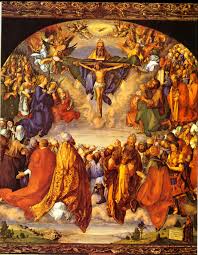
All Saints Day - a meditation

“The only tragedy is not to be Saint” – G.K. Chesterton

To have been a Christian during the Roman persecutions and to have witnessed the heroic deaths of fellow Christians had to have been a soul wrenching experience beyond compare. The Romans had been perfecting the art of human torture for centuries by the time the Christians provided more bodies to be tormented as entertainment.

It is all but impossible for the well-fed and reasonably safe American Christian to even begin to imagine the sufferings of those whose blood ran in rivers from the floor of the Roman Coliseum. It is not hard to imagine however how those who watched their fellow Christians suffer and die would have wanted to honor and remember them in some way.

For those who witnessed the Roman horrors perpetrated with the exacting scientific cruelty on the followers of Christ, the honoring of martyrs was more than just a service in their memory; it was an occasion to draw courage and grace from their heroic death, a death that they who were still alive were almost certain themselves to face.

Thus, from the earliest times, we can find many references honoring those who gave their life for Him who first gave His life for them. Initially, the martyr was honored annually on the day of his or her death. As the persecutions increased in fury, the number of calendar days that could be individually devoted to the memory of a particular martyr quickly ran out. This led to the eventual assigning by the Church of a common day to commemorate all the martyrs lest any be overlooked.

November 1 was first officially dedicated to the memory of All Martyrs (as it was originally called) by Pope Gregory III (731-741) and was officially extended to the whole Church by Pope Gregory IV (827-844) and our Church has kept this solemnity ever since.

Because, here in Guam, All Saints Day is not a Holy Day of obligation as it is in much of the rest of the Catholic world, one may lack the motivation to attend Mass and pay the Saints any special honor. Perhaps if we knew we were going to get hacked to death tomorrow or impaled on a spike and doused with pitch and set aflame to light up Nero’s garden we’d think a bit differently.

It’s hard for us to imagine such horrors sitting in our air-conditioned churches. But we may be yet called upon to suffer such things. May I suggest as preparation a reading of the following two books:

The Martyrs of The Coliseum - Historical Records of the Great Amphitheater of Ancient RomeBy: Rev. A. J. O'Reilly
Here is told both the fascinating history of the Roman Coliseum and the lives and deaths of many famous Roman martyrs, such as St. Ignatius of Antioch, St. Prisca, Pope St. Stephen, St. Vitus and companions, St. Marinus, St. Martina, etc. Tells the heroism of the martyrs, the cruelty of the Roman mob, and the incredible miracles God worked on behalf of His saints. Exciting and vivid even today. Impr. 441 pgs, PB


The Age Of Martyrs - Christianity from Diocletian (284) to Constantine (337) By: Abbott Giuseppe Ricciotti
In The Age of Martyrs, the famous Catholic historian Abbot Giuseppe Ricciotti records the epochal events of Roman history from the rise of Diocletian (284) to the death of Constantine the Great (337), a period which witnessed the last and greatest of the 10 persecutions of the Christians by the Roman government. Impr. 305 pgs, PB

Never stop praying for me


“Never stop praying for me."
- Elmer P. Rohr (to his 11 children)


Here on Guam, All Souls Day is probably celebrated with more activity and official recognition than any other place in the world except maybe the Philippines. The customs are quite beautiful: cemeteries are cleaned up, tombs are repainted, special Masses are said, flowers and bouquets are arranged about the plots, and candles light up the cemeteries for the next several nights.

The local government (and some private firms) even grants a holiday so that appropriate honor can be paid to each family’s dead. However, we should continue to remind ourselves that the purpose of All Souls Day is not to just honor the dead but to of course to pray for them.

And, why do we need to pray for them?

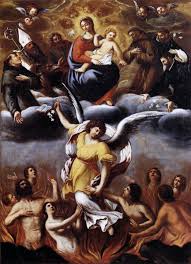
It has been said by more than one saint who was gifted with the vision of Purgatory that one moment of pain in its purifying flames is so great that it is unimaginably more painful than all the sufferings combined of a whole lifetime on this earth.

While the Church does not solemnly define the nature of the suffering a soul experiences in purgatory, the Church does declare 1) that souls do suffer in purgatory (The Church Suffering is the official title), and 2) they can do nothing to help themselves.

Because these souls are suffering and because they can do nothing of themselves to lessen their pains or shorten their time of purgation we are bound by charity to pray and even suffer for those souls.

In the past, the general Catholic consciousness of the helpless state of these souls was much more pronounced. My mother and teachers (Catholic school) never missed an opportunity to remind us to “offer it up for the poor souls in purgatory” whenever we kids experienced some sort of pain or discomfort.

It was also quite common to see or hear a death announcement accompanied by the words “please pray for the repose of the soul of…”. Funeral masses and masses for the dead (Requiems) complete with black vestments had a very sober and solemn tone to them, by which we were reminded that our loved one(s) may not yet be in heaven and that we should never cease praying for them.

Today, one not only rarely hears the admonition to offer up the pain from the splinter in your finger for the poor souls, but we quite often hear, even from practicing Catholics, some doubt or question as to the existence of purgatory (“Didn’t Vatican II do away with Purgatory?”).

It is my opinion that most Catholics can be forgiven for thinking such things. While there is usually a long list of “animas” (mass intentions for the souls of the dead) before each Mass, the level of catechetical understanding of the connection between those intentions and the suffering state of Purgatory is questionable.

Death announcements no longer read “please pray for the repose of the soul…” but happily proclaim: “in celebration of his new life”. Eulogies and homilies tend to “beatify” the person. Funeral and memorial masses are celebrated in white vestments and with a positive air.

While white vestments are legitimate and we should certainly celebrate our hope in the eternal happiness of heaven, the odds are that the person who just died, unless he or she was martyred, is probably not there yet, and may in fact be delayed in arriving there by our “he’s in a better place now” attitude..

Minus the sobering reminders of the probable state of the soul of our dearly departed and further confused by the “popular canonizations” (“In celebration of his new life…”) we may in fact neglect to pray for the person’s soul and thus leave him or her to the pains of purgatory longer than may have been the case if we were to have beseeched God with prayers and sufferings as indeed we are commanded to do.

My paternal grandfather, who celebrated the body and blood of Jesus at church in the morning with the same intensity as he celebrated homemade sausage and cider in the cellar at night, admonished his 11 children, long before death was upon him, to “never stop praying” for him after he died.

I continue to be amazed at the “awareness” of former generations as to the reality and sufferings of purgatory as contrasted with what seems to be a complete loss of this sense today.

Of course the Church has not changed its teachings. What it did do was change its practices. And therein lies another testament to the maxim that “what you do speaks so loudly that what you say I cannot hear”. Regardless of what the Catechism and the most orthodox of teachers continue to say, we simply do not “hear” because what we “see” speaks louder. How else to count for the seeming overwhelming belief that purgatory no longer exists and the preponderance of announcements celebrating “his new life” versus “please pray for the repose of the soul…” ?

As a graduate of a rather “liberal” institution in the early 80’s I got sidetracked from my childhood faith and fell in under the popular teaching that if there was a purgatory, it was just a place to stop and get “cleaned up”, and even if there was a Hell there was probably nobody in it.

But that’s not what the Church teaches. There is in fact a hell, a “lake of fire” and there is in fact a Purgatory. As to what actually happens there (in Purgatory) we know nothing other than it is a place of final cleansing.

I suppose we are welcome to believe that it is some sort of cosmic Motel 6 where we can stop and get a shower along the way. But I would much rather trust the accounts of the saints who saw it for themselves even if the Church gives no official credence to those accounts.

For those who don't accept the existence of Purgatory or don't understand it see my other post on Purgatory here. If nothing else it has a good joke about it.

For more information on these accounts see:

Purgatory Explained By: Fr. F. X. Schouppe S.J. You would never dream so much is known about Purgatory. Not only is the basic teaching of the Church given here, but also countless true stories of apparitions and revelations on Purgatory from the lives of St. Margaret Mary, St. Gertrude, St. Bridget of Sweden, the Cure of Ars, St. Lidwina of Schiedam, etc.


Stories about Purgatory & What They Reveal By: An Ursiline of Sligo. This book was written to impress upon its readers many truths about Purgatory -- first, that it exists; second, that the souls detained there suffer long and excruciating pains, and that they desperately need our prayers and sacrifices; and that we ourselves should strive mightily to avoid Purgatory. Confirms in the reader's heart a healthy and holy respect for the sufferings endured by the Holy Souls, such that he will always remember them in his prayers. Impr. 169 pgs, PB


Purgatory By: Fr. Frederick Faber. Is Purgatory almost like Hell? Or is it a place of peace and even joy? The famous Fr. Faber explains both of these classic Catholic views of Purgatory, basing his discussion on Catholic teaching and the revelations of saintly souls, especially St. Catherine of Genoa, in her Treatise on Purgatory. Impr. 85 pgs, PB

Saints Who Raised the DeadTrue Stories of 400 Resurrection Miracles By: Rev. Albert J. Hebert. Stories from the lives of St. Francis Xavier, St. Patrick, St. John Bosco, St. Catherine of Siena, St. Teresa of Avila, St. Elizabeth of Hungary, St. Rose of Lima, Bl. Margaret of Castello, etc. Includes the raising of persons who had died, descriptions of Heaven, Hell and Purgatory by temporarily dead persons and an analysis of contemporary "after death" experiences. Many pictures of the saints and their miracles. Fascinating. Formerly published by TAN under the title "Raised from the Dead".


The Life of St. Gemma Galgani By: Venerable Fr. Germanus C.P. St. Gemma Galgani (1878-1903) was a mystic, stigmatist, visionary, ecstatic, victim soul, discerner of spirits, seer of hidden things, prophetess, spouse of Christ, zealot for souls and devotee of the Poor Souls in Purgatory. She died at only 25. Her mother was also saintly, and it is beautiful to see how she helped cultivate this lily of purity. See how Gemma made great sacrifices painful to human nature from her tenderest years. Inspiring and edifying! Impr. 349 pgs

Also see the Diary of St. Faustina. Here's a link to her entries on Purgatory.

Tim Rohr
Feast of All Souls, 2009


Related Posts Plugin for WordPress, Blogger...