Thursday, March 04, 2010

Who to Vote For...Continued


This is a post regarding the upcoming special election on Guam on March 20, 2010. The post was sent as an email. It can be read here.

Four Points on Bill 185

Go here

Wednesday, March 03, 2010

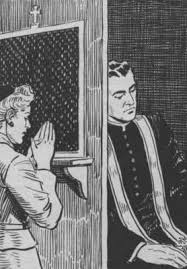
Why Confess Our Sins to a Priest


"I don't need to confess my sins to a man, I confess my sins directly to Jesus."

It's a common retort from those who reject the Catholic teaching on the Sacrament of Confession. And it sounds logical. Since only God can forgive sin, then it would seem reasonable not to bother with anybody in between. Might as well go straight to God.

The problem is that Jesus never tells us to confess our sins to him. As a matter of fact James tells us to "confess our sins to one another" (James 5:16). Now, James, we believe, was one of the Apostles. He was either passing on what he knew Jesus wanted, or he was telling a lie. If he was telling a lie, then all Scripture would be suspect. Obviously we cannot accept that.

So the next question is "who is the one another?" that James is referring to? On the face of it it could mean just anybody off the street. Obviously he didn't mean just anybody, so who he did he mean?

Like so many questions about the Scriptures, the answer is easy when put into context of the neighboring verses. Two verses before, James is advising the physically sick to seek out the "presbyters". Two verses later he is addressing the spiritually sick, those who need to confess sin. It's easy to see who James was referring to. But who were the presbyters?

In short they were overseers, men especially delegated to overseeing and ministering to a local Christian community. In any event, they were granted a special authority to stand in place of the bishop, who then, as today, had the full authority that was granted to the Apostles.

So let's review. 1. We are not told to confess our sins to Jesus. 2. We are told to confess our sins to "another". 3. Since it can't be just any other, we see in context that the other is a "presbyter".

But if only God can forgive sins then what's up with confessing to another human?

It's a simple matter of taking Jesus at his word in John 20:23 where he says to the Apostles gathered in the upper room "Receive the Holy Spirit. Whose sins you shall forgive are forgiven and whose sins you shall retain are be retained."

Here Jesus gives the Apostles the power to forgive sins. It's interesting to note that, at least in this Gospel, this is Jesus' VERY FIRST action upon rising from the dead, which should give us a clue as to how important the power given to the Apostles was and still is.

If Jesus had wanted us to only confess our sins to himself he wouldn't have given the power and the command to the Apostles that he did. We should also note that the sins must be confessed audibly since only then would the Apostle know whether the sin should be forgiven or retained.

There is no doubt from Scripture that Jesus gave the power to the Apostles to forgive sins. The question is did that authority to forgive or retain sin pass on or did it die with the Apostles? The fact that James is instructing his audience to confess sin to one another indicates that the authority had descended from the Apostles and had been granted to others.

Today, by virtue of his ordination and the laying on of hands,that goes all the way back to the Apostles, the priest, the descendant of the "presbyter", has the authority to forgive or retain sin in the name of Jesus Christ who first gave that authority to a group of specific men.

Here is an excerpt from the Catechism of the Catholic Church regarding the Church's teaching on the Sacrament of Penance.

VI. THE SACRAMENT OF PENANCE AND RECONCILIATION

1440 Sin is before all else an offense against God, a rupture of communion with him. At the same time it damages communion with the Church. For this reason conversion entails both God's forgiveness and reconciliation with the Church, which are expressed and accomplished liturgically by the sacrament of Penance and Reconciliation.38

Only God forgives sin

1441 Only God forgives sins.39 Since he is the Son of God, Jesus says of himself, "The Son of man has authority on earth to forgive sins" and exercises this divine power: "Your sins are forgiven."40 Further, by virtue of his divine authority he gives this power to men to exercise in his name.41

1442 Christ has willed that in her prayer and life and action his whole Church should be the sign and instrument of the forgiveness and reconciliation that he acquired for us at the price of his blood. But he entrusted the exercise of the power of absolution to the apostolic ministry which he charged with the "ministry of reconciliation."42 The apostle is sent out "on behalf of Christ" with "God making his appeal" through him and pleading: "Be reconciled to God."43

Reconciliation with the Church

1443 During his public life Jesus not only forgave sins, but also made plain the effect of this forgiveness: he reintegrated forgiven sinners into the community of the People of God from which sin had alienated or even excluded them. A remarkable sign of this is the fact that Jesus receives sinners at his table, a gesture that expresses in an astonishing way both God's forgiveness and the return to the bosom of the People of God.44

1444 In imparting to his apostles his own power to forgive sins the Lord also gives them the authority to reconcile sinners with the Church. This ecclesial dimension of their task is expressed most notably in Christ's solemn words to Simon Peter: "I will give you the keys of the kingdom of heaven, and whatever you bind on earth shall be bound in heaven, and whatever you loose on earth shall be loosed in heaven."45 "The office of binding and loosing which was given to Peter was also assigned to the college of the apostles united to its head."46

1445 The words bind and loose mean: whomever you exclude from your communion, will be excluded from communion with God; whomever you receive anew into your communion, God will welcome back into his. Reconciliation with the Church is inseparable from reconciliation with God.

The sacrament of forgiveness

1446 Christ instituted the sacrament of Penance for all sinful members of his Church: above all for those who, since Baptism, have fallen into grave sin, and have thus lost their baptismal grace and wounded ecclesial communion. It is to them that the sacrament of Penance offers a new possibility to convert and to recover the grace of justification. The Fathers of the Church present this sacrament as "the second plank [of salvation] after the shipwreck which is the loss of grace."47

1447 Over the centuries the concrete form in which the Church has exercised this power received from the Lord has varied considerably. During the first centuries the reconciliation of Christians who had committed particularly grave sins after their Baptism (for example, idolatry, murder, or adultery) was tied to a very rigorous discipline, according to which penitents had to do public penance for their sins, often for years, before receiving reconciliation. To this "order of penitents" (which concerned only certain grave sins), one was only rarely admitted and in certain regions only once in a lifetime. During the seventh century Irish missionaries, inspired by the Eastern monastic tradition, took to continental Europe the "private" practice of penance, which does not require public and prolonged completion of penitential works before reconciliation with the Church. From that time on, the sacrament has been performed in secret between penitent and priest. This new practice envisioned the possibility of repetition and so opened the way to a regular frequenting of this sacrament. It allowed the forgiveness of grave sins and venial sins to be integrated into one sacramental celebration. In its main lines this is the form of penance that the Church has practiced down to our day.

1448 Beneath the changes in discipline and celebration that this sacrament has undergone over the centuries, the same fundamental structure is to be discerned. It comprises two equally essential elements: on the one hand, the acts of the man who undergoes conversion through the action of the Holy Spirit: namely, contrition, confession, and satisfaction; on the other, God's action through the intervention of the Church. The Church, who through the bishop and his priests forgives sins in the name of Jesus Christ and determines the manner of satisfaction, also prays for the sinner and does penance with him. Thus the sinner is healed and re-established in ecclesial communion.

To read more, go here.

Monday, March 01, 2010

Posing a Roadblock to Gay Adoption

As documented in a CNS story dated 2/22/10, Catholic Charities of the Archdiocese of Washington D.C. will close its 80 year-old foster care and adoption program. The recent passage of a new law allowing same-sex marriage would have required the adoption program to treat different sex and opposite sex married couples equally in considering foster and adoptive parents for children, something the Catholic Church cannot do.

Proponents of same-sex marriage or its legal equivalent are constantly challenging opponents with the question "How does this affect you?" Those who are neutral about it are inclined to the "let them have their rights" attitude.

But time and again we see where this inversion of the most fundamental of all societal institutions, an institution upon which society itself is built and therefore precedes and pre-dates all societies and political orders, creates ethical dilemmas heretofore never imagined.

The current story poses one of the most glaring dilemmas. It's one thing for same-sex couples to want to share their life together. It's another thing to insert a child into that life. It's not a question as to whether same-sex couples can provide for the child. It's a question of whether or not forcing the child into a parent-child relationship with a same-sex couple is good for the child.

In short, will it be good for the child to see daddy and daddy in bed together. (What child hasn't stumbled upon an intimate moment between parents?)

Gays and lesbians make the claim that they are genetically wired towards same-sex attraction. Barring all the evidence to the contrary, let us grant them this point and ask "what about the child?" What if the child that they adopted is NOT "genetically wired" that way? How healthy is it for that child to be subjected 24-7 to a parental model that is the very antithesis of his or her physical and psychological being?

Gays will want to make the same point, that subjecting a child who may be "genetically wired" towards the same-sex, to an opposite-sex parental model, is just as unfair and unhealthy.

But in this argument, the gays and lesbians have laid their own trap. Since the entirety of their argument for gay rights as civil rights is based on something they consider to be an immutable characteristic, a gay gene, then before gays and lesbians are allowed to adopt a child, the child, out of respect for the civil rights of the child, must be first genetically tested and his or her gender identity genetic predisposition determined.

Of course, this cannot be done. There is no test because there is no gene. Gays will argue otherwise, but science has no test for a gay gene that could be used to determine the gender identity of a child.

And since the child to be adopted is the product of a man-woman relationship, whatever the defects of that relationship, the child then has a civil right to be placed in a child-parent relationship that most resembles his or her own biological origins. It is on this basis, on the rights of the child, that gay adoption, under any circumstances, must be denied.

Some may question if this affects adoption by singles. This too poses a dilemma, but again, one which is easily answered if the rights of the child are considered to be primary.

While some may not subscribe to the document, few intelligent people would argue with the basic demands of the United Nations Convention on the Rights of the Child. Article 7 states that the "child has a right to know and be cared for by his or her parents."

In the case of an abandoned or orphaned child, the law of "being cared for by his or her parents" guides us to the next best possible solution where the child is cared for by the next of kin, something that has happened naturally for millenia.

Barring that possibility the next best situation for the child would be adoption or at least foster care by a married man and woman, again, the decision being guided by the rights of the child "to know and be cared for by his or her parents". The (married) man/woman/child model best approximates the natural family and best serves the rights of the child.

Guam Adoption Law: 19GCA Ch. 4, Article 2

Friday, February 26, 2010

Bad Mouthing Gold...Again

In our local diocesan paper this week, in a column written by a member of the clergy, the
pursuit of wealth is once again impugned in favor of the "Golden Rule."

I say "once again" because the pursuit of wealth is a favorite "whipping boy" of the clergy. Time and again materialism, wealth generation, and business in general is castigated from the pulpit.

I have no doubt of the good intentions of the particular column, i.e. encouraging charity, etc. However, it's time our clergy begin to think of some new ways to encourage it without the obligatory swipe at the making of money.

The author contrasts gold with the Golden Rule. In doing so, he equates gold, and the pursuit of gold, with all that is wrong with the world: greed, lust, power, envy...the usual suspects.

I don't have time to do a whole Bible study here, but God commands the use of gold in the making of the tabernacle, the ornamentation of the temple, etc. In Revelations we find Jesus himself in a gold sash, as well as many references to gold. The Church requires that gold, or at least silver, be used for the liturgical vessels, etc.

I don't mean to be disrespectful here, but "Father" is going to be able to eat tonight and sleep in a bed. I don't have the same guarantee. Everyday I must find ways to "find gold" in order that my children can eat and sleep in safety.

The standard reply to my "need for gold" is "fine, as long as it is not excessive". But who get's to decide that? If I go out and buy an expensive house that is bigger than what "I need" or what others think I need, I would be judged, by common clergy standards, as being materialistic.

But how many people got to feed their families because I bought a house, regardless of whether or not it is what I need or not? How many people worked on that house and got paid because someone was going to buy that house? How about the people who may be hired to keep up the house and the yard? I could go on.

What amazes me most is that despite the tongue lashing the business community gets at Mass on a regular basis, the business community is the first people pastors will go to when they need something that costs money.

Let's stop the hypocrisy and the assumptions. On a material level, many of the clergy live better than we lay folks do. They have a place to stay, guaranteed meals, health insurance, and some degree of retirement security. Most of us have none of that, especially those of us who have children, lots of children.

Again, I understand Father's intention. But really, it's time to find another way of elevating charity other than demeaning those of us who must "pursue gold" every day.

Wednesday, February 24, 2010

Why Only Two

Bill 158 (Guam) will require that the words "between one man and one woman" be added to The Contract of Marriage in the Guam Code. While the introduction of this bill has set off a predictable battle between those who would defend this definition and those who would oppose it, the next level of argument will be "why only two?"

Polygamy has a much wider and deeper pedigree than does same-sex marriage. For most Americans polygamy is a thing of the biblical past or perhaps an oddity of Mormonism. However, according to some studies, polygamy today is accepted and practiced by as much 78% of the world's societies.

In fact, polygamy has always been the norm, which is why Christ's teaching on the matter was so radical and remains radical today. Essentially, marital monogamy as a key societal institution, is a Christian legacy. Even the Supreme Court has said so.

In an 1890 Supreme Court decision against plural marriage, Justice William O. Douglas wrote that polygamy was "contrary to Christianity and to the civilization that Christianity has produced in the western world". (Obviously he didn't know about the separation of church and state.)

If our laws are no longer to be informed by Christian moral teaching, as we are consistently reminded by the proponents of same-sex legislation, then we must ask "Why only two?". If marriage is simply reduced to a legal contract between two people who care about each other then why not three people who care about each other?

This is not an "illogical extreme". The U.S. Supreme Court recently (2007) declined to hear a case involving a Utah man's claim that laws banning polygamy are a violation of his First Amendment religious rights and unequal treatment under the law.

While the Court may have declined to hear the case, the fact that it made it to the Supreme Court is telling of what is to come and validates Justice Scalia's warning that the Court's previous "signing on to the homosexual agenda" would pave the way for challenges to laws against polygamy, incest, and in fact all laws governing sexual conduct. (Lawrence vs Texas, 2003 - dissenting opinion)

Get ready Guam.

Wednesday, February 17, 2010

The Problem with "Ashes"


The song "Ashes", which has become the unthinking insert into every Ash Wednesday Mass for the last 20 or so years, is tuneful, poetic, memorable...but is it liturgical?

The tune has drawn its share of criticism over the years, especially for the line "we rise again from ashes to create ourselves anew".

I'm sure the writer was just trying to make the syllables fit the meter and not attempting to insert a new doctrine into the Catechism (i.e. we don't "create ourselves" - in the strict sense). And, also, in the wake of post Vatican II "feel-good-ism" in which the tune was written, the song fit the mold: an emphasis on "I", "We", "Us" (God is not mentioned until the 4th verse.)

But most of the hoopla over the supposed heresy of the problem lyric seems to have masked the real issue with the song and that is that it doesn't have anything to do with the significance of the distribution of ashes.

The song repeats over and over "an offering of ashes, an offering to you". However, what happens on Ash Wednesday is the "imposition of ashes", not the offering of them. We are not offering ashes to the Lord. On the contrary, the Lord, through the hand of His ordained minister, is imposing ashes on our forehead, marking us for a season of penance.

While its possible to draw a connection between the offering of ourselves to God and the admission that we are but dust and ashes, the believer would be forced to jump through a couple of doctrinal hoops, a complicated move that just isn't necessary in this simplest of ceremonies.

Most of us probably don't give the problem lyrics a 2nd thought. We like the melody, and the words feel warm and meaningful. Thus it will be sung (probably) at every Ash Wednesday Mass (on Guam, at least), during the imposition of ashes.

The problem is that we have some serious issues in our Church that can be traced to a very simple cause: a lack of catechesis, and in many cases, wrong catechesis. So what's the connection?

Any teacher (or parent) will tell you that the quickest way to teach a child to memorize something is to make a song or rhyme of it. Thus little ditties like "A-B-C..." to help children memorize the alphabet, etc. It's true for adults too. It's called a "mnemonic device".

Thus despite the multitude of hours, resources, and effort poured into classroom catechesis, we pretty much undo it all by the songs we sing at Mass because the song "sticks", the lessons don't. "Ashes" is just one example. The pleasant melody masks "wrong catechesis", but it's what we remember...and repeat. And what we repeat...we remember.

Today (Ash Wednesday, 2010) you'll probably catch yourself humming the tune or playing it over and over in the "tape recorder in your head" (if you went to Mass). Meanwhile, the words are sticking to your brain: "we rise again from ashes...etc."

And by the way, that's another one. We don't "rise". We will be "raised", but we don't rise of our own accord. Only Jesus could do that.

Yes, I'm aware that the "we rise..." is really just poetic language symbolizing our cooperation with God's grace in becoming all that we can be, etc. But once again, it's symbolism over substance. And the real substance of Ash Wednesday is not about what we do or we will do, but about what He is about to do... for us.

Saturday, February 13, 2010

Valentines Day and the Protestant Predicament


Valentines Day is named after one or more early Christian martyrs named Valentine and was established by Pope Gelasius I in 496 AD. To read a rather decent and succinct history of Saint Valentine on Wikipedia go here. For a more lengthy article in the Catholic Encyclopedia, go here.

To the point though of the title of this post. At issue is the fact that Valentine's Day is in fact Saint Valentine's Day, a feast day added to the Roman Calendar, as mentioned above, by a Pope.

As we know, most non-Catholic Christians (actually all non-Catholic Christians that I know of) do not recognize either the authority of Rome (the Pope) nor the Catholic practice of honoring saints, which some consider a form of idolatry.

Yet, just about everbody I know (except Jehovah's Witnesses) "celebrate" Valentines Day - Saint Valentines Day.

Of course, they don't think of Valentines as the feast day of a Catholic saint, and if pressed, would probably respond that they emphasize the expression of love, etc., and the tradition of the day, and are definitely not honoring this early Christian martyr. (One might wonder what could be wrong with honoring an early Christian who suffered and died for Christ - but so be it.)

Sadly, many Catholics have no clue either...and think nothing of the Saint. The Church itself took Valentine off the calendar in 1969, not because he was demoted from sainthood (can't do that), but because nothing much was known about him, and in the competition for space on the ever-crowding calendar of saints and feastdays, he was let go...or more precisely, left up to local ordinaries (bishops) who are to decide to honor him or not.

One nice thing about being a "Traditional Catholic" (i.e. "Latin-Masser") is that Valentine is still on the calendar and we honor his love for Christ written into history in martyr's blood.

In any event, Valentines is a feast day honoring a Catholic saint, instituted by a Catholic Pope, and kept alive for the better part of 2 millenia by the Catholic Church. Whether our non-Catholic friends, or Catholics for that matter, pay the real Valentine any attention, does not alter the truth about the day and about the man, and about the Church that enshrined him.

But having made a note of this, we should also note that the Catholic Church is responsible for also choosing the dates for both Christmas and Easter (and Easter changes every year). I don't mean to pick a bone here, but the celebration of Christmas and Easter on the dates chosen by the Catholic Church in general, and a Pope in particular, is an implicit admission of the authority of the Catholic Church and the Pope, at least in this matter.

However, if one is to reject this authority outright, as some non-Catholic demoninations do, then intellectual honesty would demand that such objectors make their own dates for Christmas and Easter. But since that probably won't happen, I'm sure Pope Benedict has no issue with ya'll using his calendar.

Happy Valentines Day

4 Reasons Not To Pass Bill 185

Published in the PDN on 2/1/2010

The Pacific Daily News lead editorial on January 25 called for the passage of Bill 185 into law. The editorial contends that same-sex couples deserve the same marital rights and privileges as different-sex couples. In response, I would like to make four points.

First, the government is not in the business of arbitrarily handing out rights and privileges. If privileges are granted, then something is expected. In the case of different-sex married couples, the state expects the marital unit to produce, educate, and socialize the next generation (sterile couples notwithstanding). The state is willing to grant certain protections and incentives to the marital unit because the state understands that should the marital unit fail, the burden of of producing, socializing, and educating that next generation would fall to the state.

In fact, producing the next generation is what was emphasized in the oft-cited Loving vs. Virginia and its precedent case Skinner vs. Oklahoma. In these cases, the courts acknowledged marriage as a "civil right" but only in connection with "procreation" (Skinner) and the "survival of society" (Loving). The courts said nothing about the right to marry because two people love each other.

Second, civil rights apply to individuals, not to corporate entities - which a marriage is.The fact that married people can see to the affairs of each other is not a matter of civil rights, but a matter of corporate and legal agreement. There is nothing keeping a same-sex couple, or any arrangement of persons, from doing the same. The fact that an alternative entity must employ an alternative form is no more discrimination than the legal distinction between a sole-proprietorship and a corporation.

Third, if marriage, or its legal equivalent, cannot be limited to one man and one woman, then it cannot be limited to one man and one man, or one woman and one woman. The legal definition of marriage mentions nothing about a caring or loving relationship. Bill 185 would have us believe that same-sex couples should have the same legal status as married couples because the two parties commit to a relationship of "mutual caring".

If "mutual caring" is what qualifies a relationship for marital status or its legal equivalent, then there is nothing to prevent three or more people from "mutual caring". To allow the legal status of marriage to same-sex partners and not allow the same status to those desirous of a polygamous or polyandrous arrangement is an exercise in the same discrimination that same-sex couples now decry.

Fourth, regardless of what it is called, Bill 185 will make same-sex unions the legal equivalent of marriage. Once that happens, any refusal to accept the representation of same-sex unions as the equivalent of marriage will be considered discrimination. School curricula will be made to include representations of same-sex parented families. Sex education will need to include descriptions, illustrations, instructions (and hopefully, precautions) on engaging in same-sex sexual acts. Public Health departments will be required to produce media that equally represent same-sex options along with what is normally produced.

Think this is far fetched? Research the states where same-sex unions are already legal. Look up the California state law (SB777) requiring same-sex sensitivity education in public schools beginning in Kindergarten. Look up the "safe sex" literature that the Massachusetts Department of Public Health is now publishing. See for yourself what the future holds for Guam should this bill pass into law.

The number one question I heard during this long debate is "How will this affect you?" Well, that's how it will affect us. Are you willing to present your children with both the "skinny" on homosexual sex and heterosexual sex when you get around to the "birds and the bees"? No? If not, don't worry, the schools will do it for you. They will have to.

The Authority of Peter and Apostolic Succession

This is the text for my talk for the most recent edition of "Catholics on the Move" which can be viewed Sundays on KUAM at 4pm and 8pm.
Hi, I’m Tim Rohr of the Catholic Evidence Guild of Guam and this is “Sharing the Faith”.
In our last episode, we made the point that while the Catholic Church reveres Holy Scripture as the inspired Word of God, the Word of God cannot be confined to a book. In other words, if Jesus had wanted us to just follow a book he would have left us one. He didn't. What he did leave us was a Church, and a teaching authority for that Church.

We pointed out that in Matthew 16, Jesus hands Peter the Keys...not a book.

Let's take a look at Mt. 16: 18-19

And I say also unto thee, That thou art Peter, and upon this rock I will build my church; and the gates of hell shall not prevail against it.
And I will give unto thee the keys of the kingdom of heaven: and whatsoever thou shalt bind on earth shall be bound in heaven: and whatsoever thou shalt loose on earth shall be loosed in heaven. (By the way, that's right from the King James Version)

In these two verses we see Jesus doing several things:
1. He gives Simon a new name: Peter, which means Rock
2. Then He tells us why he came: to build his Church
3. He then tells us where He will build that Church: on Peter
4. He then guarantees that He personally will protect His Church: the gates of hell will not prevail

5. Next, he confers upon Peter the office of prime minister and (this is important) dynastic succession upon his office

6. And finally, he gives Peter's office ultimate authority over earth AND heaven: what you declare bound on earth will be bound in heaven...

Pretty amazing stuff.
Critics try to explain away Peter as the Rock by claiming that Jesus was only referring to Peter's confession of faith, and not Peter personally. However, if that was the case, there would have been no need for the name change. Amongst the Jews, as in the case of many ancient societies, a name denoted function. The changing of Simon's name to Peter was a role change that was obvious to the rest of the apostles.

Two important things about the name Peter. First, Peter, had never been used before as a name. No one had ever been given the name Rock before. Second, not only does Jesus continue to call him Peter throughout the rest of the Gospel, Paul and the other apostles call him Peter, or Kepha (Rock in Aramaic) throughout the rest of the New Testament. If Jesus had only been referring to Peter's confession of faith and not Peter himself, they would have just kept using his original name, Simon. But they didn't.

And what about the Keys? Was this just a nice literary symbol that Jesus used or did it mean something? Jesus' words are almost verbatim lifted from Isaiah 22:22
"And the key of the house of David will I lay upon his shoulder; so he shall open, and none shall shut; and he shall shut, and none shall open."
Again, from the King James version.
The Lord here is speaking of Eliakim. David is long gone. But the house of David is still around. And Eliakim is given the key, the authority. It's still David's house, but someone else is running things, Eliakim. Eliakim doesn't take the place of David. He's not a new David. He's filling an office in David's house, David's dynasty. Eliakim is in effect the prime minister.
Christ's almost verbatim use of Isaiah 22:22 here is not accidental. Christ, himself, is the fulfillment of the House of David. And in Mt. 16 He makes Peter the Prime Minister. The keys imply both authority and dynastic succession just as it was with Eliakim. Peter is the new prime minister, but with a twist. Where as Eliakim was not a new David, Jesus is. It's now his house, Jesus's house. And Peter or Rocky is the new first dude.

But what's really wild here is the power he gives to Peter and to Peter's office: the power to bind and loose, both on heaven and on earth. Jesus is giving this guy power over everything and through his office, the same power to all who inherit the keys...right down to Pope Benedict XVI.
Some will call this a circular argument and claim that if we don't claim the absolute authority of Scripture we cannot claim that this particular Scripture is authoritative in itself.

In short, the Catholic Church does proclaim the authority of Scripture, because the Catholic Church, the Church built on Peter, gave us that Scripture. In other words, the Bible is true because the Church which Jesus founded, built, protected, and empowered...says so.
Jesus didn't give us a book. He gave us a Church, and a teaching authority for that Church. The question is which Church is it? It's the Church built on Peter. And there is only one Church that even makes the claim.
To learn more about this topic and the Catholic Faith, visit us at www.cegguam.org
I’m Tim Rohr of the Catholic Evidence Guild of Guam, and this has been “Sharing the Faith.

Saturday, February 06, 2010

The Decline and Fall of the Chamorro


Interesting. I was listening to a local talk show this morning. The host and the guest spent quite a bit of time discussing (lamenting) the disappearance - or at least the dilution of - the Chamorro culture.

The usual culprits were named: the military administrations of the past (Spanish, American, Japanese, and then American again), the immigration of many non-Chamorros, and of course the military, with special emphasis on the pending buildup.

The guest brought up the fact that not only is Guam losing its culture but that Chamorros now are an ethnic minority in their own island, only making up approximately 40% of the population.

With the public hearing for another pro-life bill (Bill 309 - The Child's Right to Live Act) set for this Thursday (1:30pm), I couldn't resist calling in and tying the discussion to the upcoming hearing.

You may wonder what the connection is.

While the declining population of Chamorros on Guam is due to many factors (not the least of which by the way is "out-migration" - more Chamorros have left Guam for the states than have non-Chamorros immigrated), there are two factors that are never discussed:

1. Chamorro families are having fewer (much fewer) children than did their forebears.
2. As per 2008 Guam Medical Records, 2/3 of all reported abortions are Chamorro babies.

I called and brought up these two points and noted that Senator Calvo, the author of Bill 309, as well as Bill 54 (The Woman's Right to Know Act - which is still tied up in the Legislature), and the successful ban on Partial Birth Abortion, which was signed into law in 2008, was partially motivated to introduce pro-life legislation as a result of seeing for himself the effects of abortion on the Chamorro race.

There are approximately 3300 births per year on Guam. If we use the 40% figure, that means that approximately 1320 of those births were of Chamorro ethnicity. 191 abortions of Chamorro children were reported in 2008. That means that 0.3% of the entire Chamorro population (1) on Guam was aborted in 2008 alone, and a staggering 14.5% of the "Chamorro class of 2026" never saw the light of day.

When you factor in the exponential aspect - fewer Chamorros who will not be alive themselves to further perpetuate the race - the result is exponentially catastrophic.

While I personally have great sympathy for the passion of native Chamorros who want to preserve their culture, their language, and their land, ultimately, the continuance - not just preservation - of the culture, language, and land depends on the production of successive generations. But at this rate, there will soon be no "successive generations".

The decline of the Chamorro population is a phenomenon not missed by the rest of the world. Note this study published as long ago as 1984 in the Journal of Biosocial Science (1984), 16:231-239 Cambridge University Press. Here follows a summary (emphases mine):

"Since the end of World War II, the Guam native population, who are mostly Roman Catholics, has undergone one of the most dramatic socioeconomic developments ever recorded. They have rapidly become incorporated into the dominant American culture and economy. This accelerated process of modernization has been accompanied by a very sharp fertility decline. One reason for this decline has been the increasing defection of Guam Roman Catholic women from the traditional teaching of their Church on the subject of birth control. This trend of fertility decline, although at higher levels, resembles that of East Asian countries with rapid fertility decline."

But back to our radio show. Both host and guest completely (though politely) disregarded my comment and my invitation for them to consider the actual data which is a matter of public record. The conversation immediately reverted back to the original lamentations about the loss of Chamorro culture due to outside pressures.

So while scholars as far away as Cambridge are aware of the real reason for the decline in Chamorro population, local Chamorro scholars (or at least the one being interviewed) seem not to be aware. So while we continue to blame the military and colonialism - albeit with some legitimacy- the slaughter of the Chamorro people goes on quietly in downtown Tamuning.

(1) Based on an approximate total population on Guam of 178,000

Saturday, January 30, 2010

How Obama Just Nailed Ted Olson and Gay Rights to the Wall

In his State of the Union speech, President Obama openly criticized the Supreme Court for its recent First Amendment decision regarding corporate advertising. Such public bullying of the Court by the President is unthinkably crass, petulant, and small, especially given the venue and the event and given that the Court cannot publicly respond. It was also incredibly stupid given Obama's stated support of Gay Rights.

There is no doubt that several cases will reach the Court during the Obama administration that might have been on hold during a more conservative administration. One of those cases is the current Gay Marriage case being championed by big name attorney Theodore Olson in California. Olson is contending that Gay Marriage is a civil right and the case is sure to reach the Supreme Court.

It is fairly certain that there are four no votes on the Court: Scalia, Roberts, Thomas, and Alito. The yes votes are not as certain but probable: Ginsberg, Sotomayor, Beyer, & Stevens. The swing vote, the unknown, is Anthony Kennedy. If gay marriage is to have any chance before the nation's highest court, Kennedy's sympathies will need to be courted.

Obama's unthinkable, low class swipe at the Court in front of the whole nation and the world will not soon be forgotten by the Court. One Justice that will particularly remember Obama's insult is the author of the majority opinion in the case that Obama criticized: Justice Anthony Kennedy.

Regardless of Obama's personal opinion about the Court's ruling, the State of the Union speech was not the place to express it. The Court was officially present at the speech as a "guest" of Congress. It's like inviting friends to your party and then openly insulting them. This was a very bad move simply as a matter of professional manners. But it was a disastrous move for Olson and Gay Rights.

By the way, I'm going to anticipate that some who read this will focus more on the Court's opinion that they disagree with than the point of this post. The primary criticism of the ruling is that the Court has made corporations citizens. At least that's the talking point for the liberal press. What they fail to mention is that the Court has simply made businesses equal to Unions, since they already can do what businesses have been denied.

In any event, Obama's public claim that the ruling allows for foreign corporations to intrude on national politics is false. Right now it looks like the best thing going for Conservatives is Obama himself.


Related Posts Plugin for WordPress, Blogger...