Thursday, April 29, 2010

Coaltion to Oppose Bill 185 Press Release 091109

RESPONSE TO THE REVISION OF BILL 185
The need to clarify the Church’s position

While the Coalition to Oppose Bill 185 does not speak for the Catholic Church, the founder of the opposition group, Tim Rohr, wants to make it very clear that Archbishop Apuron's position on Bill 185 is NOT the Archbishop’s personal position.

Rohr says that the Archbishop Apuron’s opposition to the bill is simply the local application of an instruction contained in the Vatican document CONSIDERATIONS REGARDING PROPOSALS TO GIVE LEGAL RECOGNITION TO UNIONS BETWEEN HOMOSEXUAL PERSONS, which states "...all Catholics must oppose the legal recognition of homosexual unions..."

This document was authored by the Congregation for the Doctrine of the Faith, the Church's highest office in such matters, and promulgated by Pope John Paul II in 2003.

Rohr emphasized that the Catholic Church does NOT just oppose "homosexual marriages", but universally opposes the “legal recognition of homosexual unions" regardless of what they are called.

“Not only does the Archbishop NOT have the authority to change this teaching, the Pope doesn't either,” said Rohr. “Thus no amount of revisions, vigils, petitions, or branches filled with olives, will appease the Church. It's a dead discussion.”

Rohr challenged the proponents of the bill to leave the Church and the Archbishop out of the discussion and move on to confronting the real civil issues that Bill 185 raises such as the economic impact of creating a whole new class of dependents on an already burdened GovGuam retirement system.

The Vatican document can be found at http://www.vatican.va/

# # #

If you would like more information or to schedule an interview with Tim Rohr please call him at 477-7647, or email at tim@ibosc.com

PDN quote prompting the press release: But Vice Speaker Benjamin Cruz, sponsor of Bill 185, said he's still unsure whether the Catholic church, the biggest opponent of the bill, will be happy about it. In the bill, the term "domestic partnership" was changed to "civil partnership," to emphasize that the measure deals only with civil matters and erase any religious connotations. A provision that would have applied every legal reference to "married" equally to partners in a domestic partnership was scrapped. Instead, the measure clearly states that a civil partnership is not a marriage and concedes that marriage is between a man and a woman."We wanted to make sure that the church realized that we were not trying to trick them into having civil partnerships eventually lead into marriage," Cruz said.

Response to PDN Editorial Feb242009 n Support of Same-Sex Legal Unions

In response to the Feb. 24, 2010 editorial entitled "Fight: Guam gay and lesbian community must stand up for equality", I will address two items: 1) the  Government Accountability Office data regarding the "rights and privileges" of marriage, and 2) the PDN's call for the "same rights and privileges" for "every citizen of this country".

The much-referenced GAO data can be found in a letter dated Jan. 31, 1997 and addressed to then Senator Henry Hyde in response to Hyde's inquiry on how the Defense of Marriage Act, which had become law the previous September, would affect the interpretation of federal laws applicable to marriage.

In its response to Hyde, the GAO identified 1049 instances where marital status was a factor in federal law. The GAO derived the number by doing an electronic global search of the federal code using words and parts of words that might possibly be linked to marriage (e.g. spouse, husband, widow, marr., etc.)

The GAO goes on to admit the limitations of the search and states that the 1049 figure only applies to the number of times the key words occurred in the search and that "no conclusions can be drawn" from the number since there was no way to tell from the search whether the occurrence of the search term applied positively or negatively to marital status. The so-called "marriage penalty" was used as an example. Proponents of gay rights may want to find something more credible upon which to base their major argument.

Next, if we are to take the PDN at its word: "Champions of this cause must...ensure that each and every citizen of this country is entitled to the same rights and privileges", then, in the name of equality, the PDN must also attack all forms of discrimination regarding marriage in the Guam code, so that "each and every citizen" will be "entitled to the same rights and privileges".

Title 19, Chapter 3 of the Guam Code, the Contract of Marriage, is nine pages of restrictions, regulations, and requirements regarding who can marry, who can marry who, when you can marry, etc. Here's a sampling:

§3101 requires that parties wishing to contract marriage must be “capable” of “consent” and denies marriage to any one the government deems to be mentally impaired (3202).

§3102 denies marriage to minors without the written permission of a parent or guardian, and in some cases, the Superior Court, and even requires that the couple be capable of "consummating the marriage". (Lacking a definition of the term in the law, one may assume the traditional sense is at least implied.)

§3104 forbids marriage “between parents and children, ancestors and descendants of every degree, and between brothers and sisters of the half as well as the whole blood, and between uncles and nieces or aunts and nephews…”

§3105 forbids marriage to those who are currently married.

§3106 forbids or retroactively annuls a marriage if one party does not consent to sexual intercourse, at least initially.

§3202 forbids marriage between first cousins, between an adoptive parent and an adoptive child, between a step-parent and a step-child or between a guardian and a ward without court approval.

The list goes on, but, by the way, in all those 9 pages, there is nothing prohibiting two people of the same sex from marrying. (So why do we need a bill that will give gays and lesbians something less than marriage?)

 This is not pushing an "illogical extreme". This is taking the PDN at its word in its call for the "same rights and privileges"..."for every citizen". Of course, complete deregulation of marriage is a ridiculous proposal. But either we admit that the government can and should control who marries who, and in so doing admit that it has a reason for doing so, or we must let everyone marry whom they wish. To not engage this central dichotomy (i.e. rights only for some) is intellectually dishonest and a limp pretension to equality.

Coalition to Oppose Bill 185 Letter3/1/10

Dear Senators,

While the news has been that Bill 185 will not go to the floor for a vote due to lack of support, the bill is, nevertheless, a “live bill”, and thus still demands attention. And even if Bill 185 is withdrawn, the issue, the creation of a legal equivalent to marriage between one man and one woman, is not going to go away, and will continue to follow us into the future. Thus, it is hoped that responsible legislators will continue to educate themselves on the aspects and consequences of such legislation.

Fortunately for us, other states are “field testing” the consequences of such legislation for us. We have only to look and learn. One of the consequences of creating a legal equivalent to marriage is the right of same-sex couples to adopt children. Recently (2/22/10), in the wake of a new law in Washington D.C. allowing same-sex marriages, Catholic Charities of Washington D.C. announced that it will close its 80 year-old foster care and adoption program.

The new law would require the Catholic adoption program to treat opposite sex and same-sex couples equally in considering foster and adoptive parents for children, something the Catholic Church or its agencies cannot do. Obviously, the burden of caring for these children will probably now fall to a government agency at an increased cost to taxpayers.

Time and again we are seeing where the inversion of the most fundamental of all societal institutions, (i.e. marriage between one man and one woman) creates ethical dilemmas heretofore never imagined.

This current story poses one of the most glaring dilemmas. It's one thing for same-sex couples to want to share their life together. It's another thing to insert a child into that life. It's not a question as to whether same-sex couples can provide for the child. It's a question of whether or not forcing the child into a parent-child relationship with a same-sex couple is good for the child. In short, will it be good for the child to see daddy and daddy in bed together? (What child hasn't stumbled upon an intimate moment between parents?)

The fact is that, on Guam, gays and lesbians can adopt children now, since single adults are allowed to adopt and there is no criteria governing gender identity. While one can question whether the adoption of a child by a gay or lesbian is healthy and good for the child, by law, such an adoption cannot be challenged.  However, the passage of Bill 185 would give legal sanction to the adoption of children by same-sex couples.

Senators, the passage of Bill 185 into law is not just a matter of granting rights to a particular segment of our society, it is a matter that will affect an untold number of aspects of our society such as that just mentioned.

Senators, we encourage you to continue to be vigilant on this matter and do all you can to not only preserve the traditional family but to advance it. Please take the leadership in looking at all aspects of the law in which the family, the fundamental societal unit, is affected and do all you can to assist the family and help it prosper.

“Law shapes the culture”,


Tim Rohr
Coalition to Oppose Bill 185

Wednesday, April 28, 2010

Arizona: A Learning Opportunity for Catholics

There has been much news recently about the new Arizona law cracking down on illegal immigration. President Obama has condemned it and vowed to have the Justice Department investigate, signaling a legal showdown with the state of Arizona. The U.S. Council of Catholic Bishops (USCCB) were also quick to condemn the measure.

But President Obama has another reason to go after the state of Arizona. Less than 24 hours after Governor Jan Brewer signed the controversial immigration bill into law, she signed into law another bill that made Arizona the first state in the nation to opt out of the government funding for abortion mandated by Obama's new health care legislation (Patient Protection and Affordable Care Act - PPACA).

A quick "google" of the terms "USCCB" and "Arizona" turns up several pages dealing with the Catholic bishops condemnation of the immigration bill, but nothing about Arizona's extremely brave and brazen legislation to opt out of federal abortion funding. In being the first state to do this, Arizona lawmakers have not only thumbed their collective nose at Obamacare, but have exposed, through legislation, the massive abortion funding present in the PPACA that Obama promised would not be there. (He made the promise on national television before a Joint Session of Congress and further backed up the supposed promise with an 11th hour Executive Order.)

In short, Arizona's opting out of abortion coverage is the first shot fired across the bow of Obama's flagship issue: Health Care Reform. By now, most of us are well aware that "Health Care Reform" was really just a tool to bypass the Hyde Amendment (amongst other things) and massively fund the abortion industry. Because there are some instances where the federal government cannot intrude on states' rights, states can opt out of certain parts of the legislation. One of those parts is the state run health care exchanges through which most, but not all, of the abortion funding was to be funneled. Arizona's actions in this regard amount to a very public slap in the face to President Obama, especially since as many as 20 other states are waiting in the wings to do exactly as Arizona has done.

There are many questions that arise out of this incredibly coincidental signing of these two laws within 24 hours of each other including serious questions about the true Catholic teaching on immigration and specifically illegal immigration. But eventually all questions lead to how should a Catholic respond at the polls? (The governor seat is up for election this year.) The Catholic Church, has strong moral teachings regarding both abortion and immigration. We all know the Church's teaching on abortion. Immigration is more complicated but essentially falls under the overarching "preferential option for the poor". In short, the Church sees migration as a right, though that right is limited by various circumstances including the right of sovereign states to protect their borders. See  Pope John Paul II, Ecclesia in America (The Church in America) (January 22, 1999) (Washington, D.C.: USCCB, 1999), no. 65, citing Propositio 20.

Arizona provides all Catholics an important learning opportunity but especially here on Guam where abortion has never been a front burner political issue as it is in the states every election. As you know from previous posts, Guam has an extremely serious abortion problem, being the easiest place in the United States to obtain an abortion and with a heavy majority of those abortions being Chamorro children (i.e. most likely children of Catholic mothers). It is hoped that in our own upcoming election, we will place abortion at the top of the list when choosing between the candidates.

In short, abortion trumps all other evils, including war, racisim, poverty, nuclear proliferation, etc. It trumps the other evils simply because of the degree of innocence and defenselessness of the victim. A quick comparison between victims will help. The Arizona immigration bill is thought to be controversial because it opens the door to "racial profiling". If someone looks Mexican, he or she could be stopped by law enforcement and asked for documents. Thus a Mexican-looking person could be a possible victim. However, the "victim" has many choices. He could move to another state. If he's illegal he could go back to Mexico or seek naturalization. If nothing else, he could go into hiding. These are not happy choices, but they are still choices.

Compare the person in Arizona with Mexican features to a baby in its mother's womb. There is no way to escape the abortionist's knife. There is no scream that he or she can make that will be heard. There is nowhere to run, nowhere to hide. This is why the Church has constantly taught that abortion is the most grievous of evils. One who obtains an abortion or assists in any way is automatically excommunicated.

These two Arizona laws highlight two moral issues: racisim (potentially) and abortion (for sure). If Governor Jan Brewer is opposed by a candidate who rejects Arizona's immigration policy but supports abortion, the Catholic would be obliged to vote for Brewer. I'll provide more documentation for these teachings in the near future. But just wanted to get this out there since it is so current. I do find it curious that our bishops are not celebrating Arizona's law to opt-out of federal abortion coverage. Maybe they'll get around to it.

Friday, April 09, 2010

THE CLERGY SEX ABUSE SCANDAL AND THE ASSAULT ON GUAM

As you know the Catholic Church on Guam is under attack from an organization that calls itself SNAP (Survivors Network of those Abused by Priests). For most of us, our Faith will not be shaken by whatever allegations they may bring to the public since our Faith is not in men, not even in the priesthood, but in Jesus Christ himself who promised us that the "gates of hell would not prevail" (Mt. 16:18).

And for some of us, our faith will even be strengthened. We will become all the more adamant and motivated to defend our Catholic Faith because of these attacks. However, others, sadly, will allow their faith to be weakened, and some will use it as an excuse to leave The Faith. Thus, I would like to share, simply as a lay person, with no "letters before or after my name" a few thoughts in the hopes that this little episode will be seen as an invitation from Our Lord to become even more militant in our war against Satan on all fronts.

This article continues here.

Thursday, March 11, 2010

Who to Vote For, Continued...

March 4, 2010,

On February 19, I sent out an Esperansa Newsletter imploring you to support only the candidates who would make a public commitment to oppose both abortion and the legalization of same-sex unions.

I pointed out the deplorable state of Guam's public record on divorce, abortion, crimes against the family, and out-of-wedlock birthrate, and traced these ills to our unwillingness to hold our elected officials accountable on moral grounds.

I also offered a solution: getting a signed commitment from candidates before we give them our vote. A copy of a sample commitment statement can be found here, or you can read the entire letter of 2/19 here.

Yesterday, March 3, during a public forum held by the National Association of Social Workers-Guam Chapter at the Hilton Guam Resort & Spa, the candidates were asked the following question:
If you are elected and Bill 185, which recognizes domestic and civil partnerships, is placed before the Legislature, how would you vote on the policy proposal?

You can personally read their answers here or in today's PDN.

In our opinion none of the candidates answered correctly to our satisfaction. However, given our Church's teaching requiring Catholics to support those candidates whose positions "will do the least moral harm", we would have to support Tony Ada or Martin Benavente, ONLY.

Both Ada and Benavente answered "No" to the above question, which is in our view the correct answer. However, both recommended that the issue be left to a referendum, which in our view, and the Church's view, is the wrong answer. The Church clearly states that all Catholics, and especially politicians, "are obliged to oppose the legal recognition of homosexual unions" (Considerations Regarding Proposals to Give Legal Recognition to Unions Between Homosexual Persons, Ch. IV. Par. 10)

Thus, given the Church's clear and adamant teaching on the matter, politicians, as well as all Catholics must oppose such legislation regardless of its form. Perhaps someone on this mailing list can forward this newsletter to Ada and Benavente as there is a good chance that they may not be aware of the above referenced document.

Roque Aguon and William Sarmiento both appealed to their Catholic Faith, but did not say No. As just mentioned, the Catholic Faith does not allow for another opinion on the matter. And Art De Oro and Sara-Thomas Nededog both stated that they would support the legalization of same-sex unions.

The abortion question was not asked. Or, if it was, it was not reported.

There are some who think that this is one issue among many and that we shouldn't be giving so much weight to this one issue. It's not we (Esperansa) who are "giving weight" to the issue, it is the Magisterium of the Roman Catholic Church. It is a non-negotiable. We are only passing on the teaching of the Church and urging its local application in this election.

There are also others that think because Bill 185 is reportedly "dead" that it shouldn't factor into the current election. Bill 185 is not dead (as evidenced by the question posed at the forum). It is still a live bill and could go to a vote at any time. The current election could tip the balance in favor of the bill.

And even if Bill 185 was withdrawn, the issue will not go away. Proponents will simply wait until there is a more favorable climate in the Legislature, something you, as a voter, could help bring about by voting for anyone who did not answer with a resounding "NO".

For those who think that the legalization of same-sex unions is a matter of civil rights I recommend reading my rebuttal to a PDN editorial which was printed on 2/1/10 (read here.) But regardless of the argument over civil rights we must remind ourselves that we will be held to account by a much higher judge than what we will encounter in the civil order.

One last point, and this is just a personal reflection: What to do about our friends, relatives, co-workers, business associates, etc, who are "gay"?

I move in many circles. I encounter "gays" in all those circles. Simply put, they are no different than any other human being. I have no issue at all with anyone who considers him or herself to be "gay". I have problems of my own. However, I do believe that no matter our condition when we come into this world, we are not created to stay that way.

All of us our called to supernatural life. The word itself "super-natural" means above nature. We are created and graced by the Sacraments to rise above our natures, no matter what they may be, and respond to God's call to perfection: "Be ye perfect...". Yes, it will hurt, but love without pain is a lie.

So for those of us who want to see a better Guam, now is the time to make a change. Let's vote based on principles and not on party, personal relationships and personalities. We've already been doing that.


Tim Rohr
The Esperansa Project

Subscribe to the Esperansa mailing list at www.esperansa.org

Who to Vote For?

On March 20, Guam will hold a special election for a vacant seat in the 30th Guam Legislature. There are 6 candidates in the running. Who will you vote for?

I can't tell you who to vote for but I will tell you who I will vote for: the candidate(s) who answer yes to the following 3 questions.

*****
1. Will you support anti-abortion legislation that has been passed into law in the states and has been upheld by the courts?

2. Will you oppose the legalization of same-sex unions regardless of what they are called.

3. Will you sign a statement stating as such?

*****
The answer to all three MUST BE an unequivocal YES. As a matter of fact, if there's even a waver on Question 1. The conversation is over. No need to even ask Number 2.

A PDF copy of the statement can be found at www.johnpaulthegreatguam.com See the note on the Home Page for the link.

For those who attended the recent talks sponsored by the Archdiocese at four parishes regarding Bill 185, you will recall that my personal talk began with a list of several serious moral problems that face Guam:

1. The easiest place in the United States to get an abortion.
2. One of the highest abortion rates per capita.
3. The fastest and easiest place in the United States to get a divorce.
4. More divorces on Guam than marriages since 2004.
5. An out of wedlock birthrate that is almost 3 times higher than any other state.
6. Three times the average number of people in prison than the rest of the United States with the number one crime being Domestic Violence (crimes against the family), and the number two crime related to sexual misconduct.
7. An overwhelming number of porno shops, strip bars, and "massage parlors",etc.
(I have documented these numbers in previous posts)

And all on an island that has a Catholic per capita population many times higher than any state!!

The question I posed is "How did we get here?" "How in one generation did we get here?" How did we (though I'm not from here) squander the Faith of our ancestors in one generation and make Guam into what the above stats show?

I answered those questions with one answer: "We haven't been watching who we're electing". We elect people we like, people who pay attention to us, people who do us favors, people we are related to." But for the most part we completely ignore the moral principles to which we ultimately all will be held to account.

True, there is more to the moral demise of Guam than just electing the wrong people, but it's at least one thing, one very important thing, that we can begin to do something about.

Some will ignore the moral issues stated above. For them, there are more important issues, education, public safety, etc. For most, it will not be about issues at all, but about supporting their friend or supporting their party.

In the Old Testament, God punished the disobedient Israelites by giving them the leaders they deserved. Maybe we should ponder this a bit before we run off to the polls.

Again, I am not and cannot tell you who to vote for. As for this election, I do not know any of the candidates personally and I have not been approached by any for their support. But if I am, I will have my questions, and my written statement ready.

I will post the names of all the candidates who sign the statement. If you have the signatures of any candidates, let me know and I'll add their name to the list that we will make publicly available.

By the way, the same goes for the current run for Governor. We will be posting those too.

It's time to stop the silent slaughter of the innocent in downtown Tamuning. We need leaders who are not afraid. It's up to you.


Tim Rohr
The Esperansa Project

Subscribe to the Esperansa mailing list at www.esperansa.org

Monday, March 08, 2010

The Moral Priority of Abortion

In a recent Facebook conversation regarding the current health care debate I was asked "would you support a politician solely on their pro-life stance?"


Here is my reply:


Thanks for asking. Yes, I would. Here's why. While there are lots of issues, the fundamental aspect of democracy is respect for the dignity of every person equally (as opposed to Tyranny which is based on the power of the strong over the weak). It also follows in a democracy that the weaker and more powerless a person is the more the powerful have the responsibility to provide and protect. Thus, the laws we have about children, the elderly, the handicapped, and so forth. Thus in a democracy, the integrity of the democracy is in direct proportion to its protection of the powerless: the more powerless, the more protection. 


The unborn child is the most powerless and the most defenseless of all because he or she cannot even scream or cry which is all most infants can do to communicate danger or discomfort. Thus in this health care debate, its not just health care that is at stake, but the very foundation and meaning of democracy. While we cannot outlaw abortion until Roe v Wade is overturned, taxpayers should not have to be made to pay for an action which at its root is the very antithesis of democracy. 


This is hard to understand because it is easy to point to all the helpless or defenseless people in our society including the uninsured. However, it is the DEGREE OF DEFENSELESSNESS of the victim that determines the priority, and the unborn is simply the most defenseless. 


As an aside, I am sympathetic to those who would want to keep abortion legal in the event of rape or incest, which is extremely rare. However, the real question is not when is abortion okay, but when is it okay for one human being to kill another. 


Obviously our society allows for such instances: war, self-defense, capital punishment. But the killing of an innocent, defenseless human being? When is that okay? 

Thursday, March 04, 2010

Who to Vote For...Continued


This is a post regarding the upcoming special election on Guam on March 20, 2010. The post was sent as an email. It can be read here.

Four Points on Bill 185

Go here

Wednesday, March 03, 2010

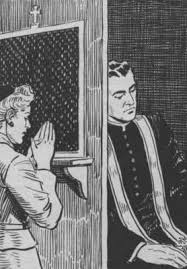
Why Confess Our Sins to a Priest


"I don't need to confess my sins to a man, I confess my sins directly to Jesus."

It's a common retort from those who reject the Catholic teaching on the Sacrament of Confession. And it sounds logical. Since only God can forgive sin, then it would seem reasonable not to bother with anybody in between. Might as well go straight to God.

The problem is that Jesus never tells us to confess our sins to him. As a matter of fact James tells us to "confess our sins to one another" (James 5:16). Now, James, we believe, was one of the Apostles. He was either passing on what he knew Jesus wanted, or he was telling a lie. If he was telling a lie, then all Scripture would be suspect. Obviously we cannot accept that.

So the next question is "who is the one another?" that James is referring to? On the face of it it could mean just anybody off the street. Obviously he didn't mean just anybody, so who he did he mean?

Like so many questions about the Scriptures, the answer is easy when put into context of the neighboring verses. Two verses before, James is advising the physically sick to seek out the "presbyters". Two verses later he is addressing the spiritually sick, those who need to confess sin. It's easy to see who James was referring to. But who were the presbyters?

In short they were overseers, men especially delegated to overseeing and ministering to a local Christian community. In any event, they were granted a special authority to stand in place of the bishop, who then, as today, had the full authority that was granted to the Apostles.

So let's review. 1. We are not told to confess our sins to Jesus. 2. We are told to confess our sins to "another". 3. Since it can't be just any other, we see in context that the other is a "presbyter".

But if only God can forgive sins then what's up with confessing to another human?

It's a simple matter of taking Jesus at his word in John 20:23 where he says to the Apostles gathered in the upper room "Receive the Holy Spirit. Whose sins you shall forgive are forgiven and whose sins you shall retain are be retained."

Here Jesus gives the Apostles the power to forgive sins. It's interesting to note that, at least in this Gospel, this is Jesus' VERY FIRST action upon rising from the dead, which should give us a clue as to how important the power given to the Apostles was and still is.

If Jesus had wanted us to only confess our sins to himself he wouldn't have given the power and the command to the Apostles that he did. We should also note that the sins must be confessed audibly since only then would the Apostle know whether the sin should be forgiven or retained.

There is no doubt from Scripture that Jesus gave the power to the Apostles to forgive sins. The question is did that authority to forgive or retain sin pass on or did it die with the Apostles? The fact that James is instructing his audience to confess sin to one another indicates that the authority had descended from the Apostles and had been granted to others.

Today, by virtue of his ordination and the laying on of hands,that goes all the way back to the Apostles, the priest, the descendant of the "presbyter", has the authority to forgive or retain sin in the name of Jesus Christ who first gave that authority to a group of specific men.

Here is an excerpt from the Catechism of the Catholic Church regarding the Church's teaching on the Sacrament of Penance.

VI. THE SACRAMENT OF PENANCE AND RECONCILIATION

1440 Sin is before all else an offense against God, a rupture of communion with him. At the same time it damages communion with the Church. For this reason conversion entails both God's forgiveness and reconciliation with the Church, which are expressed and accomplished liturgically by the sacrament of Penance and Reconciliation.38

Only God forgives sin

1441 Only God forgives sins.39 Since he is the Son of God, Jesus says of himself, "The Son of man has authority on earth to forgive sins" and exercises this divine power: "Your sins are forgiven."40 Further, by virtue of his divine authority he gives this power to men to exercise in his name.41

1442 Christ has willed that in her prayer and life and action his whole Church should be the sign and instrument of the forgiveness and reconciliation that he acquired for us at the price of his blood. But he entrusted the exercise of the power of absolution to the apostolic ministry which he charged with the "ministry of reconciliation."42 The apostle is sent out "on behalf of Christ" with "God making his appeal" through him and pleading: "Be reconciled to God."43

Reconciliation with the Church

1443 During his public life Jesus not only forgave sins, but also made plain the effect of this forgiveness: he reintegrated forgiven sinners into the community of the People of God from which sin had alienated or even excluded them. A remarkable sign of this is the fact that Jesus receives sinners at his table, a gesture that expresses in an astonishing way both God's forgiveness and the return to the bosom of the People of God.44

1444 In imparting to his apostles his own power to forgive sins the Lord also gives them the authority to reconcile sinners with the Church. This ecclesial dimension of their task is expressed most notably in Christ's solemn words to Simon Peter: "I will give you the keys of the kingdom of heaven, and whatever you bind on earth shall be bound in heaven, and whatever you loose on earth shall be loosed in heaven."45 "The office of binding and loosing which was given to Peter was also assigned to the college of the apostles united to its head."46

1445 The words bind and loose mean: whomever you exclude from your communion, will be excluded from communion with God; whomever you receive anew into your communion, God will welcome back into his. Reconciliation with the Church is inseparable from reconciliation with God.

The sacrament of forgiveness

1446 Christ instituted the sacrament of Penance for all sinful members of his Church: above all for those who, since Baptism, have fallen into grave sin, and have thus lost their baptismal grace and wounded ecclesial communion. It is to them that the sacrament of Penance offers a new possibility to convert and to recover the grace of justification. The Fathers of the Church present this sacrament as "the second plank [of salvation] after the shipwreck which is the loss of grace."47

1447 Over the centuries the concrete form in which the Church has exercised this power received from the Lord has varied considerably. During the first centuries the reconciliation of Christians who had committed particularly grave sins after their Baptism (for example, idolatry, murder, or adultery) was tied to a very rigorous discipline, according to which penitents had to do public penance for their sins, often for years, before receiving reconciliation. To this "order of penitents" (which concerned only certain grave sins), one was only rarely admitted and in certain regions only once in a lifetime. During the seventh century Irish missionaries, inspired by the Eastern monastic tradition, took to continental Europe the "private" practice of penance, which does not require public and prolonged completion of penitential works before reconciliation with the Church. From that time on, the sacrament has been performed in secret between penitent and priest. This new practice envisioned the possibility of repetition and so opened the way to a regular frequenting of this sacrament. It allowed the forgiveness of grave sins and venial sins to be integrated into one sacramental celebration. In its main lines this is the form of penance that the Church has practiced down to our day.

1448 Beneath the changes in discipline and celebration that this sacrament has undergone over the centuries, the same fundamental structure is to be discerned. It comprises two equally essential elements: on the one hand, the acts of the man who undergoes conversion through the action of the Holy Spirit: namely, contrition, confession, and satisfaction; on the other, God's action through the intervention of the Church. The Church, who through the bishop and his priests forgives sins in the name of Jesus Christ and determines the manner of satisfaction, also prays for the sinner and does penance with him. Thus the sinner is healed and re-established in ecclesial communion.

To read more, go here.

Monday, March 01, 2010

Posing a Roadblock to Gay Adoption

As documented in a CNS story dated 2/22/10, Catholic Charities of the Archdiocese of Washington D.C. will close its 80 year-old foster care and adoption program. The recent passage of a new law allowing same-sex marriage would have required the adoption program to treat different sex and opposite sex married couples equally in considering foster and adoptive parents for children, something the Catholic Church cannot do.

Proponents of same-sex marriage or its legal equivalent are constantly challenging opponents with the question "How does this affect you?" Those who are neutral about it are inclined to the "let them have their rights" attitude.

But time and again we see where this inversion of the most fundamental of all societal institutions, an institution upon which society itself is built and therefore precedes and pre-dates all societies and political orders, creates ethical dilemmas heretofore never imagined.

The current story poses one of the most glaring dilemmas. It's one thing for same-sex couples to want to share their life together. It's another thing to insert a child into that life. It's not a question as to whether same-sex couples can provide for the child. It's a question of whether or not forcing the child into a parent-child relationship with a same-sex couple is good for the child.

In short, will it be good for the child to see daddy and daddy in bed together. (What child hasn't stumbled upon an intimate moment between parents?)

Gays and lesbians make the claim that they are genetically wired towards same-sex attraction. Barring all the evidence to the contrary, let us grant them this point and ask "what about the child?" What if the child that they adopted is NOT "genetically wired" that way? How healthy is it for that child to be subjected 24-7 to a parental model that is the very antithesis of his or her physical and psychological being?

Gays will want to make the same point, that subjecting a child who may be "genetically wired" towards the same-sex, to an opposite-sex parental model, is just as unfair and unhealthy.

But in this argument, the gays and lesbians have laid their own trap. Since the entirety of their argument for gay rights as civil rights is based on something they consider to be an immutable characteristic, a gay gene, then before gays and lesbians are allowed to adopt a child, the child, out of respect for the civil rights of the child, must be first genetically tested and his or her gender identity genetic predisposition determined.

Of course, this cannot be done. There is no test because there is no gene. Gays will argue otherwise, but science has no test for a gay gene that could be used to determine the gender identity of a child.

And since the child to be adopted is the product of a man-woman relationship, whatever the defects of that relationship, the child then has a civil right to be placed in a child-parent relationship that most resembles his or her own biological origins. It is on this basis, on the rights of the child, that gay adoption, under any circumstances, must be denied.

Some may question if this affects adoption by singles. This too poses a dilemma, but again, one which is easily answered if the rights of the child are considered to be primary.

While some may not subscribe to the document, few intelligent people would argue with the basic demands of the United Nations Convention on the Rights of the Child. Article 7 states that the "child has a right to know and be cared for by his or her parents."

In the case of an abandoned or orphaned child, the law of "being cared for by his or her parents" guides us to the next best possible solution where the child is cared for by the next of kin, something that has happened naturally for millenia.

Barring that possibility the next best situation for the child would be adoption or at least foster care by a married man and woman, again, the decision being guided by the rights of the child "to know and be cared for by his or her parents". The (married) man/woman/child model best approximates the natural family and best serves the rights of the child.

Guam Adoption Law: 19GCA Ch. 4, Article 2
Related Posts Plugin for WordPress, Blogger...