Monday, June 04, 2012

INCORRUTIBITER GENUIT


I was going to move on to another topic this week but I happened upon an interesting debate that has prompted me to share further on a critical aspect of the Perpetual Virginity of Mary.

The debate is over the proper interpretation and presentation of John Paul II’s Theology of the Body, the name given to a series of talks given by the Pope on the subject of human sexuality. TOB’s most prominent apostle is Christopher West, who has popularized the Pope’s teaching through a series of books, CD’s, DVD’s, and seminars.

The Pope’s treatment of the subject is deeply philosophical and reverently nuanced, however, West’s approach is much less so. Example: where the Pope might refer to “the conjugal act”, West will sometimes say “have sex”. West’s strategic street lingo approach, as well as his questionable interpretation of some aspects of TOB, has provoked criticism and debate.

The debate is not merely academic. There is real evidence that “sex education” - which Theology of the Body essentially is - if not properly framed and nuanced, can produce the exact opposite of what it aims to prevent: illicit and irresponsible sexual behavior.

Exhibit A would be the easily evidenced fevered increase of sexual activity among young people wherever sex education has been introduced into the curriculum, even when presented in an academic and scientific way.

And while West attempts to retain the theological framework of TOB, the language reduction is nevertheless provocative, e.g. “having sex” stirs images in a way that “conjugal act” does not.

The debate over West’s approach has pitted some big names in Catholic academia against each other. One of those debates involves well-known pro-life author and academic Dr. Janet Smith and the equally well-known and much-revered Dr. Alice Von Hildebrand.

Von Hildebrand is critical of West, and Smith has come to his defense. The debate has several aspects to it but the item that caught my attention was a discussion over whether or not West should have referred to Mary’s “bloody placenta”. Von Hildebrand took issue with the reference, which provoked the following response from Smith:

“She (Von Hildebrand) believes it is incorrect to think that Mary may have expelled a bloody placenta. Pregnant wombs have placentas. Did not Mary’s? Would it be wrong to think it might have been bloody?...Scripture itself makes reference to Mary’s womb and breasts; is the placenta really so objectionable that it could not be mentioned?”

If you are feeling uneasy about such a discussion, you should. As you might guess, the Church has traditionally approached the physiological aspects of the birth of Jesus with sacred caution. In fact, Pope John XXIII forbade any further public speculation about it.

However, the issue jumped into public view a few years ago upon the release of the movie THE NATIVITY STORY. The film portrayed the birth of Jesus as a natural birth - complete with labor pains and presumably an expelled placenta.

Though well-received by the Catholic press and even prominent clergy, others cautioned that the depiction of Mary in labor poses problems to two Marian dogmas: the Immaculate Conception and the Perpetual Virginity.

As you will recall, bringing forth children “in sorrow” (labor) (Gen 3:16), is the penalty to the woman for Original Sin. The Dogma of the Immaculate Conception holds that Mary was preserved from Original Sin and thus she is not subject to its penalty, i.e. Mary did not birth Jesus “in sorrow”.

In regard to Perpetual Virginity, the Church teaches that not only did Mary never have conjugal relations, she remained “incorrutibiter genuit" which means she “begot (Jesus) incorruptibly”. Aquinas puts it thus: “Mary gave birth painlessly in miraculous fashion without opening of the womb and without injury to the hymen...” (Summa Theologiae III.28.2).

In other words, not only was Jesus miraculously conceived, he was also miraculously birthed. And the fact that our Church has solemnly defined this since the Synod of Capua in 392 A.D., demonstrates that the Church, early on, saw the danger of speculation about things such as a “bloody placenta” and sought to put a seal on it. Apparently West and Smith didn’t get the message.






Thursday, May 31, 2012

ENGAGING THE CHALLENGE TO THE PERPETUAL VIRGINITY OF MARY


In a previous column, entitled THE ATTACK ON MARY, we noted that of all the things that drive anti-Catholics nuts about Catholic beliefs, the thing that drives them most nuts is what we believe about Mary.
The Aeiparthenos (Ever Virgin)

And of those things which we believe about Mary, such as the Immaculate Conception and her bodily Assumption, the most irksome, to non and anti-Catholics, is our belief in her Perpetual Virginity. In fact, the very words “Perpetual Virginity” seem to provoke a cringe similar to that provoked by the sound of fingernails scraping a chalkboard.

The intent in this column is to share a few thoughts on how to engage the “Protestant” disbelief in the Perpetual Virginity, but we should first note that a disbelief in the value of consecrated virginity in general is, at its root, a fundamental Protestant tenet promulgated by “the First Protestant”, Martin Luther.

While Luther may have had some legitimate beefs relative to the so-called “sale of indulgences”, it seems that his real itch involved celibacy. In 1521, Luther wrote: I see myself insensible, hardened, sunk in idleness, alas! seldom in prayer, and not venting one groan over God’s Church. My unsubdued flesh burns me with devouring fire. In short, I … am devoured by the flesh, by luxury, indolence, idleness, somnolence.

A few years later, Luther wrote to a group of nuns: “In such cases (no longer wishing to remain celibate) it is time to run away, leaving the convent and all it entails behind.” Luther went  on to explain: “Though womenfolk are ashamed to admit to this... a woman has no control over herself. God has made her body to be with man...”

Apparently Luther had his own body in mind for he eventually helped himself to the nuns, taking one for his wife and offering another to the Bishop of Mainz (if he would convert) during a Luther-inspired pogrom against celibacy in which scores of German monks and nuns were “liberated” from their monasteries, convents, AND their vows. The story goes downhill from there.

But what about that? What about Luther’s claim that God made a woman’s “body to be with a man.” Ummm, well, yah, and visa versa. However, and without a long dissertation on celibacy: “With God, all things are possible”. So of course, with God’s grace, a man or woman can give his or her body (and soul) entirely to God.

So you might say that Catholics, since we are the only Christians to institutionally place a value on consecrated virginity, are the only true “Full Gospel Church”, i.e. we actually believe that “all things are possible with God”, including consecrated virginity,  and take seriously - for those engaged in particular ministries - St. Paul’s Corinthian exhortation to celibacy (1 Cor 7:8-9). But Luther’s personal peccadillos aside, how do we engage a challenge to our belief in the Perpetual Virginity of Mary?

Usually the challenge is based on one of the ten instances in the New Testament wherein “brothers (and/or sisters) of the Lord” are mentioned. A simple response to this is to point out that Aramaic had no word for “cousins”, and “brother” and/or “sister” was used to reference several degrees of kin.

Another challenge is based on Matthew 1:25 which says: “And he (Joseph) did not know her until she had brought forth her firstborn son.” The implication is that the word “until” assumes that Joseph and Mary had normal marital relations after Jesus was born.

This argument is also easily dispatched by simply referencing other instances in Scripture wherein the word “until” is used, but does not mean that anything different followed: e.g. no one knew the location of Moses’ grave “until this present day” (Deut. 24.6). We still don’t know.

And then of course there is the matter of Jesus, on the cross, entrusting his mother to the apostle, John. If Mary had other children, there would have been no need for Jesus to do this.

Perhaps the easiest and most useful reply, though, is to simply ask the challenger to show you in the Bible where it says that Mary had other children. He or she will resort to the memorized lines about the “brothers of the Lord”. But stay with the program: continue to ask where it says that Mary had other children. Of course, the Bible never says that she does.

The reason this works is because of the “Protestant’s” own belief in “the Bible alone”, i.e. “if it’s not in the Bible, it didn’t happen”. “Protestants” use this principle to discredit the Immaculate Conception, the Assumption, and other doctrines which are not explicit in Scripture. You are simply asking them to use this same principle of “sola scriptura” to prove that Mary was not a Perpetual Virgin. They can’t. End of conversation. (Unless of course you’d like to invite him or her to join the one, true Church!)

Friday, May 25, 2012

WHY IS IT SO DIFFICULT TO DISCUSS MARRIAGE?

That’s the question posed by the editors of THE MEANING OF MARRIAGE, a collection of scholarly essays examining the societal impact of same-sex marriage. Essentially the answer is “because we’ve never had to”, at least not in the way we are forced to discuss it today. 

Though marriage has been at or near the heart of almost every issue of human endeavor, from royal alliances to what to make for dinner, the fundamental male-female nature of marriage has never before been called into question, which is why we find ourselves stammering in defense of marriage after we say “Because....”

In fact, the very fact that we are at a loss for words is sort of an explanation in itself. From the dawn of human consciousness, and quite without instruction other than that which was carved into our bodies, men and women intuited the need to “marry” long before there was a word or a “grunt” for it. It probably went something like this:

Man and woman make baby. Baby can’t take care of itself. Man go hunt and collect berries to feed baby and woman. Sooner or later, man and woman make another baby. Man go hunt some more and collect more berries.

It probably wasn’t out of any external sense of moral obligation that the man did his part to provide and protect. Sons and daughters, in time, meant protection and help when the man could no longer protect or help himself. The permanent bonding necessary to raise a child to adulthood simply derived from the will to survive.

In short, marriage is the organic extension of the procreative act. It proceeds from the very nature of our bodies, which are fundamentally ordered towards generation. All of nature is simply designed to make more of itself. And the life-giving, life-nurturing, life-long thing that we have come to call marriage, which some try to tell us is mere social or religious convention, is really a primordial phenomenon that has, through generations of natural selection, proven to be the most effective model of human survival.

True, both society and religion eventually adapted it, codified it, regulated it, and protected it, but they didn’t create it, and never claimed to. And this is why “same-sex marriage” will never achieve the equality it presumes to seek. Same-sex marriage will forever owe its existence to the state. And irregardless of the rights and status the state might concoct for it, same-sex marriage simply has no history, no primordial roots, and no organic connection to human survival.

This is not because history is homophobic. Same-sex unions of any kind, quite apart from any religious circumscription, are, by their very nature, a Darwinian dead-end. And no legislative or judicial machinations can change that fact.

But this is also why we find it so difficult to defend marriage. Long before same-sex marriage appeared on the legal horizon, heterosexual married couples, through chemical, surgical, or mechanical means, had already divorced sex from its procreative end. And, natural marriage, the organically occurring intuitive relationship between the co-creators of a unique and separate being, once intentionally and artificially stripped of its procreative end, simply has no standing. Thus, our appeals to the procreative purpose of marriage ring with a contraceptive thud relative to the increasing din of chants for marriage equality.

In altering its ends, its purpose, we have altered the nature of marriage itself. Empirically speaking, the “good of the spouses” has become the primary end, and child rearing has not only become a secondary end, it has been relegated to an optional marital appendage - something to fit in once educational and career goals are met and before a woman’s biological clock runs out...if at all.

Such a thing is completely new to the human experience. Marriage has never been ultimately about spouses but about progeny. And unintentional sterility aside, everything about marriage is historically, culturally, and socially ordered to support that end. 

That many, if not most, of us have subscribed to this new ordering of the purpose of marriage, leaves us little ground on which to stand, be it in opposition to same-sex marriage or explaining why couples should marry at all.

Tuesday, May 22, 2012

If gay marriage is okay, why not other kinds?

My letter to the editor challenging the Pacific Daily News editorial of May 14, 2012 advocating for mariage equality. The original editorial can be found here. My response can be found here.


Tuesday, May 15, 2012

THE QUIET REVOLUTION


While the polls tell us that Americans are increasingly warming to the idea of same-sex marriage, the idea that marriage should be anything other than a union of one man and one woman continues to be trounced at the ballot box.

Last week, North Carolina became the 30th state to ban same-sex marriage, and did so in the strongest possible terms: with a constitutional amendment. In fact, the North Carolina ban went even further, outlawing not just same-sex marriage, but also the recognition of any and all same-sex unions such as domestic partnerships and civil unions.

Attempts to typify North Carolina’s strong action against same-sex marriage as predictable bible-belt behavior, collapse, given that same-sex marriage was also constitutionally banned in the very un-bible-belt state of California and banned by referendum in similarly secular Maine. In fact, same-sex marriage has been rejected wherever it has been left to a popular vote and has only made advances through progressive judges and legislatures.

So what’s going on? The Media and most of our academic and major social institutions would have us believe that the universalization of same-sex marriage is inevitable, that, like the President, we will all get around to “evolving”. But the electoral stomping same-sex marriage is increasingly receiving at the ballot box tells us that something quite different is in fact “evolving”.

Perhaps the comments of the out-going president of the nation’s largest pro-abortion organization give us a clue. In announcing her intent not to continue as president of NARAL, Nancy Keenan cited her desire to have more time to address the growing “intensity gap” as her reason for stepping down. By “intensity gap” Keenan means the lack of interest among younger generations in the advancement of abortion rights.

(Of course, It is the height of irony that the leader of an organization which has helped oversee the destruction of more than 53 million young people (yet in-utero) would bemoan the lack of young people to take up the cause of the continued slaughter of more young people.)

However, a later comment by Keenan actually betrays her despair and signals that she knows the gig is up: “I just thought, my gosh, they are so young”, she told the Washington Post. “There are so many of them, and they are so young.” Keenan was responding to her shock at seeing such a large number of young people at a recent pro-life rally in Washington DC, young people she normally doesn’t see at pro-abortion events.

Keenan’s concern over a lack of a next generation to take up the banner of the Culture of Death is a clue to the growth of the “Quiet Revolution” which is simply this: for the last 40 years or so, cultural conservatives have been having more babies than cultural liberals.

It’s simply demographics. Age and death comes calling for all. And the self-imposed sterility of the Liberal Left for the last several decades has left them a decreasing number of heirs, both biologically and ideologically, while the Traditionalist Right has simply been making more babies.

Eric Kaufman, of the American Enterprise Institute, documents this trend in an article entitled “The Future Will Be More Religious and Conservative Than You Think”. Kaufman predicts that “population change is reversing secularism and shifting the center of gravity of entire societies in a conservative religious direction.”

Demographic change also explains the decline of religious vocations in some quarters and its increase in others. Traditional Catholics have been “making more babies” than their contracepting Catholic counterparts. There are simply more children being born to and brought up in families that adhere to the traditional (conservative) practice of the Faith, and thus there are more traditionally oriented vocations.

So while the political, academic, and media elite blame some sort of Tea Party ideology for the looming collapse of their much longed for Utopia, biology is the real culprit. One group has been doing the “be fruitful and multiply” thing, and the other has been sterilizing themselves out of existence. Guess who will inherit the earth...and how they will vote?


Thursday, May 10, 2012

OBAMA'S WHAT WOULD JESUS DO MOMENT, OR WAS IT WHAT WOULD JOSEPH (BIDEN) DO?


President Obama’s May 9 endorsement of same-sex marriage came as no surprise to Cardinal Timothy Dolan, president of the U.S. Council of Catholic Bishops. In response to the President’s announcement, Cardinal Dolan said that President Obama’s comments “follow upon various actions already taken by his Administration that erode or ignore the unique meaning of marriage.” He called the President’s support for same-sex marriage “deeply saddening” and vowed to continue to pray for the President to “act justly to uphold and protect marriage and by so doing serve the true good of all persons.”

President Obama had been under pressure from his base since taking office to take a more aggressive stance in support of same-sex marriage. Though Obama supported same-sex marriage in his 1996 run for Illinois state senator, he opposed it in his 2004 bid for U.S. Senator when he was up against Alan Keyes, a Catholic, Black, conservative. He also affirmed his support for traditional marriage in his 2008 bid for the presidency when he appeared in a television interview with Pastor Rick Warren, whom Obama would eventually invite to do the invocation at his inauguration.

Once in the White House, Obama has done much to support gay rights, hosting gay and lesbian events at the White House, striking down “Don’t Ask, Don’t Tell”, and publicly refusing to defend the federal Defense of Marriage Act. On public support for same-sex marriage, though, he had stopped short and claimed that his position was “evolving”.

However, as of Wednesday, his position seems to have fully evolved with a little prodding from Vice-President, Joe Biden, who had endorsed same-sex marriage a few days earlier. While the White House has denied it, Obama’s endorsement of same-sex marriage appears to have been in response to criticism from same-sex marriage advocates who saw Biden’s comments as an opportunity to pressure the President into making a similar announcement.

The President’s endorsement came within hours of North Carolina becoming the 30th state to ban same-sex marriage in an overwhelming vote and in the strongest possible terms: a constitutional amendment. Despite the Biden incident, analysts are still scratching their heads as to Obama’s timing. However, some Catholics analysts see Obama’s appeal to Christ and the Golden Rule as the key to understanding his motives.

As his reason for the sudden support of same-sex marriage, Obama told the television interviewer: “...you know, we are both practicing Christians and...you know, when we think about our faith, the thing at root that we think about is, not only Christ sacrificing himself on our behalf, but it’s also the Golden Rule, you know, treat others the way you would want to be treated…”

In other words, Obama’s reason is “What would Jesus do?” And some Catholic analysts are wondering if this isn’t Obama taking his fight with the U.S. bishops to the next level in order to further divorce the bishops from their flocks given that polls show growing Catholic support for the contraceptive mandate and same-sex marriage.

THE ATTACK ON MARY

As you may be aware, a local anti-Catholic pastor regularly makes the Catholic veneration of Mary a frequent target on his ubiquitous “drive time” radio spots. He’s not alone of course. Mary-bashing is almost a sport amongst many anti-Catholics, and any recognition of her, other than honorable mention for her role in the Christmas story, seems to drive them mad.

The thinly veiled disgust with which these people speak of Mary is a source of pain for many Catholics who not only regard Mary as the Mother of God, but as their own Mother as well. It's like these guys are saying bad things about your own mom, and there is nothing that quite boils the blood as when some jerk is messing with your mom!

I can remember my own mother crying after a fruitless conversation with a neighbor who had left the Catholic Church for one of those born-again church-in-an-abandoned-gas station deals. The neighbor blasted Mary with all the regurgitated venom she could recall from the anti-Marian diatribe she probably had heard from her “gas station pastor” the night before.  I was just a boy then, but even today, I can still feel the rage that welled up within me, seeing my mother wounded, but also smelling the evil I still smell today when someone attacks and degrades the Mother of God. Perhaps you know the “smell” as well.

But what to make of it? From whence comes this hostile disgust? This knee-jerk attack? What is it that drives these people nuts about the veneration of the Blessed Mother and impels them to degrade, impugn, muddy, and malign the Woman through whom the Son of God took flesh? Is it just a lack of understanding? Misinformation? Invincible ignorance? Perhaps all of the above. But perhaps something else too. And here's my thought.

In Genesis 3:15, God informs Satan of his doom: “I will put enmity between thee and the Woman and thy seed and her seed and she will crush thy head while you lie in wait for her heel.”  In short, it’s curtains for Satan, and Mary is at the center of it.

Some believe this verse (as found in the Vulgate) to be translated in error, that it is not Mary who will crush the head of Satan but her seed: Jesus. Thus later translations change the “she” to a “he”. But translation debates aside, God undeniably chooses to crush Satan through Mary. (Thus the centuries of paintings and statues showing her doing so.)

Without getting too theological here, it is necessary to understand that salvation is ongoing: that Christ has saved us, is saving us, and will continue to save us (should that be our desire) until the end of time; and he does so, he comes to us, as he first did, through his Mother. Thus John Paul II says: [it is] “in Mary and through Mary (that) the situation of humanity (sin) has been reversed...” (The Protoevangelium of Salvation). And this is why Satan hates her.

However, Satan cannot harm Mary directly because she is sinless. God has put “enmity” - total opposition - between Satan and the Woman. Since Satan is pure evil, total enmity in this case means the total opposite of pure evil which is pure good, sinlessness, which is precisely why Mary is the “Refuge of Sinners” and why we “flee to thy  (her) protection”.

As humans, it is impossible to imagine the cosmic proportions of Satan’s hatred of Mary. But I believe we get a glimpse of it when the Mother of God is attacked, either in the pornographic “art” of a Marian image splattered with elephant dung (as displayed in the Brooklyn Museum), or the diseased harangue we hear from the likes of the anti-Catholics already noted.

To Satan, it matters not how or through whom the Mother of God is discredited, demeaned, and disavowed. The fewer sinners that seek her refuge, the more for him to devour. Don’t be one of them.

Thursday, April 19, 2012

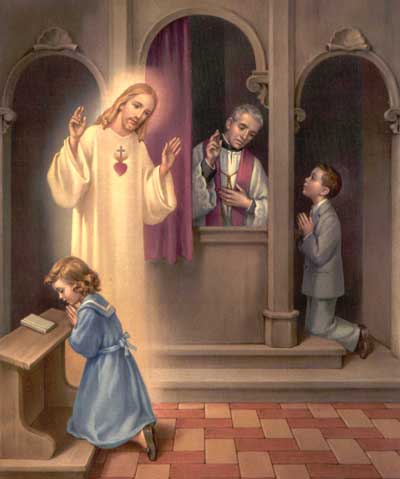
Why Do I Have to Go To Confession?


That question is usually followed by the words “I go directly to God”. 

While you are welcome to think you can go "directly to God", the problem is, Jesus nowhere says to do that. In fact, the Bible instructs us to confess our sins, not to God, but "to one another”:

"Therefore, confess your sins to one another and pray for one another, that you may be healed." (James 5:16)

But who is the "one another" to whom we are to confess? Shall we just pull someone off the street and confess our sins? Of course not.

The directive to "confess your sins to one another" occurs within the context of an instruction on the Sacrament of the Sick in which James instructs the Christian community to call the "presbyter", who is to anoint the sick person and hear his confession:

“Is anyone among you sick?" He should summon the presbyters of the church, and they should pray over him and anoint [him] with oil in the name of the Lord, and the prayer of faith will save the sick person, and the Lord will raise him up. If he has committed any sins, he will be forgiven. Therefore, confess your sins to one another and pray for one another, that you may be healed.” (James 5:14-16)

It is clear, in this passage, that the main agent of anointing and forgiveness is the "presbyter". In the early Christian communities, a presbyter ("overseer") could have been a bishop or another man authorized to act in his place, much as the parish priest does today.  In any event, the presbyter is distinguished from the rest of the community because he is to be summoned by the others, and he appears to have certain powers that the other Christians do not.

"But", you may say, "only God can forgive sins". This is true. It is also true that God can do anything, including authorize others to forgive sins. And this he does in John 20:19-23:

“On the evening of that first day of the week, when the doors were locked, where the disciples were, for fear of the Jews, Jesus came and stood in their midst and said to them, ‘Peace be with you.’ When he had said this, he showed them his hands and his side. The disciples rejoiced when they saw the Lord. [Jesus] said to them again, ‘Peace be with you. As the Father has sent me, so I send you.’ And when he had said this, he breathed on them and said to them, ‘Receive the Holy Spirit. Whose sins you forgive are forgiven them, and whose sins you retain are retained.’” (John 20:19-23)

Given that the Resurrection is the central act of all history, it is quite profound, when you think about it, that Christ's first order of business upon rising from the dead is to give the apostles the power to forgive sins. This should strike us with a rather terrible significance. He has just risen from the dead. He has just walked through a wall (the doors were locked). The apostles are probably beside themselves. And the very first thing he does is to make them new men (he "breathed on them") and give them the power to forgive sins!

In fact, the forgiveness of sins is their primary mission. This is what they are sent to do ("so I send you"). And the very fact that Christ empowers these men to forgive sins and sends them forth to do so automatically makes it incumbent upon the rest of us to seek this forgiveness of sins from those men who are authorized to grant it: our priests and bishops. Given that this is Christ's desire, it is the height of disobedience and sinful obstinacy to not seek forgiveness in the Sacrament of Confession.

Some think that Christ simply intended a general spirit of Christian forgiveness and not the on-your-knees-in-front-of-the-priest type of confession. However, the fact that the apostles were granted the power to both forgive and "retain" sins tells us that the power is juridical, that the apostles (and those authoritatively descended from them) are to sit in judgement on the penitent's sins. And in order for there to be a judgement there must first be a hearing - thus, the confessional and the oral accounting of our transgressions (and preferably on our knees).

We also know that the power to forgive sins was not meant just for the Apostles but was intended to be passed on to those whom they would ordain. We know this because the presbyters mentioned in James are not Apostles, but specially authorized (ordained) members of the Christian community who are obviously authorized to hear and forgive sins as the apostles were. Today, that power has descended through the Sacrament of Ordination to the bishops and priests who walk among us today.

Given the timing of the institution of the Sacrament and the centrality of the forgiveness of sins in the apostolic mission, there can be no doubt about the critical importance of the the Sacrament of Reconciliation and the necessity of our availing ourselves of it. And we must no longer fool ourselves about "confessing directly to God". It is simply not his will that we do so.

Now just a couple of practical matters. The Sacrament of Confession demands that there be a place for it, a confessional. Church Law (Canon 964) requires that confessionals be in a church or oratory, 2) that there be “a fixed grate between the penitent and the confessor...”, 3) that the confessionals be “in an open place so that the faithful who wish to can use them freely”, and 4) “Confessions are not to be heard outside a confessional without a just cause.”

In other words, we shouldn’t have to hunt for the confessional, we must have the option of an anonymous confession (a fixed grate), and sitting out in the open hearing confessions - a practice that has been in vogue for several years - is not the norm.

Also Canon 986 requires that confession be scheduled so that penitents “have the opportunity to approach individual confession on days and at times established for their convenience.” Regularly scheduled times for confession are critical to the right to an anonymous confession since having to seek out a priest to hear one’s confession precludes anonymity.

And speaking of anonymity, I personally always go to confession behind the grate, even if the priest knows me. I do it out of consideration for the priest. The priest is bound not only to never reveal the sin of a penitent, but to forget the sin once the confessional encounter is over. How much harder is it for him to do - as a man - when he has a face to go with the sin.

Thursday, April 12, 2012

Why Do I Have to Go To Mass?


A few years ago, an article appeared in a national Catholic publication entitled “Busy Altars, Empty Pews”. As the title suggests, while an increasing number of the laity have been recruited into service for a variety of liturgy-related ministries, an increasing number of the laity have been simultaneously absenting themselves from the liturgy altogether.

This wasn’t supposed to happen. The whole idea of an increased “active participation” of the laity was supposed to give the laity a greater stake in their Church, engendering increased enthusiasm and more robust liturgical participation. However, the numbers and empty pews don’t lie. A 2011 Georgetown CARA poll shows that only 22% of Americans who identify themselves as Catholics attend Mass weekly. What happened?

We’ve seen no shortage of attempts to staunch the bleeding from the pew: more relevant music, greeting ministries, friendlier homilies, more convenient Mass times, modernizations and updating of every sort, and even an altered architecture which is pushing the sanctuary ever closer to the congregation (which seems to have had the effect of pushing the people right out the back door). We even get a good lecture now and then on the importance of attending Mass and the occasional reminder that to deliberately skip Sunday Mass is a serious sin. But the numbers don’t lie. The people are leaving.

Of course there are the exceptions - certain parishes which seem to be teeming with life. But even those seem to depend on a particularly charismatic minister or two who is the engine of the whole deal. And when that person departs, the parish slumps, and we hear such things as “When Father so and so was here”, or “When Mr. what’s-his-name was around...”

On Guam, our numbers probably have not yet sunk as low as the rest of the U.S. because of what we could call “residual faith”:  we are still benefitting from the deep piety and belief that saw “the greatest generation” through the ravages of World War II and the ensuing poverty and struggle.

And, so long as “grandma” is alive, we will probably still see a remnant practice of the faith. But no one has to do a poll to show that Mass attendance amongst the young is declining as rapidly as the elders are passing. So what can we do?

I suspect that many of those who no longer attend Mass no longer attend because they have never heard a convincing reason to attend. A generation or two ago, such a reason was not necessary. Today it is.

We try of course. We speak of the desirability of giving at least one hour a week to God, keeping holy the Lord’s day, praying, showing God respect, and all that. But all of those things can be done elsewhere and on one’s own. There is still no reason to go to Mass.

Sometimes we even get up the courage to remind our Mass-defecting friends and relatives that to miss Mass is a sin, a serious sin, a mortal sin - something some of us are old enough to remember hearing. But they rightly guess that we are just repeating a phrase and are not prepared to give any evidence for it. So they shrug their shoulders and walk away, and we write it off as “people nowadays”.

So what should we say? You may not find my personal reason for faithful Sunday Mass attendance in any catechism, but it is what I’ve taught my own children, so I thought I’d share. Here goes.

As we know, on the night before he died, Jesus instructed his apostles to DO THIS IN MEMORY OF ME. This is not a recommendation. This is a command. THIS is how Christ desires to be commemorated, memorialized, acknowledged, recognized, worshipped, made present, and received.

We also know that he intended this act to be repeated weekly on the day of his Resurrection because this is what we see the first Christians doing in Acts 20:7. “On the first day of the week we gathered together to break bread...”

This short phrase tells us a lot. It tells us that worship was weekly, it was on Sunday, it was corporate (“gathered”), and it was not just a prayer meeting, but the celebration of the Eucharist (“break bread”).

This is why we can not fulfill our duty to God on our own, when we feel like it, or in someplace other than the Catholic Mass. First, we must be present where the DO THIS is actually done. Second, it must be done weekly. Third, it must be done on Sunday. Fourth, it must be done in community. And the only “place” all four of these things happen is at the Catholic Mass.

But, so what if this is true? Why should I care? In Matthew 10:32, Christ tells us why we had better care, when he warns: “He who acknowledges me, I will acknowledge before my Father. He who denies me, I will deny before my Father.”

“Acknowledgement” here does not mean some casual recognition of an historical figure. It means publicly acknowledging that Jesus Christ is God. And we do that by participating in the DO THIS, by being where Christ, in the person of the priest, turns bread and wine into his Body, Blood, Soul, and Divinity: the Catholic Mass.

To not DO THIS, to ignore his command, to not attend Mass, is to deny him. And this is why the Church has always taught that to deliberately and consciously not DO THIS, to not worship him as instructed, to not attend Mass, is a mortal sin. And to die in a state of unrepentant mortal sin means an eternity in Hell.

And while we can all hope that one day our attendance at Mass will be motivated by something greater than the fear of Hell, we can at least start there. See you on Sunday.

Wednesday, April 04, 2012

WHY I AM CATHOLIC - PART 6: DO THIS


Last Supper by Pascal Adolphe Dagnan-Bouveret (1852-1929)


In our last installment we made the case for the historical authenticity of the Gospels. In short, when compared with any other ancient document, there is more evidence for the historical reliability of the Gospels than there is for the writings of Socrates, Plato, or even Shakespeare - unquestioned intellecutal pillars of classical western civilization.  So let us look at what those Gospels record.


They record, of course, the birth, life, passion, death, resurrection, and ascension of Jesus Christ. They also record his teachings, miracles, and directives. For our purpose - which is to evince and expound upon the reason to be Catholic - let us examine one of those teachings, his most important: DO THIS.


In fact it is more than a teaching, it is a directive, an order. And it is most important because worship is man’s fundamental duty to God, and Christ’s instruction at the Last Supper is an instruction on how he is to be worshipped, commemorated, acknowledged, remembered, and recognized. There is, for man, nothing more important.

Scripture records: on the night before he died, Jesus took the bread and said THIS IS MY BODY, EAT THIS..., and the wine and said THIS IS MY BLOOD, DRINK THIS... And then he commands: DO THIS IN MEMORY OF ME.

Many Christian church services have great singing, sermons, and fellowship, but only one Church fully worships God as Christ Himself instructed. Only one Church obeys, and has obeyed from the beginning, despite the fallibility and failings of its ministers, the command of Jesus Christ to DO THIS.

To be sure, many Christian communities have communion services, but the presider normally does not hold up the bread and wine and say THIS IS MY BODY...THIS IS MY BLOOD. And while it is true that some Anglican and even some Lutheran churches have liturgies in which at least the words and actions of Christ at the Last Supper are re-presented, neither religion accepts that the bread and wine REALLY are the true body and blood of Jesus Christ.


For our purposes, we need not engage the debate over whether or not the bread and wine become the actual body and blood of Jesus Christ upon the words of the minister. We are simply looking at whether or not non-Catholic Christian churches actually do what Christ instructed on the night before he died.  Do they DO THIS?

Only the Catholic Church obeys this command and obeys Christ's command to DO THIS fully. What’s more, the Catholic Church obeys Christ’s instruction as the first Christians obeyed it: weekly and on Sunday. Acts 20:7 says “On the first day of the week they gathered together to break bread...” We know that the "break bread" is not a reference to some first century picnic because “breaking bread”, as demonstrated elsewhere in the New Testament, references the Eucharistic celebration.

So here, right in the heart of the New Testament, we see the first Christians commemorating Christ as he instructed, commemorating him weekly, and commemorating him on the first day of the week. And where is the only place on Earth where we will find that command obeyed, obeyed weekly, and on Sunday? Answer: The Catholic Mass.

Jesus did not say to sing, lecture, dance, drum, shout, shake, or read your bible in memory of me. He said DO THIS IN MEMORY OF ME. And the Catholic Mass is simply the only place where the DO THIS is done and Christ is worshipped as he taught us to worship.

Related Posts Plugin for WordPress, Blogger...