Thursday, May 10, 2012

OBAMA'S WHAT WOULD JESUS DO MOMENT, OR WAS IT WHAT WOULD JOSEPH (BIDEN) DO?


President Obama’s May 9 endorsement of same-sex marriage came as no surprise to Cardinal Timothy Dolan, president of the U.S. Council of Catholic Bishops. In response to the President’s announcement, Cardinal Dolan said that President Obama’s comments “follow upon various actions already taken by his Administration that erode or ignore the unique meaning of marriage.” He called the President’s support for same-sex marriage “deeply saddening” and vowed to continue to pray for the President to “act justly to uphold and protect marriage and by so doing serve the true good of all persons.”

President Obama had been under pressure from his base since taking office to take a more aggressive stance in support of same-sex marriage. Though Obama supported same-sex marriage in his 1996 run for Illinois state senator, he opposed it in his 2004 bid for U.S. Senator when he was up against Alan Keyes, a Catholic, Black, conservative. He also affirmed his support for traditional marriage in his 2008 bid for the presidency when he appeared in a television interview with Pastor Rick Warren, whom Obama would eventually invite to do the invocation at his inauguration.

Once in the White House, Obama has done much to support gay rights, hosting gay and lesbian events at the White House, striking down “Don’t Ask, Don’t Tell”, and publicly refusing to defend the federal Defense of Marriage Act. On public support for same-sex marriage, though, he had stopped short and claimed that his position was “evolving”.

However, as of Wednesday, his position seems to have fully evolved with a little prodding from Vice-President, Joe Biden, who had endorsed same-sex marriage a few days earlier. While the White House has denied it, Obama’s endorsement of same-sex marriage appears to have been in response to criticism from same-sex marriage advocates who saw Biden’s comments as an opportunity to pressure the President into making a similar announcement.

The President’s endorsement came within hours of North Carolina becoming the 30th state to ban same-sex marriage in an overwhelming vote and in the strongest possible terms: a constitutional amendment. Despite the Biden incident, analysts are still scratching their heads as to Obama’s timing. However, some Catholics analysts see Obama’s appeal to Christ and the Golden Rule as the key to understanding his motives.

As his reason for the sudden support of same-sex marriage, Obama told the television interviewer: “...you know, we are both practicing Christians and...you know, when we think about our faith, the thing at root that we think about is, not only Christ sacrificing himself on our behalf, but it’s also the Golden Rule, you know, treat others the way you would want to be treated…”

In other words, Obama’s reason is “What would Jesus do?” And some Catholic analysts are wondering if this isn’t Obama taking his fight with the U.S. bishops to the next level in order to further divorce the bishops from their flocks given that polls show growing Catholic support for the contraceptive mandate and same-sex marriage.

THE ATTACK ON MARY

As you may be aware, a local anti-Catholic pastor regularly makes the Catholic veneration of Mary a frequent target on his ubiquitous “drive time” radio spots. He’s not alone of course. Mary-bashing is almost a sport amongst many anti-Catholics, and any recognition of her, other than honorable mention for her role in the Christmas story, seems to drive them mad.

The thinly veiled disgust with which these people speak of Mary is a source of pain for many Catholics who not only regard Mary as the Mother of God, but as their own Mother as well. It's like these guys are saying bad things about your own mom, and there is nothing that quite boils the blood as when some jerk is messing with your mom!

I can remember my own mother crying after a fruitless conversation with a neighbor who had left the Catholic Church for one of those born-again church-in-an-abandoned-gas station deals. The neighbor blasted Mary with all the regurgitated venom she could recall from the anti-Marian diatribe she probably had heard from her “gas station pastor” the night before.  I was just a boy then, but even today, I can still feel the rage that welled up within me, seeing my mother wounded, but also smelling the evil I still smell today when someone attacks and degrades the Mother of God. Perhaps you know the “smell” as well.

But what to make of it? From whence comes this hostile disgust? This knee-jerk attack? What is it that drives these people nuts about the veneration of the Blessed Mother and impels them to degrade, impugn, muddy, and malign the Woman through whom the Son of God took flesh? Is it just a lack of understanding? Misinformation? Invincible ignorance? Perhaps all of the above. But perhaps something else too. And here's my thought.

In Genesis 3:15, God informs Satan of his doom: “I will put enmity between thee and the Woman and thy seed and her seed and she will crush thy head while you lie in wait for her heel.”  In short, it’s curtains for Satan, and Mary is at the center of it.

Some believe this verse (as found in the Vulgate) to be translated in error, that it is not Mary who will crush the head of Satan but her seed: Jesus. Thus later translations change the “she” to a “he”. But translation debates aside, God undeniably chooses to crush Satan through Mary. (Thus the centuries of paintings and statues showing her doing so.)

Without getting too theological here, it is necessary to understand that salvation is ongoing: that Christ has saved us, is saving us, and will continue to save us (should that be our desire) until the end of time; and he does so, he comes to us, as he first did, through his Mother. Thus John Paul II says: [it is] “in Mary and through Mary (that) the situation of humanity (sin) has been reversed...” (The Protoevangelium of Salvation). And this is why Satan hates her.

However, Satan cannot harm Mary directly because she is sinless. God has put “enmity” - total opposition - between Satan and the Woman. Since Satan is pure evil, total enmity in this case means the total opposite of pure evil which is pure good, sinlessness, which is precisely why Mary is the “Refuge of Sinners” and why we “flee to thy  (her) protection”.

As humans, it is impossible to imagine the cosmic proportions of Satan’s hatred of Mary. But I believe we get a glimpse of it when the Mother of God is attacked, either in the pornographic “art” of a Marian image splattered with elephant dung (as displayed in the Brooklyn Museum), or the diseased harangue we hear from the likes of the anti-Catholics already noted.

To Satan, it matters not how or through whom the Mother of God is discredited, demeaned, and disavowed. The fewer sinners that seek her refuge, the more for him to devour. Don’t be one of them.

Thursday, April 19, 2012

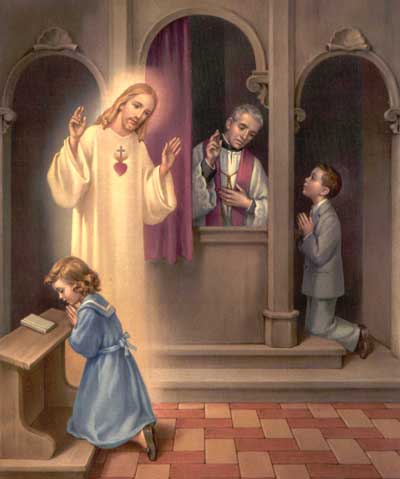
Why Do I Have to Go To Confession?


That question is usually followed by the words “I go directly to God”. 

While you are welcome to think you can go "directly to God", the problem is, Jesus nowhere says to do that. In fact, the Bible instructs us to confess our sins, not to God, but "to one another”:

"Therefore, confess your sins to one another and pray for one another, that you may be healed." (James 5:16)

But who is the "one another" to whom we are to confess? Shall we just pull someone off the street and confess our sins? Of course not.

The directive to "confess your sins to one another" occurs within the context of an instruction on the Sacrament of the Sick in which James instructs the Christian community to call the "presbyter", who is to anoint the sick person and hear his confession:

“Is anyone among you sick?" He should summon the presbyters of the church, and they should pray over him and anoint [him] with oil in the name of the Lord, and the prayer of faith will save the sick person, and the Lord will raise him up. If he has committed any sins, he will be forgiven. Therefore, confess your sins to one another and pray for one another, that you may be healed.” (James 5:14-16)

It is clear, in this passage, that the main agent of anointing and forgiveness is the "presbyter". In the early Christian communities, a presbyter ("overseer") could have been a bishop or another man authorized to act in his place, much as the parish priest does today.  In any event, the presbyter is distinguished from the rest of the community because he is to be summoned by the others, and he appears to have certain powers that the other Christians do not.

"But", you may say, "only God can forgive sins". This is true. It is also true that God can do anything, including authorize others to forgive sins. And this he does in John 20:19-23:

“On the evening of that first day of the week, when the doors were locked, where the disciples were, for fear of the Jews, Jesus came and stood in their midst and said to them, ‘Peace be with you.’ When he had said this, he showed them his hands and his side. The disciples rejoiced when they saw the Lord. [Jesus] said to them again, ‘Peace be with you. As the Father has sent me, so I send you.’ And when he had said this, he breathed on them and said to them, ‘Receive the Holy Spirit. Whose sins you forgive are forgiven them, and whose sins you retain are retained.’” (John 20:19-23)

Given that the Resurrection is the central act of all history, it is quite profound, when you think about it, that Christ's first order of business upon rising from the dead is to give the apostles the power to forgive sins. This should strike us with a rather terrible significance. He has just risen from the dead. He has just walked through a wall (the doors were locked). The apostles are probably beside themselves. And the very first thing he does is to make them new men (he "breathed on them") and give them the power to forgive sins!

In fact, the forgiveness of sins is their primary mission. This is what they are sent to do ("so I send you"). And the very fact that Christ empowers these men to forgive sins and sends them forth to do so automatically makes it incumbent upon the rest of us to seek this forgiveness of sins from those men who are authorized to grant it: our priests and bishops. Given that this is Christ's desire, it is the height of disobedience and sinful obstinacy to not seek forgiveness in the Sacrament of Confession.

Some think that Christ simply intended a general spirit of Christian forgiveness and not the on-your-knees-in-front-of-the-priest type of confession. However, the fact that the apostles were granted the power to both forgive and "retain" sins tells us that the power is juridical, that the apostles (and those authoritatively descended from them) are to sit in judgement on the penitent's sins. And in order for there to be a judgement there must first be a hearing - thus, the confessional and the oral accounting of our transgressions (and preferably on our knees).

We also know that the power to forgive sins was not meant just for the Apostles but was intended to be passed on to those whom they would ordain. We know this because the presbyters mentioned in James are not Apostles, but specially authorized (ordained) members of the Christian community who are obviously authorized to hear and forgive sins as the apostles were. Today, that power has descended through the Sacrament of Ordination to the bishops and priests who walk among us today.

Given the timing of the institution of the Sacrament and the centrality of the forgiveness of sins in the apostolic mission, there can be no doubt about the critical importance of the the Sacrament of Reconciliation and the necessity of our availing ourselves of it. And we must no longer fool ourselves about "confessing directly to God". It is simply not his will that we do so.

Now just a couple of practical matters. The Sacrament of Confession demands that there be a place for it, a confessional. Church Law (Canon 964) requires that confessionals be in a church or oratory, 2) that there be “a fixed grate between the penitent and the confessor...”, 3) that the confessionals be “in an open place so that the faithful who wish to can use them freely”, and 4) “Confessions are not to be heard outside a confessional without a just cause.”

In other words, we shouldn’t have to hunt for the confessional, we must have the option of an anonymous confession (a fixed grate), and sitting out in the open hearing confessions - a practice that has been in vogue for several years - is not the norm.

Also Canon 986 requires that confession be scheduled so that penitents “have the opportunity to approach individual confession on days and at times established for their convenience.” Regularly scheduled times for confession are critical to the right to an anonymous confession since having to seek out a priest to hear one’s confession precludes anonymity.

And speaking of anonymity, I personally always go to confession behind the grate, even if the priest knows me. I do it out of consideration for the priest. The priest is bound not only to never reveal the sin of a penitent, but to forget the sin once the confessional encounter is over. How much harder is it for him to do - as a man - when he has a face to go with the sin.

Thursday, April 12, 2012

Why Do I Have to Go To Mass?


A few years ago, an article appeared in a national Catholic publication entitled “Busy Altars, Empty Pews”. As the title suggests, while an increasing number of the laity have been recruited into service for a variety of liturgy-related ministries, an increasing number of the laity have been simultaneously absenting themselves from the liturgy altogether.

This wasn’t supposed to happen. The whole idea of an increased “active participation” of the laity was supposed to give the laity a greater stake in their Church, engendering increased enthusiasm and more robust liturgical participation. However, the numbers and empty pews don’t lie. A 2011 Georgetown CARA poll shows that only 22% of Americans who identify themselves as Catholics attend Mass weekly. What happened?

We’ve seen no shortage of attempts to staunch the bleeding from the pew: more relevant music, greeting ministries, friendlier homilies, more convenient Mass times, modernizations and updating of every sort, and even an altered architecture which is pushing the sanctuary ever closer to the congregation (which seems to have had the effect of pushing the people right out the back door). We even get a good lecture now and then on the importance of attending Mass and the occasional reminder that to deliberately skip Sunday Mass is a serious sin. But the numbers don’t lie. The people are leaving.

Of course there are the exceptions - certain parishes which seem to be teeming with life. But even those seem to depend on a particularly charismatic minister or two who is the engine of the whole deal. And when that person departs, the parish slumps, and we hear such things as “When Father so and so was here”, or “When Mr. what’s-his-name was around...”

On Guam, our numbers probably have not yet sunk as low as the rest of the U.S. because of what we could call “residual faith”:  we are still benefitting from the deep piety and belief that saw “the greatest generation” through the ravages of World War II and the ensuing poverty and struggle.

And, so long as “grandma” is alive, we will probably still see a remnant practice of the faith. But no one has to do a poll to show that Mass attendance amongst the young is declining as rapidly as the elders are passing. So what can we do?

I suspect that many of those who no longer attend Mass no longer attend because they have never heard a convincing reason to attend. A generation or two ago, such a reason was not necessary. Today it is.

We try of course. We speak of the desirability of giving at least one hour a week to God, keeping holy the Lord’s day, praying, showing God respect, and all that. But all of those things can be done elsewhere and on one’s own. There is still no reason to go to Mass.

Sometimes we even get up the courage to remind our Mass-defecting friends and relatives that to miss Mass is a sin, a serious sin, a mortal sin - something some of us are old enough to remember hearing. But they rightly guess that we are just repeating a phrase and are not prepared to give any evidence for it. So they shrug their shoulders and walk away, and we write it off as “people nowadays”.

So what should we say? You may not find my personal reason for faithful Sunday Mass attendance in any catechism, but it is what I’ve taught my own children, so I thought I’d share. Here goes.

As we know, on the night before he died, Jesus instructed his apostles to DO THIS IN MEMORY OF ME. This is not a recommendation. This is a command. THIS is how Christ desires to be commemorated, memorialized, acknowledged, recognized, worshipped, made present, and received.

We also know that he intended this act to be repeated weekly on the day of his Resurrection because this is what we see the first Christians doing in Acts 20:7. “On the first day of the week we gathered together to break bread...”

This short phrase tells us a lot. It tells us that worship was weekly, it was on Sunday, it was corporate (“gathered”), and it was not just a prayer meeting, but the celebration of the Eucharist (“break bread”).

This is why we can not fulfill our duty to God on our own, when we feel like it, or in someplace other than the Catholic Mass. First, we must be present where the DO THIS is actually done. Second, it must be done weekly. Third, it must be done on Sunday. Fourth, it must be done in community. And the only “place” all four of these things happen is at the Catholic Mass.

But, so what if this is true? Why should I care? In Matthew 10:32, Christ tells us why we had better care, when he warns: “He who acknowledges me, I will acknowledge before my Father. He who denies me, I will deny before my Father.”

“Acknowledgement” here does not mean some casual recognition of an historical figure. It means publicly acknowledging that Jesus Christ is God. And we do that by participating in the DO THIS, by being where Christ, in the person of the priest, turns bread and wine into his Body, Blood, Soul, and Divinity: the Catholic Mass.

To not DO THIS, to ignore his command, to not attend Mass, is to deny him. And this is why the Church has always taught that to deliberately and consciously not DO THIS, to not worship him as instructed, to not attend Mass, is a mortal sin. And to die in a state of unrepentant mortal sin means an eternity in Hell.

And while we can all hope that one day our attendance at Mass will be motivated by something greater than the fear of Hell, we can at least start there. See you on Sunday.

Wednesday, April 04, 2012

WHY I AM CATHOLIC - PART 6: DO THIS


Last Supper by Pascal Adolphe Dagnan-Bouveret (1852-1929)


In our last installment we made the case for the historical authenticity of the Gospels. In short, when compared with any other ancient document, there is more evidence for the historical reliability of the Gospels than there is for the writings of Socrates, Plato, or even Shakespeare - unquestioned intellecutal pillars of classical western civilization.  So let us look at what those Gospels record.


They record, of course, the birth, life, passion, death, resurrection, and ascension of Jesus Christ. They also record his teachings, miracles, and directives. For our purpose - which is to evince and expound upon the reason to be Catholic - let us examine one of those teachings, his most important: DO THIS.


In fact it is more than a teaching, it is a directive, an order. And it is most important because worship is man’s fundamental duty to God, and Christ’s instruction at the Last Supper is an instruction on how he is to be worshipped, commemorated, acknowledged, remembered, and recognized. There is, for man, nothing more important.

Scripture records: on the night before he died, Jesus took the bread and said THIS IS MY BODY, EAT THIS..., and the wine and said THIS IS MY BLOOD, DRINK THIS... And then he commands: DO THIS IN MEMORY OF ME.

Many Christian church services have great singing, sermons, and fellowship, but only one Church fully worships God as Christ Himself instructed. Only one Church obeys, and has obeyed from the beginning, despite the fallibility and failings of its ministers, the command of Jesus Christ to DO THIS.

To be sure, many Christian communities have communion services, but the presider normally does not hold up the bread and wine and say THIS IS MY BODY...THIS IS MY BLOOD. And while it is true that some Anglican and even some Lutheran churches have liturgies in which at least the words and actions of Christ at the Last Supper are re-presented, neither religion accepts that the bread and wine REALLY are the true body and blood of Jesus Christ.


For our purposes, we need not engage the debate over whether or not the bread and wine become the actual body and blood of Jesus Christ upon the words of the minister. We are simply looking at whether or not non-Catholic Christian churches actually do what Christ instructed on the night before he died.  Do they DO THIS?

Only the Catholic Church obeys this command and obeys Christ's command to DO THIS fully. What’s more, the Catholic Church obeys Christ’s instruction as the first Christians obeyed it: weekly and on Sunday. Acts 20:7 says “On the first day of the week they gathered together to break bread...” We know that the "break bread" is not a reference to some first century picnic because “breaking bread”, as demonstrated elsewhere in the New Testament, references the Eucharistic celebration.

So here, right in the heart of the New Testament, we see the first Christians commemorating Christ as he instructed, commemorating him weekly, and commemorating him on the first day of the week. And where is the only place on Earth where we will find that command obeyed, obeyed weekly, and on Sunday? Answer: The Catholic Mass.

Jesus did not say to sing, lecture, dance, drum, shout, shake, or read your bible in memory of me. He said DO THIS IN MEMORY OF ME. And the Catholic Mass is simply the only place where the DO THIS is done and Christ is worshipped as he taught us to worship.

Tuesday, March 27, 2012

BARKING UP THE WRONG TREE: THE PROBLEM WITH THE RELIGIOUS FREEDOM ARGUMENT


Bishop Thomas Curry
As most of us know by now, the First Amendment’s guarantee of religious freedom is being invoked by our Church leaders to challenge President Obama’s contraceptive mandate. What you probably haven’t heard is that we have no constitutional basis for doing so, and if brought before the court, we would lose such a challenge.

At least that is the opinion of Bishop Thomas Curry of Los Angeles, an historian and First Amendment scholar - an opinion of course that is completely out of step with Cardinal Dolan and the rest of the USCCB who have pinned their hopes for a wider exemption from the mandate on the basis that it violates religious freedom.

Curry opined in a recent speech given at Catholic University that the contraceptive mandate is NOT unconstitutional because it does not target a specific religion. The fact that Catholics feel targeted is simply due to the fact that the Catholic Church is the only major religion which prohibits deliberate contraceptive acts. But the Catholic Church would have no more First Amendment standing against the mandate than Jehovah Witnesses had against serving in the military during the days of a mandated draft.

As you may recall, JW’s and other conscientious objectors, while they could be exempted from military service, were not exempt from the penalty for not serving. Some were given alternative community tasks, others were assigned to non-combat duty, and still others, as in the famous Muhammed Ali case, were sentenced to prison. Under the mandate, Catholics are free to avoid the mandate by not purchasing health insurance, but they would still be liable for the penalty for not doing so as were conscientious objectors to the military draft.

Also, Catholic leaders seem to have forgotten that there is no blanket guarantee of religious liberty in America, and indeed, we may not want one. In 1878, the Supreme Court ruled that George Reynolds, a Mormon, did not have a First Amendment right to marry more than one wife, despite the dictates of his religion, and was sent to jail for doing so. The Catholic Church did not protest and today would still support the state’s right to penalize polygamists.

While the Mormon church has since changed its teaching on plural marriage, Islam has not. Islam teaches that a man can have up to four wives. Will we be expecting the U.S. bishops to demand religious liberty for American Muslims in that regard? Islam also teaches honor killings and the killing of converts to Christianity (though not all hold to it). Any calls for religious liberty here?

What about religious liberty for Wiccans and other neo-pagan religions? There is already a Wiccan shrine, built at taxpayer expense, on the grounds of the U.S. Air Force Academy, and a taxpayer funded witch ministry to see to the spiritual needs of Wiccan cadets. Do we....should we support religious liberty for the religious practices of witchcraft-related and other pagan religions? I think not, but this is where the religious liberty argument will take us, and I think that this is precisely where President Obama is allowing it - if not wanting it - to go (for the purposes of a much larger social engineering agenda).

Also Catholics seem to have forgotten that religious liberty, as an established doctrine, only dates back to Vatican II. Prior to that, Catholicism had gradually incorporated a pragmatic approach to religious tolerance, but the Church historically not only condemned and persecuted what it deemed to be heresy, it condemned and persecuted heretics as well.

It makes me wonder if Obama isn’t waiting for just the right moment to bring up the Inquisitions, the Crusades, and the decimation of native New World populations by (Spanish-Catholic) Conquistadors. And let’s not forget that for centuries Christianity did not condemn slavery but in fact commanded slaves to obey their masters. (Something that we will look into another time but has already been floated by media mongers.) I can hear Obama scoffing (with the god-like reverb that seems to accompany all his speeches): “Catholics? Religious liberty? Come on, give me a break!” - and then roars of approval and thunderous applause. Scary.

The truth about those things and how the Church actually intervened to tame the excesses of what were essentially state-sponsored ventures (at least in the case of the Inquisitions, the conquest of the New World, and slavery) won’t matter. Perception is everything, and the Church, still limping from its clergy sex abuse wound, will be blasted  out of the public arena by the Obamanites as Jew-burning, Indian-killing, Muslim-brutalizing, slavery-advocating, child-molesting, woman-subjugating, medieval pretenders to religious freedom. And we are marching right into this with signs held high!

The absolutely amazing thing  is that the USCCB’s cry for religious freedom is not even necessary. Obama, unintentionally perhaps, has already given the bishops all the exemption they need. Let’s review:

The mandate exempts religious employers and defines a religious employer as:  (1) has the inculcation of religious values as its purpose; (2) primarily employs persons who share its religious tenets; (3) primarily serves persons who share its religious tenets; and (4) is a non-profit organization under Internal Revenue Code...

Most Catholic organizations already qualify under the IRS code, so let’s look at the others. (1) What is keeping the bishops from simply stating that all of its institutions, its hospitals, schools, clinics, orphanages, etc., have “the inculcation of religious values as its purpose”? Do we not exist first and foremost to share the Gospel of Jesus Christ in word and deed?

Incredibly, one of the arguments proffered by the USCCB leadership has been that not even Jesus, since he cared for everyone, would qualify for the exemption. This amazing statement presupposes that Jesus’s primary purpose was to heal the sick, not save them! That we can even float this argument with any degree of seriousness from the official rostrum of the USCCB is an indication of just how far our commitment to social justice has gone to replace our duty to save souls.

As for (2) employing or (3) serving people who share our religious tenets we can simply say “we don’t know” and shift the burden of proof to the government. A religious employer can no more determine the level of adherence in the heart of an employee or patient to its church’s religious tenets than could a priest determine the level of adherence to Catholic religious tenets in the hearts of those who regularly attend Sunday Mass. And the government would have no means of doing so either.

In fact, this is Bishop Curry’s point. After stating that the imposition of the contraceptive mandate is not in itself unconstitutional, Curry points out that the language of the exemption in which Obama attempts to define what constitutes a religious employer is the part of the mandate that IS unconstitutional. For not only does the President NOT have the authority to define what constitutes a religious employer, he neither has the authority to measure whether or not, or to what degree, a person employed or served by a religious institution subscribes to its religious tenets.

Imagine the conundrum. A non-Catholic patient in a Catholic hospital responds to his government interrogator:  “Yes, I believe in the Trinity, that Jesus Christ is God, that he died for my sins and opened the gates of heaven, and that he established his Church on earth. It could be the Catholic Church. I’m not sure yet. I’m looking into it.” Or imagine a Catholic working at a Catholic university saying “Yes, I believe in the Catholic Church as the true Church but I don’t go along with the Church’s teaching on divorce and birth control.”

In short, the exemption is impossible to police and the USCCB, in barking about religious freedom, is simply barking up the wrong tree. But to change course and exploit the exemption the bishops would have to say that the primary purpose of every Catholic institution is to share the Gospel of Jesus Christ and that while they would like to be able to determine the level of adherence to that Gospel by the people they employ and serve, they have no means of doing so.

By merely stating so, Obama and his contraceptive-sterility-mad matron (Sibelius) could not touch the Church. However, the fact that it appears that we have either not thought of this, or there is in fact a reluctance to claim our institutions and our work for Jesus Christ, is evidence that our Church may have bigger problems than Obama.

*****

That said, regardless of how the Church fairs in its stand-off over the exemption, the rest of us who are not directly in the employ of the Church, are already being forced to fund, through our insurance premiums, the evil that our Church condemns.

For the rest of us, our only hope is for the individual (not the contraceptive) mandate to be declared unconstitutional (the case is being heard as of this writing), and barring that, the election of a president and a congress who are committed to the repeal of the whole Obamacare monstrosity - for it contains many other such death-driven surprises.

Meanwhile, let us hope that our own Archdiocese will claim that all of its institutions have “the inculcation of its religious values as its purpose” and in so doing avoid having to fund the evil our Church rejects. The rest of us will just have to look out for ourselves. But we can at least make sure that the congressional candidate of our choosing this November is committed to the death of this whole evil edict. We shall see.

Wednesday, March 21, 2012

THE RECALL OF THE YOUCAT


The Youth Catechism of the Catholic Church, nicknamed YOUCAT, has been increasingly criticized ever since its release in 2011 and there is now a serious petition to recall it.

At first the protests seemed to be confined to issues related to the phrasing of particular entries in the Italian and German versions, but it appears that the English version contains several issues and we would do well to be advised of them.

The first problem occurs in Question 15 which reads: “How can Sacred Scripture be “truth” if not everything in it is right?” The question is awkwardly worded and could easily lead the young reader to suppose that somethings in Scripture are wrong.

The YOUCAT’s answer attempts to clarify what is meant by the question but further confuses matters by stating that the Sacred Authors were products of their culture and “dominated by its errors”.

This is a rather amazing statement since we know 1) that several of the Sacred Authors were persecuted precisely because they contradicted their culture, 2) not only were NOT “dominated by its errors” but in fact condemned those errors, and 3) while fallen men like the rest of us, were protected from error by the Holy Spirit as regards what is ultimately recorded in Holy Scripture.

A more informed and mature reader might be able to apprehend a more complex understanding of the question as regards particular challenges related to translations, versions, or even the historicity of certain events, but the young reader is simply led to believe that Scripture may contain errors - something repeatedly condemned by the Church for centuries.

Another problem occurs in Question 42 in which the reader is asked: “Can someone accept the theory of evolution and still believe in the Creator?” The problem occurs in the answer to the question which essentially answers “yes” so long as one “does not fall into the heresy of evolutionism”.  The young reader, fresh from his high school exposure to Darwinism, is not likely to understand the “heresy of evolutionism”.

The understanding of evolution within the context of revelation is extremely complex and even John Paul II’s skilled treatment of it (1996) has met with skepticism and opposition. To simply throw the whole question of evolution into a radically simplified and ambiguous entry for consumption by youth is dangerous.

But the real issue is that the entry entirely misses the ultimate qualifier for the Catholic acceptance of any theory of creation and that is that the Catholic must believe that the first man and first woman were directly created by God.

There are other problems which we do not have space to address here so we will skip to perhaps the most problematic entry of all - given the current national drama over the contraception debate.

Question 421 asks: “Why are all methods of preventing the conception of a child not equally good?” The question presupposes a graduated moral grade for different methods of birth control which is not only FALSE but a grave error when one considers the Church’s outright condemnation of deliberate contraceptive acts as “intrinsically evil”. (CCC 2370)

The question is a setup to highlight the Church’s acceptance of NFP (periodic abstinence) but grossly misrepresents it. The YOUCAT states:

“The Church recommends the refined methods of self-observation and natural family planning (NFP) as methods of deliberately regulating conception. These are in keeping with the dignity of man and woman; they respect the innate laws of the female body; they demand mutual affection and consideration and therefore are a school of love. [2370–2372, 2399]

Actually, the Church does NOT recommend NFP. As per paragraph 2370 of the official Catechism, NFP is only allowed for sufficient reason: “Periodic continence, that is, the methods of birth regulation based on self-observation and the use of infertile periods, is in conformity with the objective criteria of morality.158” (CCC 2370)

There is no recommendation here. Periodic continence is simply allowed due to its “conformity with the objective criteria of morality” and the footnote “158” provides the key to a serious treatment of this “objective criteria” which centers on the necessity for “grave reason”.

Treatment of this requires a whole other column, but in short, 158 is a footnote to a section in Humanae Vitae which itself footnotes a critical reference to a teaching by Pius XII on the necessity of “grave reason”- upon which the morality of periodic continence depends.

The official teaching of the Catholic Church commonly builds upon previous teaching,  and a single footnote can often lead to whole tomes and presumes familiarity with them. The YOUCAT, while its intent to reach the younger Catholic is laudable, tragically dumbs down critical issues and endangers its readers. Use with caution.

The Bellarmine Report: YOUCAT weak on homosexuality, contraception, euthanasia, evolution, and scripture.
INSIGHT SCOOP- the blog of Ignatius Press which publishes the YOUCAT in defense of the YOUCAT's answer to question 421. (I do not agree with it and find it to be weak, but am providing the link so you can read their defense. Obviously the need to explain an explanation defeats the purpose of the catechism and shows its inherent weakness.)


Related Posts Plugin for WordPress, Blogger...