I have been mostly smiling to myself for the last several months as I have read different things regarding the "preparation" of the laity for the new Roman Missal. I have been smiling, and mostly to myself, because of the obvious discomfort of those who have been doing most of the writing. It's quite evident that they are not happy about this. The new translation represents a big step backward for some, if not many. It's another blow to the revolution, their revolution.
In a booklet authored by a Fr. Turner for LTP, the author laments the passing of the old "Sacramentary" telling us that it "has served us well"..."helped entire communities make the jump from praying Mass in Latin to praying it in Enlgish"... "showed us how a good translation can enhance the prayer of individuals and of entire congregation"..."gave us a better understanding of the faith we share"...and "laid a foundation for vernacular worship upon which the Church is now building anew."
Never mind the fact that those "entire" congregations are now much smaller, that only 1/3 of Catholics believe in the Real Presence, and that the Vatican mandated the change more than ten years ago because the wayward translation was doing anything but laying a foundation.
The translations of 1970 and 1973 were seen and used as opportunities to further divorce the the English speaking church, particularly in the U.S., from Rome and any vestige of the "medieval" Church, especially as represented in the Traditional Mass.
That it has taken over a decade for the U.S. to respond to John Paul II's demand for a more authentic translation is indicative of the resistance to the giving up of the last rebel stronghold of the post Vatican II revolution, the Sacramentary that has given us fewer Catholics, less faithful Catholics, less knowledgable Catholics, less reverent Catholics, and less Catholic Catholics.
Lex orandi, lex credendi.

Tuesday, July 05, 2011


Saturday, July 02, 2011
Third Sunday after Pentecost - Notes from Fr. Eric Forbes
|

The Adoption Argument for Same-Sex Marriage
Following is a letter to a local radio talk show host who commonly resorts to the needs of parentless children as a justification for same-sex marriage. It's a common, emotional, and seemingly rational appeal.
Dear XXXXX:
Hope you'll take a minute to consider a few thoughts regarding same-sex marriage. I heard you talking about gay marriage and adoption. As a talk show host, I realize that often times you may be saying things simply to provoke conversation, which of course is your job, so I don't necessarily think that everything you say is what you personally believe. But in case you don't already know....
There is no shortage of heterosexual married couples in the United States, including Guam, who are waiting to adopt a child. Just google the words "waiting to adopt". There are even "waiting to adopt"' support groups. In Guam, since we have no adoption agency or legal entity that keeps track of such things, we have to go to the people who facilitate adoptions to get any kind of data. Kamalin Karidat is the most active organization in local adoptions. I am told that there are at least 20 couples at any one time waiting to adopt and they sometimes have to wait years.
Same Sex Marriage Equality Creates New Inequalities
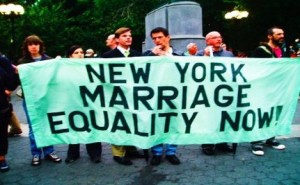
Printed in the Umatuna 6/19/2011
Last Friday, New York became the sixth state to legalize “gay marriage”. Catholic lawmakers provided the key votes and a Catholic governor signed the bill into law. Catholic senator, Mark Grisanti, said that though he was raised to believe that marriage was between a man and a woman he could not “legally come up with an argument against same-sex marriage.”
Grisanti continued: "If I take the Catholic out of me...then absolutely they should have these rights...” Grisanti’s comments invite further comment on: 1) the issue of rights, 2) the legislative imposition of personal beliefs, 3) the legal argument against same-sex marriage.
Rights
New York’s gay marriage bill actually had nothing to do with rights. As Katherine Franke, a partner in a same-sex domestic partnership, wrote in the New York Times the day before the vote, same-sex couples, under New York’s domestic partnership law, already have all the rights of married people. Ms. Franke even bemoaned a possible loss of freedom and flexibility that she now enjoys in a domestic partnership that she would not have within the tighter legal strictures of marriage.
Legislative imposition of personal beliefs
Grisanti’s metaphysical contortion about taking “the Catholic out of me” is another transliteration of the “I’m personally opposed, but...” that lawmakers will resort to when shrinking from a moral stand. Though raised to believe that marriage was between a man and a woman, Grisanti said he could not legally come up with an argument against same-sex marriage. We must then wonder what else Grisanti was raised to believe that he should not be making laws about: lying, cheating, stealing, murder?
All laws have a moral base. Politicians decide what’s right and wrong for the rest of us all the time whether its setting a speed limit or outlawing murder. As of June 23, Guam senators have introduced 243 bills! That means that Guam senators are deciding what is best for the rest of us 1.4 times every day including holidays and weekends! It’s only when it comes to same-sex legislation and abortion that certain lawmakers suddenly wax philosophical. Hmmm.
Legal argument
As for the lack of a legal argument against same-sex marriage, this was a senate chamber, not a court room. Senators engage the process which makes things legal or illegal. As a senator, Grisanti did not need a legal argument, he was in a position to make one. But since he didn’t, I will, or at least I will borrow one from Don Browning, Professor Emeritus at University of Chicago Divinity School.
Browning, along with other legal theorists, wonder if giving marriage benefits to same-sex couples “does injustice to other human arrangements where people care for one another...” Such arrangements could include a man or woman caring for an ailing sibling, an adult child caring for an aging parent, or two elderly persons of the same sex in a non-sexual relationship pooling resources.
Why should they, simply because they are NOT in a sexual relationship, be denied the same rights that New York has now extended to same-sex couples because they ARE in a sexual relationship? In short, if marriage is simply a matter of mutual caring divorced from procreation, then it is an INJUSTICE, as Browning says, “to extend marriage privileges to a particular group of sexual friendships while excluding many other interdependent care givers.”
But beyond the legal argument there is the official teaching of the Catholic Church which these Catholic politicians chose to ignore at their own peril. Every Catholic needs to know exactly what our Church teaches on this matter and where it can be found. It is as follows:
“When legislation in favour of the recognition of homosexual unions is proposed for the first time in a legislative assembly, the Catholic law-maker has a moral duty to express his opposition clearly and publicly and to vote against it. To vote in favour of a law so harmful to the common good is gravely immoral.” (Congregation for the Doctrine of the Faith, Considerations regarding proposals to give legal recognition to unions between homosexual persons, June 3, 2003, Joseph Cardinal Ratzinger, Prefect)
Last Friday, New York became the sixth state to legalize “gay marriage”. Catholic lawmakers provided the key votes and a Catholic governor signed the bill into law. Catholic senator, Mark Grisanti, said that though he was raised to believe that marriage was between a man and a woman he could not “legally come up with an argument against same-sex marriage.”
Grisanti continued: "If I take the Catholic out of me...then absolutely they should have these rights...” Grisanti’s comments invite further comment on: 1) the issue of rights, 2) the legislative imposition of personal beliefs, 3) the legal argument against same-sex marriage.
Rights
New York’s gay marriage bill actually had nothing to do with rights. As Katherine Franke, a partner in a same-sex domestic partnership, wrote in the New York Times the day before the vote, same-sex couples, under New York’s domestic partnership law, already have all the rights of married people. Ms. Franke even bemoaned a possible loss of freedom and flexibility that she now enjoys in a domestic partnership that she would not have within the tighter legal strictures of marriage.
Legislative imposition of personal beliefs
Grisanti’s metaphysical contortion about taking “the Catholic out of me” is another transliteration of the “I’m personally opposed, but...” that lawmakers will resort to when shrinking from a moral stand. Though raised to believe that marriage was between a man and a woman, Grisanti said he could not legally come up with an argument against same-sex marriage. We must then wonder what else Grisanti was raised to believe that he should not be making laws about: lying, cheating, stealing, murder?
All laws have a moral base. Politicians decide what’s right and wrong for the rest of us all the time whether its setting a speed limit or outlawing murder. As of June 23, Guam senators have introduced 243 bills! That means that Guam senators are deciding what is best for the rest of us 1.4 times every day including holidays and weekends! It’s only when it comes to same-sex legislation and abortion that certain lawmakers suddenly wax philosophical. Hmmm.
Legal argument
As for the lack of a legal argument against same-sex marriage, this was a senate chamber, not a court room. Senators engage the process which makes things legal or illegal. As a senator, Grisanti did not need a legal argument, he was in a position to make one. But since he didn’t, I will, or at least I will borrow one from Don Browning, Professor Emeritus at University of Chicago Divinity School.
Browning, along with other legal theorists, wonder if giving marriage benefits to same-sex couples “does injustice to other human arrangements where people care for one another...” Such arrangements could include a man or woman caring for an ailing sibling, an adult child caring for an aging parent, or two elderly persons of the same sex in a non-sexual relationship pooling resources.
Why should they, simply because they are NOT in a sexual relationship, be denied the same rights that New York has now extended to same-sex couples because they ARE in a sexual relationship? In short, if marriage is simply a matter of mutual caring divorced from procreation, then it is an INJUSTICE, as Browning says, “to extend marriage privileges to a particular group of sexual friendships while excluding many other interdependent care givers.”
But beyond the legal argument there is the official teaching of the Catholic Church which these Catholic politicians chose to ignore at their own peril. Every Catholic needs to know exactly what our Church teaches on this matter and where it can be found. It is as follows:
“When legislation in favour of the recognition of homosexual unions is proposed for the first time in a legislative assembly, the Catholic law-maker has a moral duty to express his opposition clearly and publicly and to vote against it. To vote in favour of a law so harmful to the common good is gravely immoral.” (Congregation for the Doctrine of the Faith, Considerations regarding proposals to give legal recognition to unions between homosexual persons, June 3, 2003, Joseph Cardinal Ratzinger, Prefect)
Saturday, June 25, 2011
Ite Missa Est
The following is my article which was printed in the June 26, 2011 issue of the "Umatuna", the newspaper of the Archdiocese of Agana. It can be read in entirety here. "Ite Missa Est" will be the title of a weekly column I will write regarding living the Faith beyond the church doors.

“Sunday Catholics.” It’s a common accusation leveled at some who seem to pay little heed to their faith outside of Sunday Mass. Certainly, only God can judge the heart, but the allegation still resonates.
There are many reasons why one might neglect his or her faith during the week, but perhaps one reason could be simply a translation problem. At the end of the Mass, we are told “The Mass is ended, go in peace.” There’s something about that word “ended”, you know, like, “We’re done for this Sunday...out a here...let’s go to brunch””, and so on.
Sometimes we hear “Go in peace to love and serve the Lord.” That’s perhaps a little more of an encouragement to continue one’s faith life beyond the church doors (“serve the Lord”), but it still feels like “Have a good week and see you next Sunday”.
Sometimes we hear “Go in peace to love and serve the Lord.” That’s perhaps a little more of an encouragement to continue one’s faith life beyond the church doors (“serve the Lord”), but it still feels like “Have a good week and see you next Sunday”.
The Latin text from which these dismissal phrases derive is “Ite, missa est”, which literally translates: “Go, sent is.” Hmmm. “Go, sent is”. What to make of this? The Catholic Dictionary tells us that “Ite, missa est” is “one of the most ancient Roman formulae, as can be seen by its archaic and difficult expression”, and notes that even medieval commentators were “much exercised to explain the meaning of the strange expression.”
Abortion on Guam - What Next? A Catholic View
The following appeared in the June 19, 2011 issue of the "Umatuna", the newspaper of the Archdiocese of Agana, Guam

Abortion on Guam - What’s Next? A Catholic view
On procured abortion, the teaching of the Catholic Church is unequivocal: “a grave offense...a crime against human life” (Catechism of the Catholic Church), “an unspeakable crime” (Gaudium et Spes), the “most unjust of discriminations” and “murder...particularly serious and deplorable” (Evangelium Vitae).
Wednesday, June 15, 2011
A Response to Julian Bond of the NAACP
This letter was printed as a Letter to the Editor in the Pacifc Daily News, June 2011
In his article “Marriage equality is civil rights issue” (PDN, 06/12/11), NAACP chief, Julian Bond, misquotes Loving v. Virginia. In fact, he literally “miss quotes” as in “misses quotation marks” around the words “basic civil rights of man”. Those words are in quotations in the Loving decision because the court was referencing a previous case: Skinner v. Oklahoma (1944).
The context of the quote in Skinner is as follows: “We are dealing here with legislation which involves one of the basic civil rights of man. Marriage and procreation are fundamental to the very existence and survival of the race.”
Thus, in contrast to Mr. Bond’s claim that Loving paves a precedent for same-sex marriage, the Loving court (by referencing Skinner) actually remakes the case for the right to marry in light of the procreative potential of the marital union and the fundamental necessity of such unions for “the very existence and survival of the [human] race.” In fact, even if the Loving court did not reference Skinner, the words “very existence and survival” (though they also appear in Skinner) can only refer to a potentially procreative union.
Nothing is ever said in Loving, in Skinner, or elsewhere in the law, about marriage being for the good or happiness of a couple. Marriage, in the law, is a straightforward civil institution, deserving of protection and social incentives due to its unique capacity to produce, socialize, and educate the necessary next generation - naturally sterile couples (and irresponsible parents) notwithstanding - upon which the “very existence and survival” of society depends.
Also, Bond’s appeal to the aging Mildred Loving’s desire to see marital rights extended to same-sex couples is about as substantive as an appeal to Norma McCovey’s desire to see an end to legalized abortion. McCovey is, today, an ardent pro-life activist. But in 1973 she was Jane Roe, the pro-abortion poster girl of Roe v. Wade.
Bond, and others who wish to advance the case for same-sex marriage, must construct arguments that do not manipulate social, historical, anthropological, and juridical realities in an attempt to manufacture precedent. Such constructions simply undermine the credibility of the cause and those associated with it. Perhaps that is why, under Bond, the influence of the NAACP has seriously waned.
Tim Rohr is a resident of Agat
Saturday, May 21, 2011
Sunday, May 01, 2011
Morning musings of a Devil's Advocate: on the beatification of JPII

Saturday, April 30, 2011
The Royal Wedding and the Thing Itself

Friday, April 22, 2011
Reflection on Good Friday trek up Mt. Jumallong Manglo

This year I decided to go up in the morning again just for the experience. As expected, there was the usual mix: people praying, people cussing, people partying, people shouting, running.
It bothered me at first to hear the F word and the S word casually flung about as we attempted to enter into the holiest of experiences: the way of the cross. I kept my head down and trudged upward, stopping at each station to pray with my kids and concluding our prayers with a singing of the Stabat Mater.
By the grace of God my anger at the disrespect and rabble which met me at every turn dissipated as I realized that this is probably exactly what accompanied the original way of the cross: praying, cussing, partying, joking, casual curiosity, rabble (that's such a good word)....
It helped me reflect on something I heard on a Christian radio station yesterday: that Christ's real suffering was way beyond the physical. The speaker mentioned that lots of people suffered crucifixion. Christ's physical sufferings were not unique. What was unique about the suffering of Christ was the inner crucifixion he suffered: the rejection of His love by those he "knit in their mother's womb" (Ps 139).
But still couldn't help but think that such disrespect and casual observance is something fairly new for Guam. Too bad.
Thursday, January 13, 2011
Prayer for Consecration of the Day

O Lord God, King of heaven and earth, may it please Thee this day to order and to hallow, to rule and to govern our hearts and our bodies, our thoughts, our words and our works, according to Thy law and in the doing of Thy commandments, that we, being helped by Thee, may here and hereafter worthily be saved and delivered by Thee, O Saviour of the world, who livest and reignest for ever and ever. Amen.
DIRIGIRE et sanctificare, regere et gubernare dignare, Domine Deus, Rex coeli et terrae, hodie corda et corpora nostra, sensus, sermones et actus nostros in lege tua et in operibus mandatorum tuorum; ut hic et in aeternum, te auxilante, salvi et liberi esse mereamur, Salvator mundi: Qui vivis et regnas in saecula saeculorum, Amen.
Subscribe to:
Posts (Atom)
